THIS OBJECT WAS SOLD
Three Charging Horsemen - Jacob De Gheyn II (1565–1629)


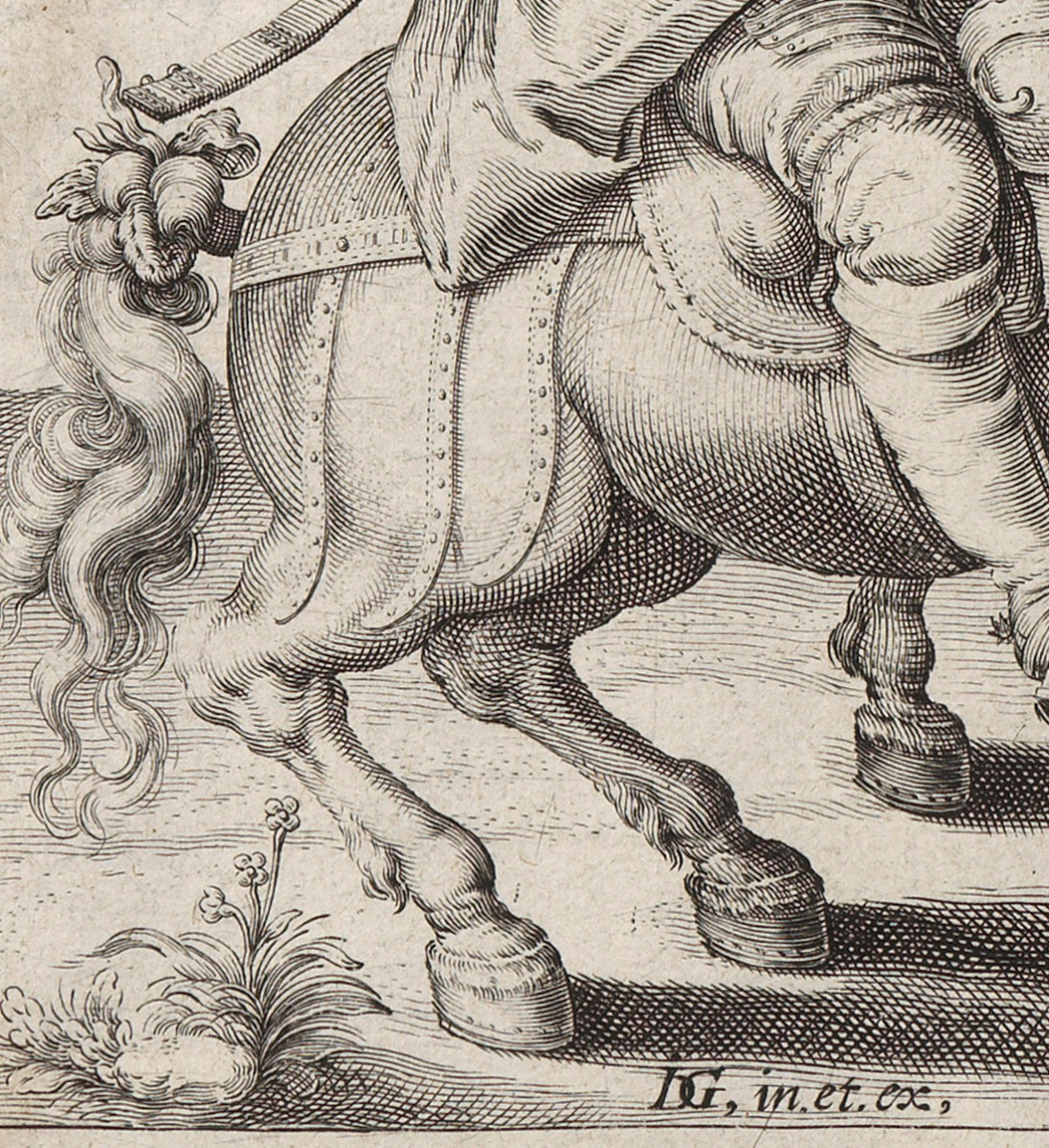


Engraving. Interlaced DG monogram, followed by in. and ex. Numbered "18". First state circa 1590–1600.
This print, numbered "18", concludes the series of eighteen Horsemen engraved by Jacob de Gheyn II at the end of the 16th century. The series belongs to the period when the artist assimilated Italian models while developing a highly personal graphic language, nourished by the Mannerist heritage and the precision characteristic of Dutch workshops. The scene depicts three armored horsemen engaged in a vigorous charge. The accentuated movement of the horses, the twists of the figures, and the refinement of the armor testify to de Gheyn's attention to equestrian compositions disseminated by Stradanus and Tempesta, but also to his ability to offer a more analytical and structured interpretation. The engraving, of great finesse, highlights the interplay of light on the metal and the dramatic tension of the scene.
The monogram DG, accompanied by the notation "in. et ex.", indicates that de Gheyn was both the composer and engraver. The absence of a publisher's address, the crispness of the lines, and the freshness of the printing place this proof in its first state, prior to printings incorporating editorial additions or retouching.
The series of Knights occupies an important place in the artist's development: it foreshadows his later military series and the illustrations for the Wapenhandelinghe, while also demonstrating the graphic ambition of an engraver who, by the 1590s, had established himself as one of the leading figures of Northern Mannerism. A complete set of its 22 plates, including the 18 Knights, sold for €46,000 in the Netherlands.
The print is presented under a green wash and protected by anti-reflective and UV-protective glass. It is mounted in a Louis XIV-era Bérain frame.
Dimensions: 15.5 x 20.5 cm sheet – 36 x 40 cm with frame.
Biography: Jacques de Gheyn II (Antwerp, 1565 – The Hague, March 29, 1629) was born into a family of engravers and apprenticed with the renowned Goltzius around 1585 in Haarlem. From 1590, he produced his own prints in Amsterdam, then moved to Leiden from 1595 to 1602, where he collaborated with, among others, the great philosopher and jurist Grotius. In 1605, he settled in The Hague, where he remained until his death, working for, among others, the House of Orange-Nassau. He then abandoned engraving in favor of oil painting, of which only about twenty paintings survive today. His son, Jacques de Gheyn III, was also an engraver but likely painted very few pictures.
This print, numbered "18", concludes the series of eighteen Horsemen engraved by Jacob de Gheyn II at the end of the 16th century. The series belongs to the period when the artist assimilated Italian models while developing a highly personal graphic language, nourished by the Mannerist heritage and the precision characteristic of Dutch workshops. The scene depicts three armored horsemen engaged in a vigorous charge. The accentuated movement of the horses, the twists of the figures, and the refinement of the armor testify to de Gheyn's attention to equestrian compositions disseminated by Stradanus and Tempesta, but also to his ability to offer a more analytical and structured interpretation. The engraving, of great finesse, highlights the interplay of light on the metal and the dramatic tension of the scene.
The monogram DG, accompanied by the notation "in. et ex.", indicates that de Gheyn was both the composer and engraver. The absence of a publisher's address, the crispness of the lines, and the freshness of the printing place this proof in its first state, prior to printings incorporating editorial additions or retouching.
The series of Knights occupies an important place in the artist's development: it foreshadows his later military series and the illustrations for the Wapenhandelinghe, while also demonstrating the graphic ambition of an engraver who, by the 1590s, had established himself as one of the leading figures of Northern Mannerism. A complete set of its 22 plates, including the 18 Knights, sold for €46,000 in the Netherlands.
The print is presented under a green wash and protected by anti-reflective and UV-protective glass. It is mounted in a Louis XIV-era Bérain frame.
Dimensions: 15.5 x 20.5 cm sheet – 36 x 40 cm with frame.
Biography: Jacques de Gheyn II (Antwerp, 1565 – The Hague, March 29, 1629) was born into a family of engravers and apprenticed with the renowned Goltzius around 1585 in Haarlem. From 1590, he produced his own prints in Amsterdam, then moved to Leiden from 1595 to 1602, where he collaborated with, among others, the great philosopher and jurist Grotius. In 1605, he settled in The Hague, where he remained until his death, working for, among others, the House of Orange-Nassau. He then abandoned engraving in favor of oil painting, of which only about twenty paintings survive today. His son, Jacques de Gheyn III, was also an engraver but likely painted very few pictures.
Explore similar pieces and discover your ideal find:
Prints (Relief, Intaglio)