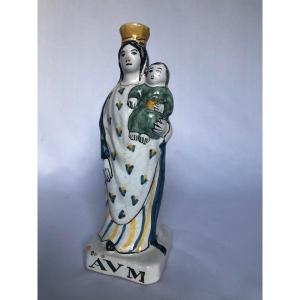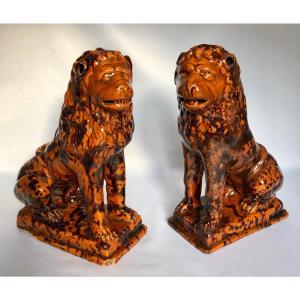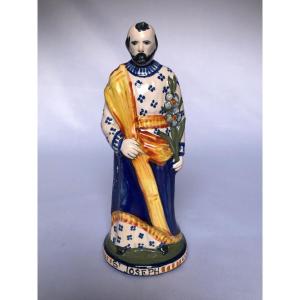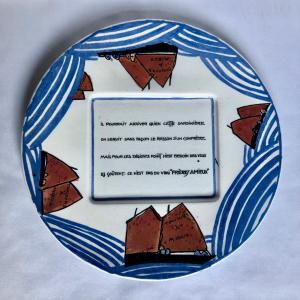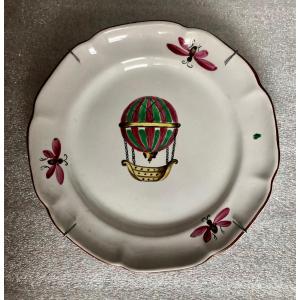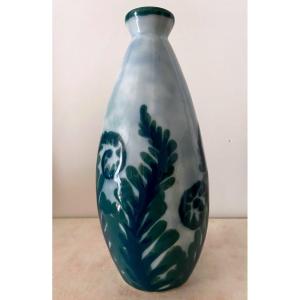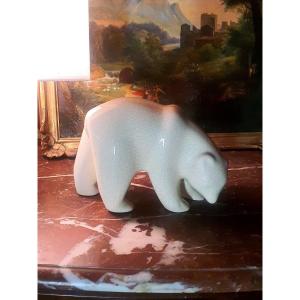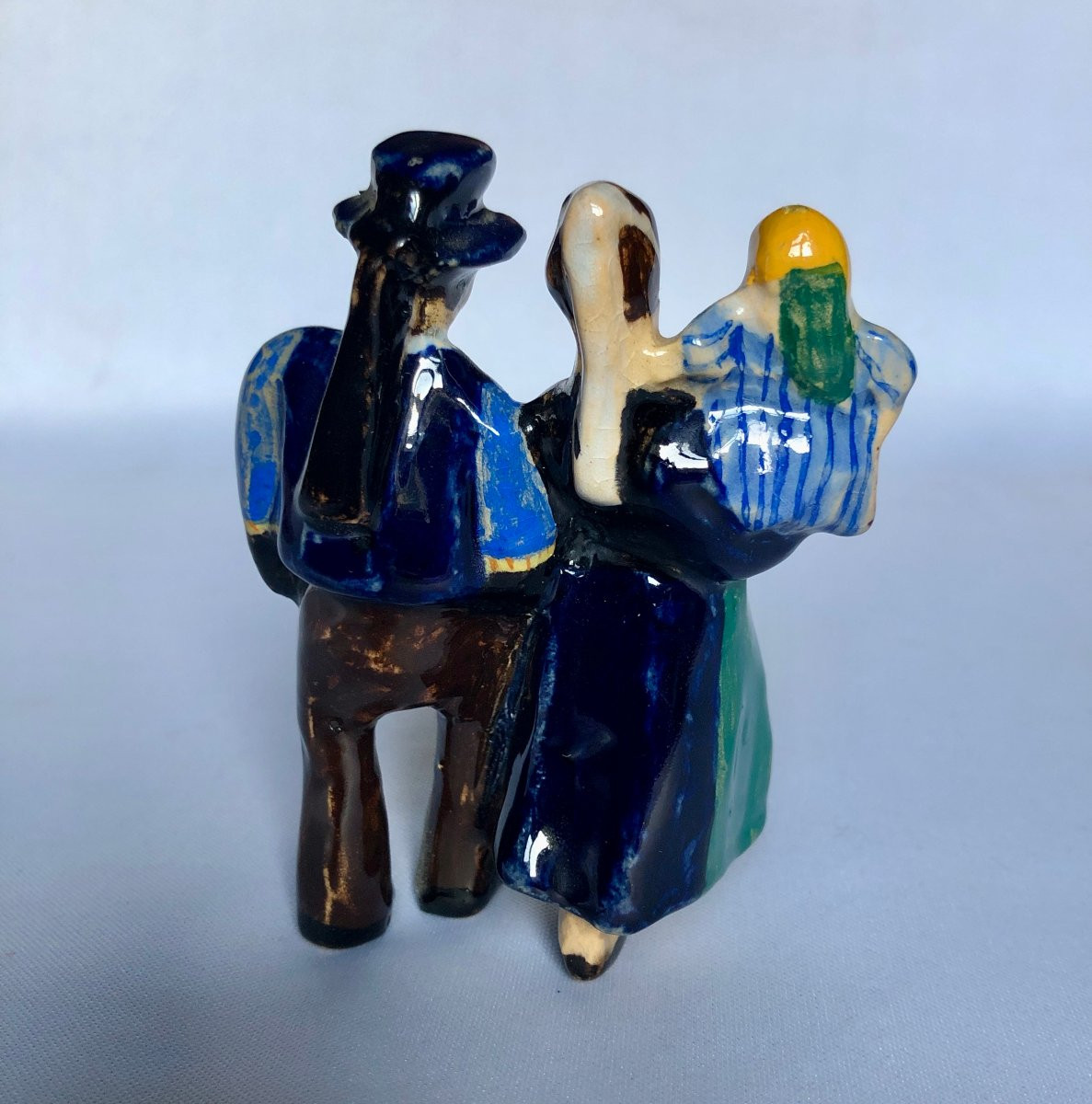

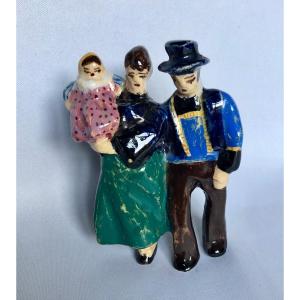


Rare Couple From Quimper And Their Child - Jim Sevellec - Henriot Factory - Brittany
Artist: Jim Sévellec
Henriot Factory.
Polychrome earthenware, circa 1930.
Jim Sévellec (1897-1971):
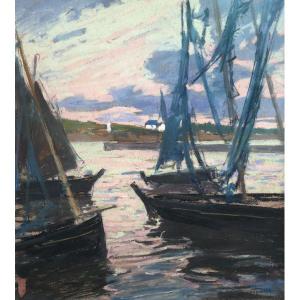
Eugène Sévellec, known as Jim Sévellec, was born and raised in Camaret-sur-Mer, the son of a naval officer. Two factors fostered his artistic vocation: his father, who encouraged the freedom of his aesthetic expression, and Camaret, which at the time was a meeting place for artists from diverse backgrounds. Among them were the writer Saint-Pol-Roux, and in the field of painting, Charles Cottet and Robert Antral. From a very young age, he drew scenes of life in the port, and under the influence of Saint-Pol-Roux, he went to Paris to study art under Louis-Marie Désiré-Lucas.
During the First World War, he was mobilized in 1916 into the infantry and served, among other things, as an interpreter for American and Scottish soldiers. This is how his friends came to call him by his stage name, "Jim," easier to pronounce than Eugène. Released from his military obligations, he attended the PTT (Post, Telegraph, and Telephone) school and simultaneously frequented Parisian artistic circles. In 1924, he was assigned to monitor submarine cables in Brest, marking his return home and the beginning of a rich and prolific artistic career. He and some friends created an artistic group called "La Phalange Bretonne" (The Breton Phalanx), and he exhibited at the Galerie Saluden in Brest.
Well-established in the local art scene, he taught at the Brest School of Fine Arts while continuing his work at the PTT. Jim Sévellec began his collaboration with the Henriot factory in Quimper in 1928. From then on, while never ceasing to paint, Jim Sévellec provided numerous designs for Henriot's production. In 1936, along with René-Yves Creston, he was appointed an official painter of the French Navy. For the Tanguy Tower Museum, he recreated the history of the city of Brest through dioramas. He also created several decorative ensembles for hotels and restaurants in Brest, Camaret, and Dinard.
Polychrome earthenware, circa 1930.
Jim Sévellec (1897-1971):
Eugène Sévellec, known as Jim Sévellec, was born and raised in Camaret-sur-Mer, the son of a naval officer. Two factors fostered his artistic vocation: his father, who encouraged the freedom of his aesthetic expression, and Camaret, which at the time was a meeting place for artists from diverse backgrounds. Among them were the writer Saint-Pol-Roux, and in the field of painting, Charles Cottet and Robert Antral. From a very young age, he drew scenes of life in the port, and under the influence of Saint-Pol-Roux, he went to Paris to study art under Louis-Marie Désiré-Lucas.
During the First World War, he was mobilized in 1916 into the infantry and served, among other things, as an interpreter for American and Scottish soldiers. This is how his friends came to call him by his stage name, "Jim," easier to pronounce than Eugène. Released from his military obligations, he attended the PTT (Post, Telegraph, and Telephone) school and simultaneously frequented Parisian artistic circles. In 1924, he was assigned to monitor submarine cables in Brest, marking his return home and the beginning of a rich and prolific artistic career. He and some friends created an artistic group called "La Phalange Bretonne" (The Breton Phalanx), and he exhibited at the Galerie Saluden in Brest.
Well-established in the local art scene, he taught at the Brest School of Fine Arts while continuing his work at the PTT. Jim Sévellec began his collaboration with the Henriot factory in Quimper in 1928. From then on, while never ceasing to paint, Jim Sévellec provided numerous designs for Henriot's production. In 1936, along with René-Yves Creston, he was appointed an official painter of the French Navy. For the Tanguy Tower Museum, he recreated the history of the city of Brest through dioramas. He also created several decorative ensembles for hotels and restaurants in Brest, Camaret, and Dinard.
580 €
Period: 20th century
Style: Art Deco
Condition: Excellent condition
Material: Earthenware
Height: 8,5 cm
Reference (ID): 1713813
Availability: In stock
Print