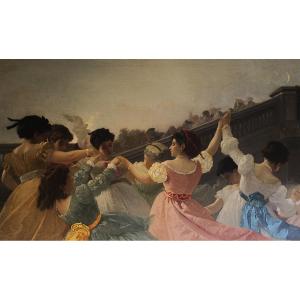


Giovanni Ponticelli Naples, 1820-1881 Dance Party At Villa Floridiana In Vomero
Artist: Ponticelli Giovanni
GIOVANNI PONTICELLI Naples, 1820-1881 Dance Party at Villa Floridiana in Vomero
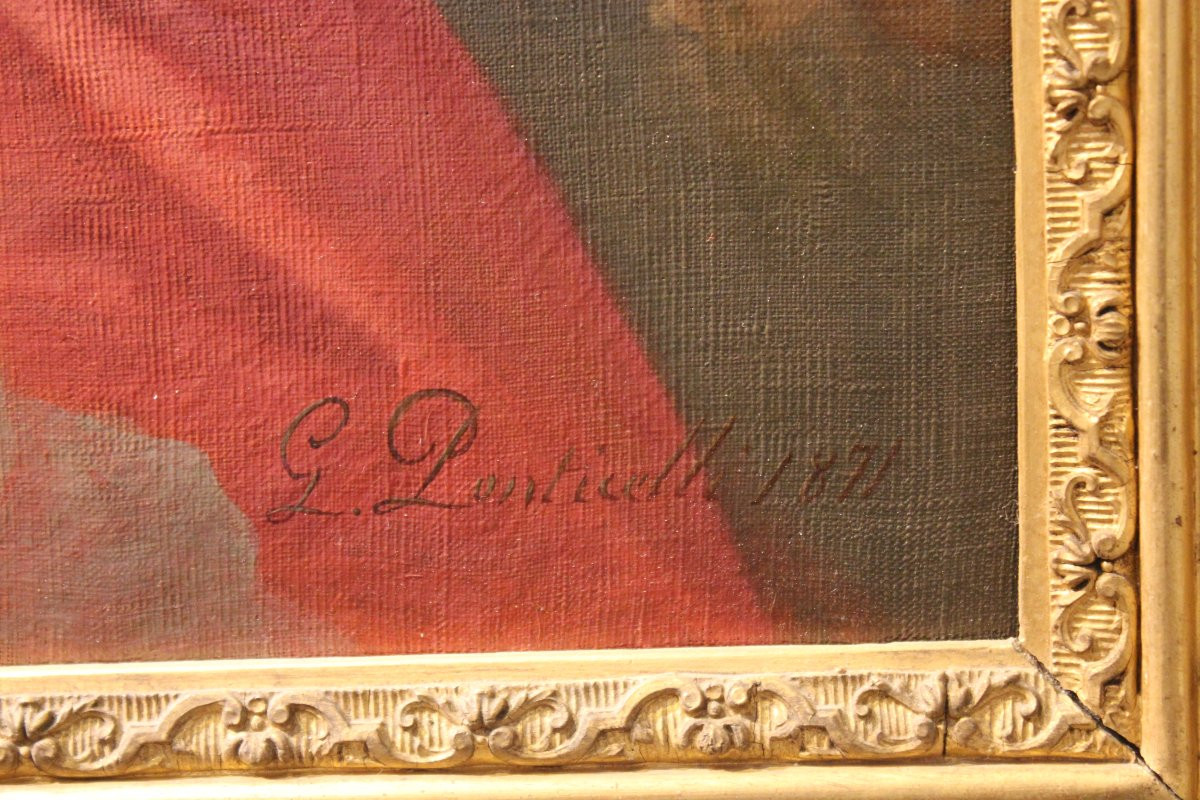
Signed and dated lower right: "G. Ponticelli 1871"
External dimensions: 105 x 180 cm
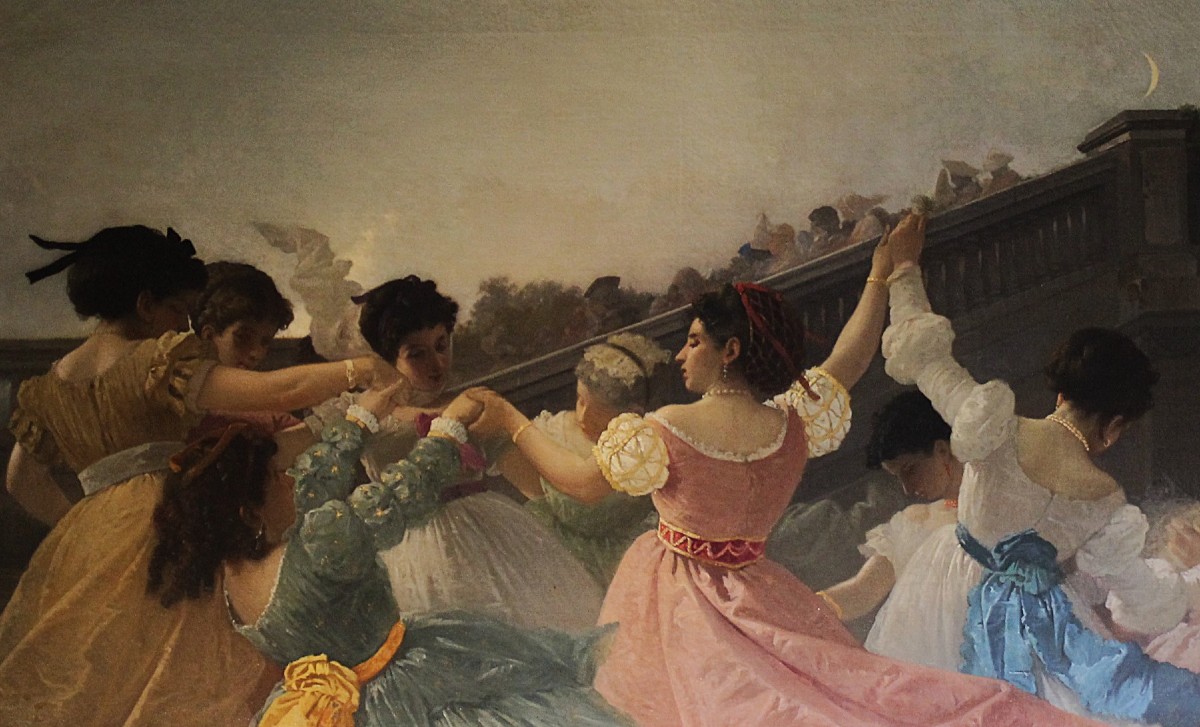
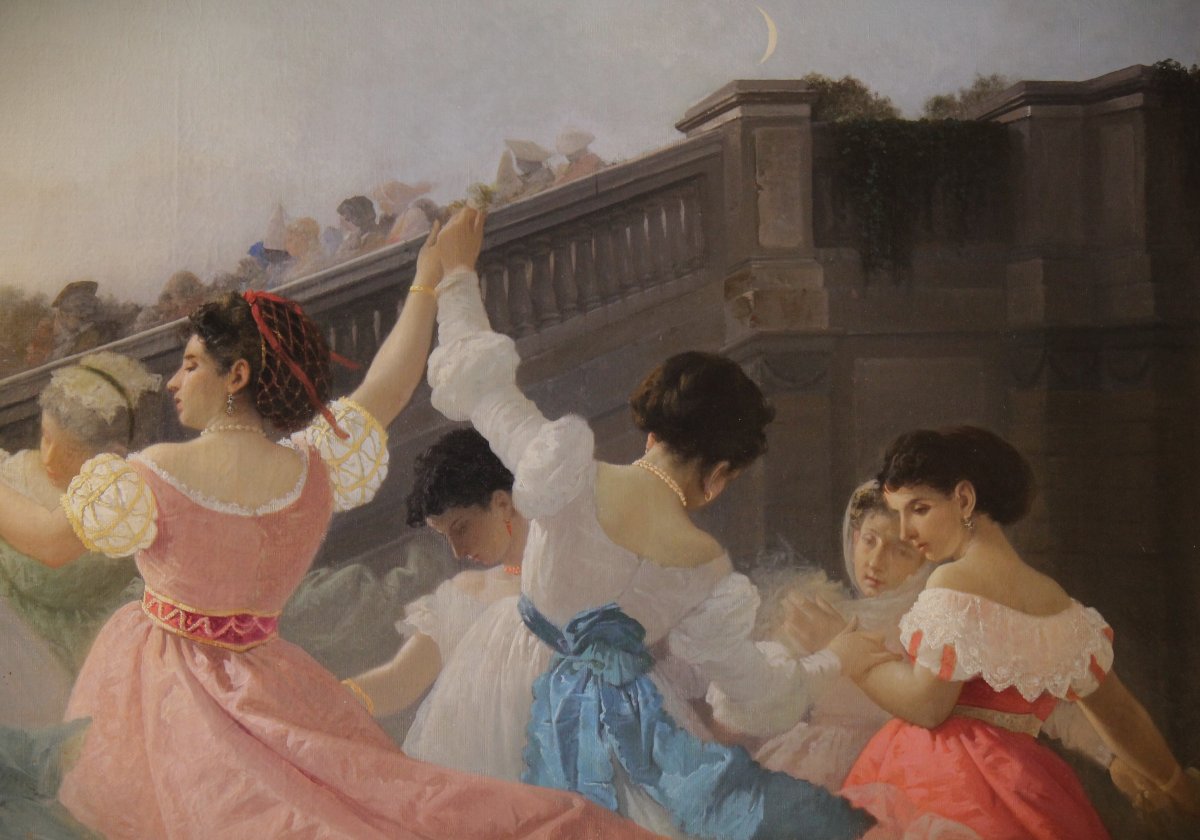
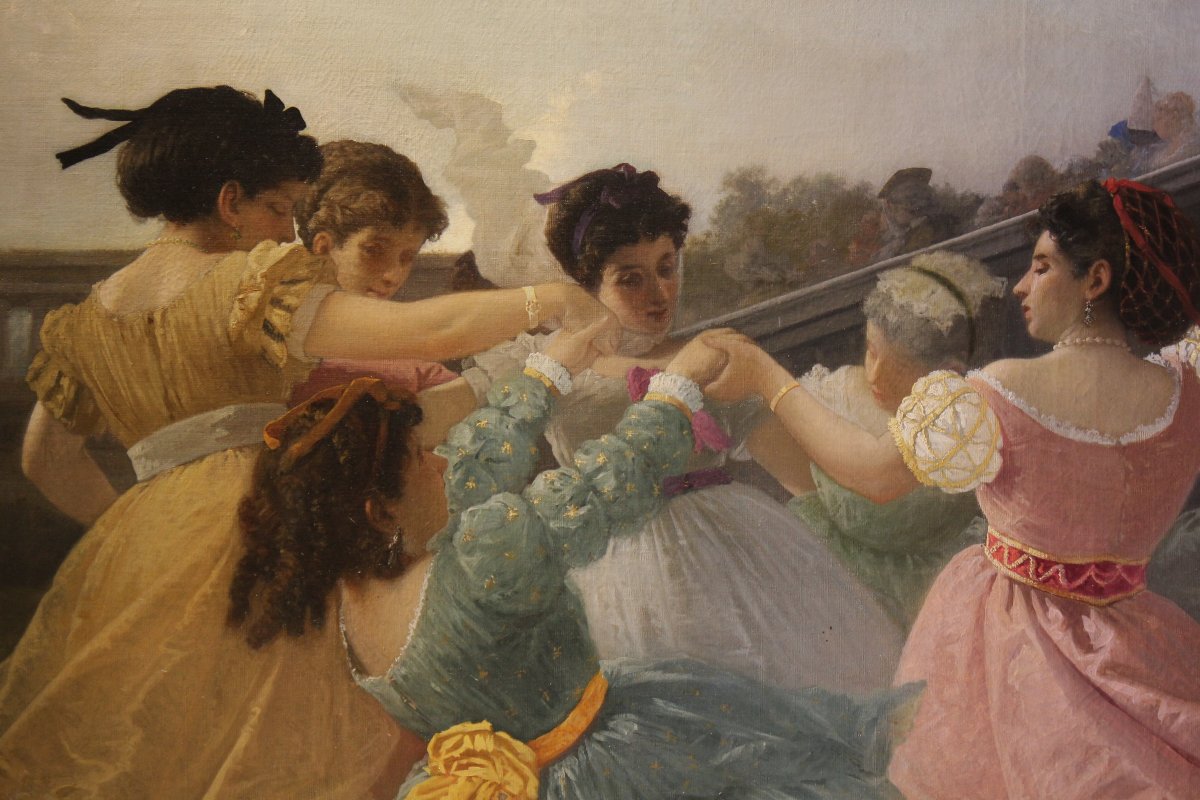
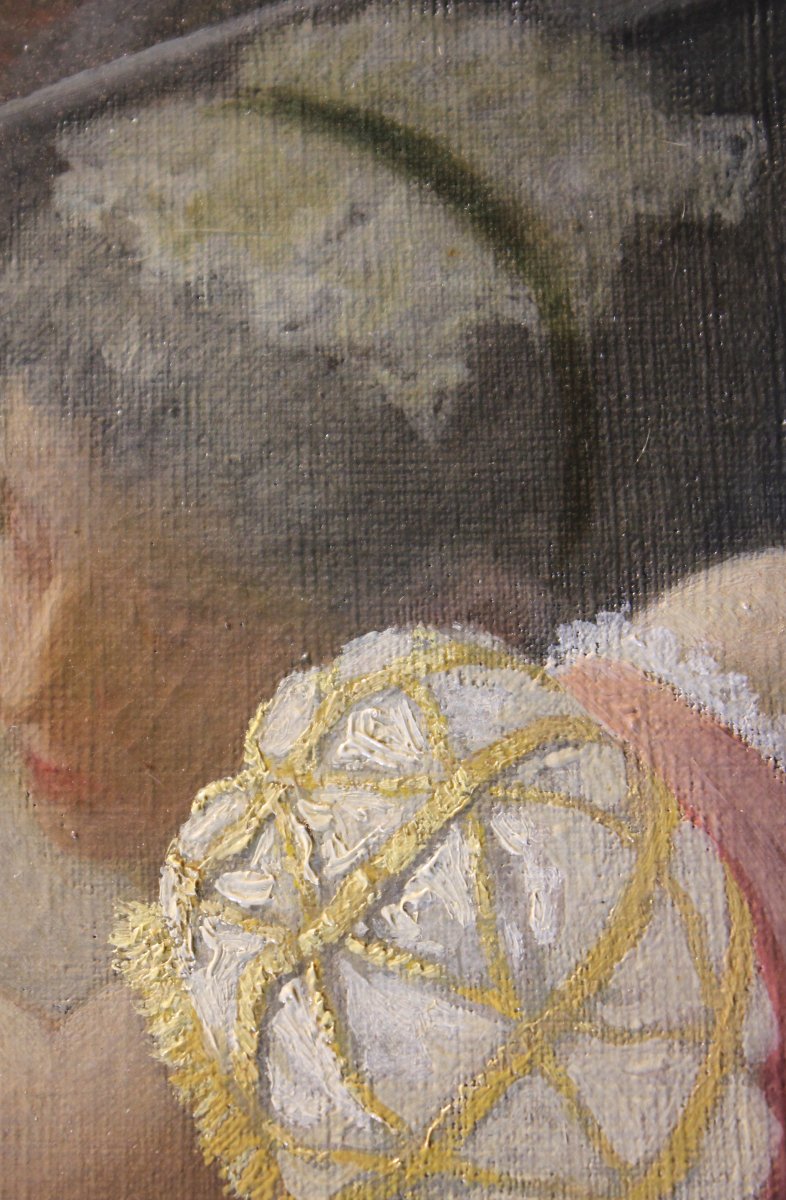
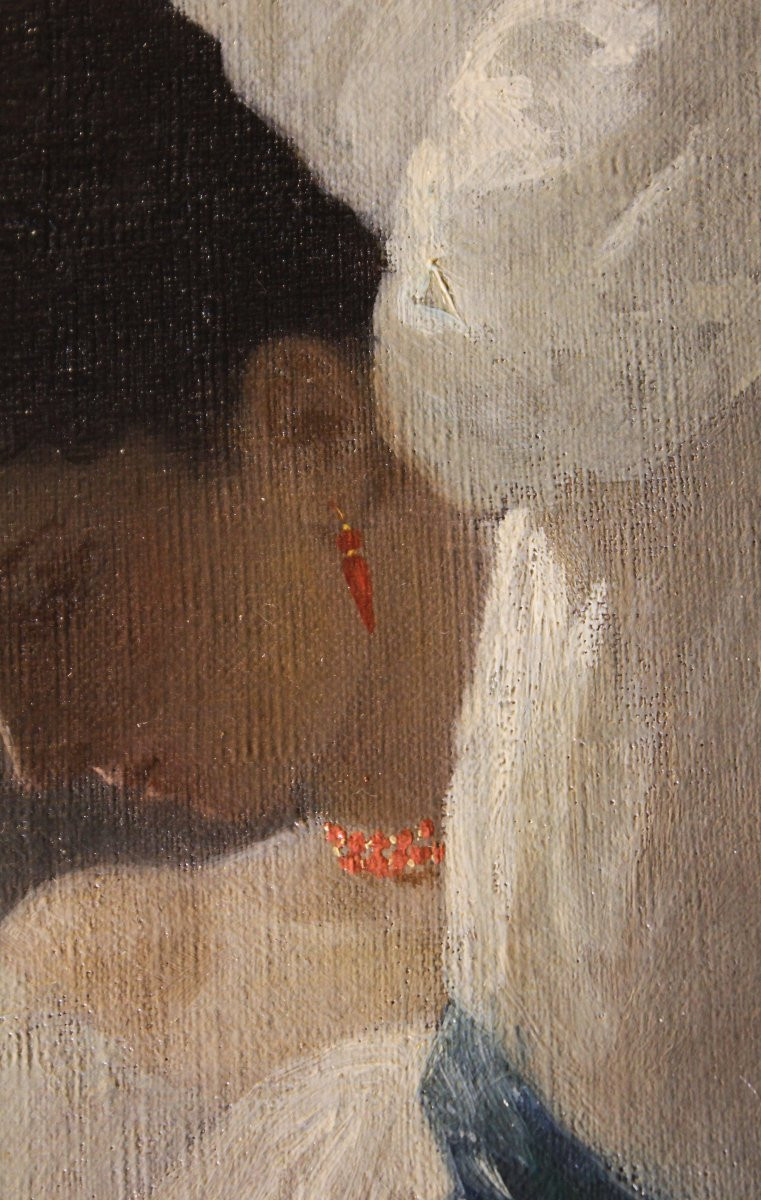
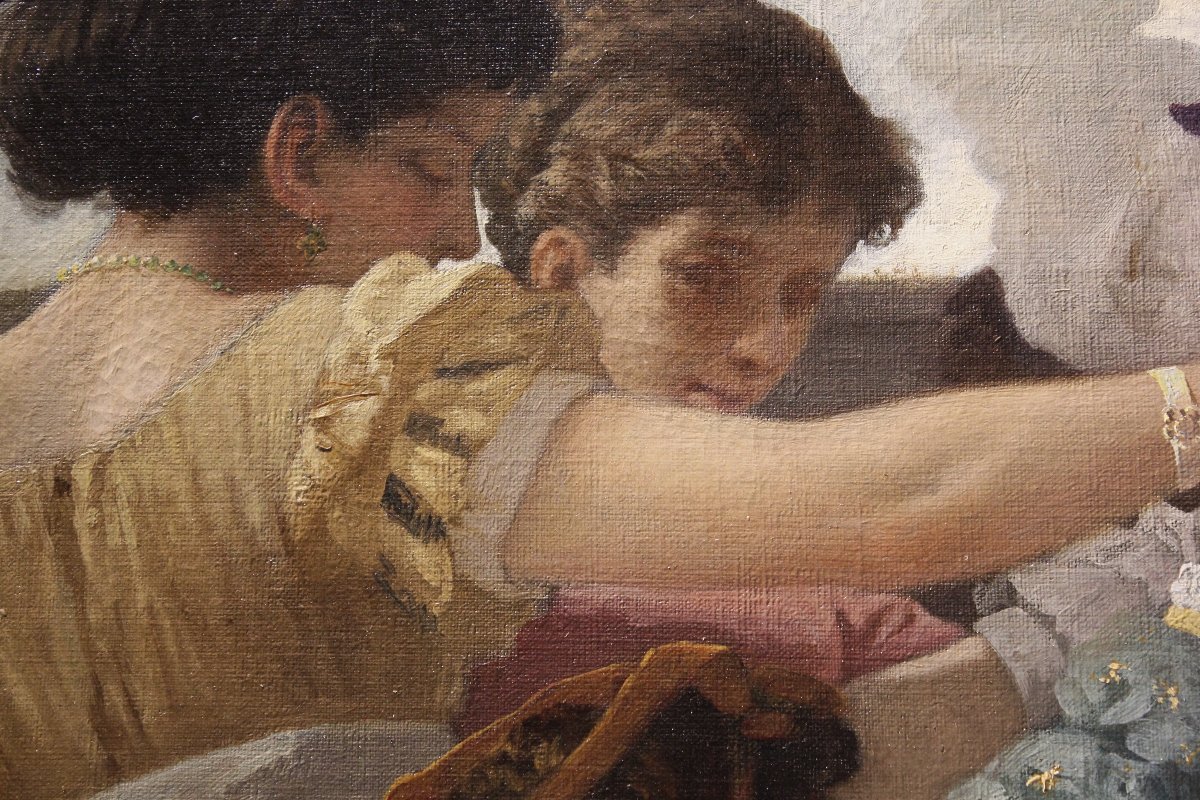
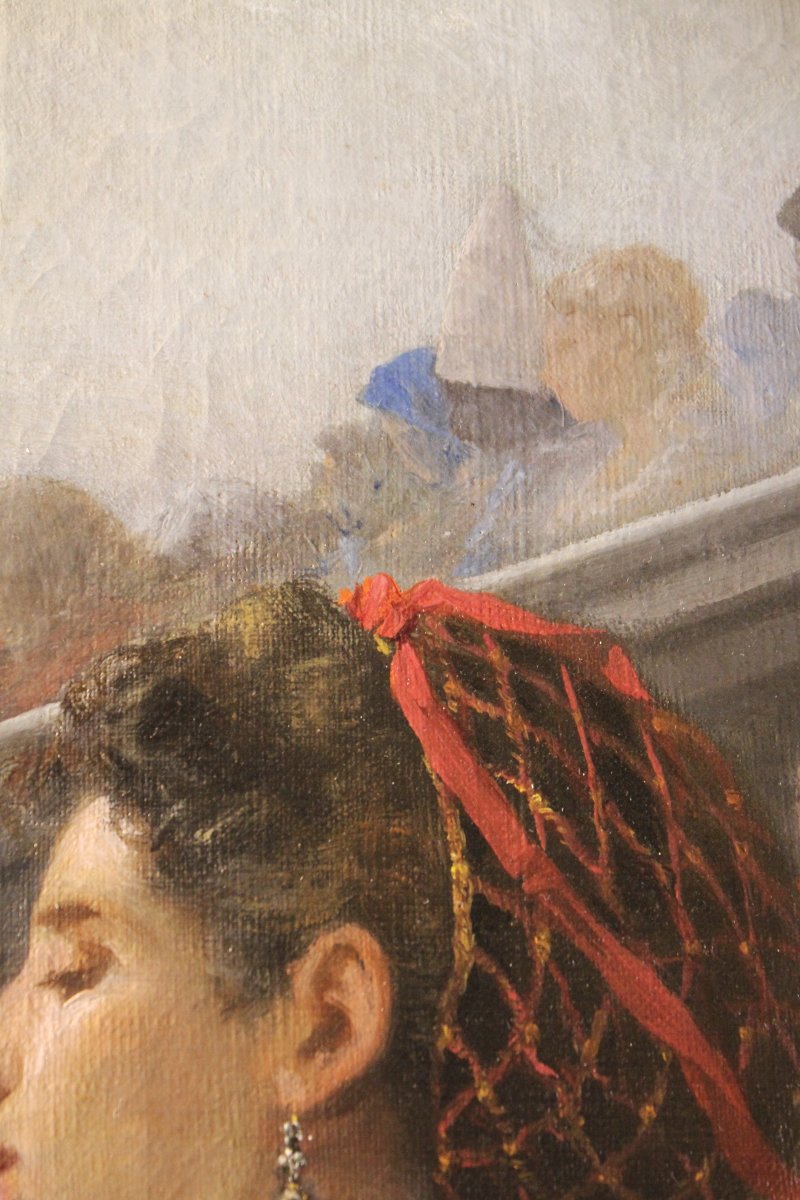
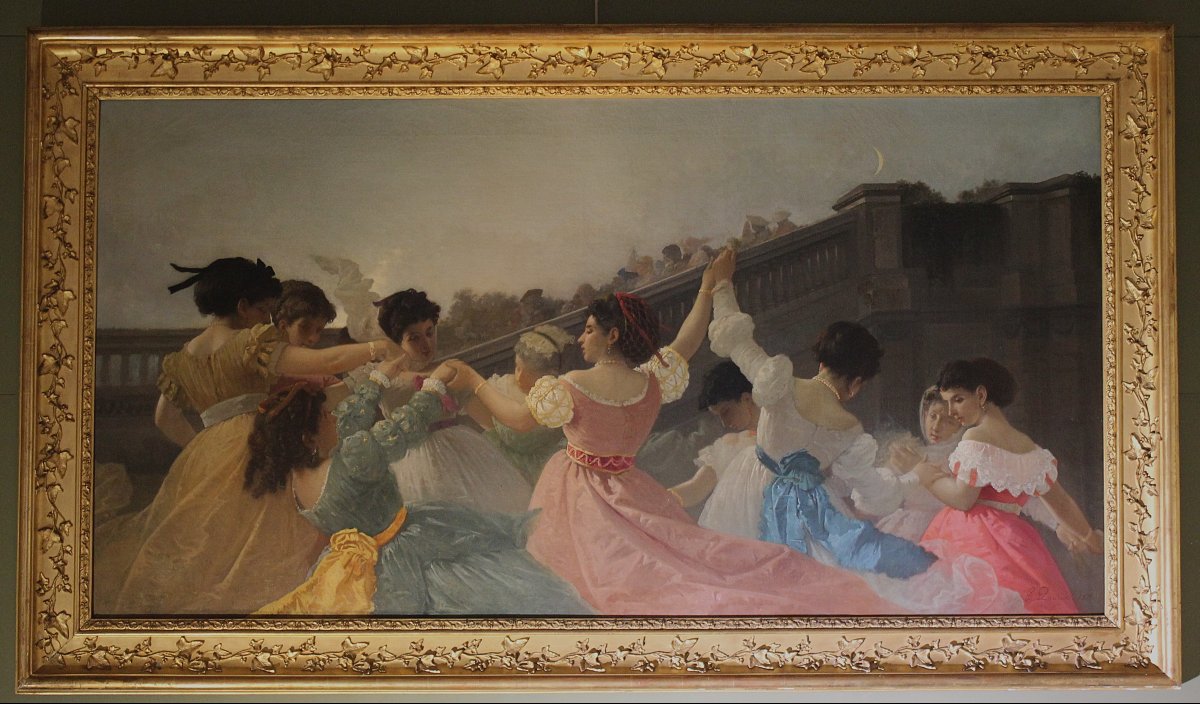
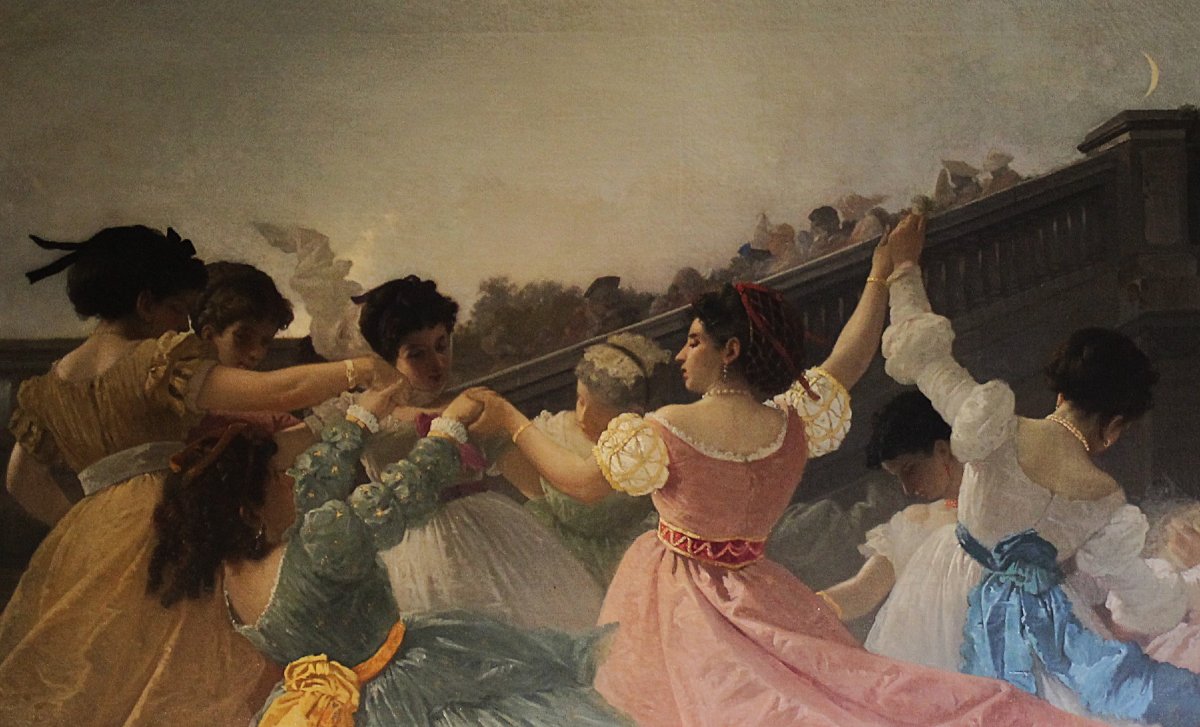
A group of young women in country festival attire dance in a circle in front of a monumental staircase filled with a crowd of costumed people. Among the large bonnets and headdresses of folk style, a wig with an eighteenth-century tricorne and the black mask topped with the pointed white hat of Pulcinella, an icon of the city of Naples, stand out. In the background, on the left, an aqueduct or an arched bridge can be seen. The party most likely takes place in the garden of a villa, in summer, towards evening, heralded by the crescent moon in the sky. The girls express a restrained joy, if not, truth be told, a certain sadness, which is especially evident on the face of the one on the right, who almost seems to withdraw from the dance. There are no smiles, but nostalgic and melancholic expressions, as if their thoughts were focused elsewhere, rather than on the present.
This dramatic tension is characteristic of the painting of Neapolitan Giovanni Ponticelli, who reached his full maturity in the transitional period between the fall
of the Bourbons and the unification of Italy. Trained at the Royal Institute of Fine Arts in Naples, he studied with Smargiassi and Mancinelli, "mediating between the naturalistic innovations of Palizzi's reform and the Romantic-Verist achievements of Morelli" (M.B. Coppola). He made his debut at the Bourbon Biennale of 1855 with three works on religious themes (The Virgin and Child with Saint Joseph; The Parable of the Ten Virgins; The Great Mother of God Adored by Angels), and at the 1859 Biennale he presented the canvas of Saint Elizabeth, Queen of Hungary, visiting a hovel inhabited by a languishing family kept in the Royal Palace of Caserta (fig. 1). Later, in the midst of the Risorgimento, he explored patriotic themes, as demonstrated by the painting titled A Wounded Garibaldian Recounting His Deeds to Two Young Girls, exhibited at the first National Exhibition in Florence in 1861. At the Neapolitan Promotrici of 1864 and 1867, he presented paintings on historical subjects, respectively, Torquato Tasso and the Sciarra Colonna Band and Cavalier Bajardo Convalescing; In the second, from the Art Collection of the Metropolitan City of Naples (fig. 2), "the use of bright colors and the analytical attention to detail in describing the objects, such as the surprising fabrics of the clothes and furnishings, allow us to realistically reconstruct the Renaissance atmosphere in which the scene is set. The knight without blemish and without fear had become, in the post-unification climate, an example of the fight against the oppressor" (M.B. Coppola)2.
Ponticelli also distinguished himself for his landscape and genre paintings. Among the latter, Il vizioso (The Vicious Man) (Pescara, Museo dell'Ottocento, fig. 3) stands out—presented along with Il ragttiere (The Junk Dealer) at the Third National Exhibition of Fine Arts held in Naples in 1877. In this painting, illustrating the theme of a card game, he creates a "scene, charged with tension, […] rendered with remarkable realism, evident in the meticulous description of the elegant clothes that denote the social status of the subjects depicted, along with a careful reproduction of their various expressions."
1 M.B. Coppola, in l’altro Ottocento. Dipinti della collezione d’arte della Città Metropolitana di Napoli, edited by I. Valente, exhibition catalog (Naples, Complesso monumentale di San Domenico Maggiore, 23 December 2015–28 February 2016), Naples 2016, p. 30.
2 Ibid., p. 30.
Pietro Di Natale (art historian and consultant on ancient and modern art)
Signed and dated lower right: "G. Ponticelli 1871"
External dimensions: 105 x 180 cm
A group of young women in country festival attire dance in a circle in front of a monumental staircase filled with a crowd of costumed people. Among the large bonnets and headdresses of folk style, a wig with an eighteenth-century tricorne and the black mask topped with the pointed white hat of Pulcinella, an icon of the city of Naples, stand out. In the background, on the left, an aqueduct or an arched bridge can be seen. The party most likely takes place in the garden of a villa, in summer, towards evening, heralded by the crescent moon in the sky. The girls express a restrained joy, if not, truth be told, a certain sadness, which is especially evident on the face of the one on the right, who almost seems to withdraw from the dance. There are no smiles, but nostalgic and melancholic expressions, as if their thoughts were focused elsewhere, rather than on the present.
This dramatic tension is characteristic of the painting of Neapolitan Giovanni Ponticelli, who reached his full maturity in the transitional period between the fall
of the Bourbons and the unification of Italy. Trained at the Royal Institute of Fine Arts in Naples, he studied with Smargiassi and Mancinelli, "mediating between the naturalistic innovations of Palizzi's reform and the Romantic-Verist achievements of Morelli" (M.B. Coppola). He made his debut at the Bourbon Biennale of 1855 with three works on religious themes (The Virgin and Child with Saint Joseph; The Parable of the Ten Virgins; The Great Mother of God Adored by Angels), and at the 1859 Biennale he presented the canvas of Saint Elizabeth, Queen of Hungary, visiting a hovel inhabited by a languishing family kept in the Royal Palace of Caserta (fig. 1). Later, in the midst of the Risorgimento, he explored patriotic themes, as demonstrated by the painting titled A Wounded Garibaldian Recounting His Deeds to Two Young Girls, exhibited at the first National Exhibition in Florence in 1861. At the Neapolitan Promotrici of 1864 and 1867, he presented paintings on historical subjects, respectively, Torquato Tasso and the Sciarra Colonna Band and Cavalier Bajardo Convalescing; In the second, from the Art Collection of the Metropolitan City of Naples (fig. 2), "the use of bright colors and the analytical attention to detail in describing the objects, such as the surprising fabrics of the clothes and furnishings, allow us to realistically reconstruct the Renaissance atmosphere in which the scene is set. The knight without blemish and without fear had become, in the post-unification climate, an example of the fight against the oppressor" (M.B. Coppola)2.
Ponticelli also distinguished himself for his landscape and genre paintings. Among the latter, Il vizioso (The Vicious Man) (Pescara, Museo dell'Ottocento, fig. 3) stands out—presented along with Il ragttiere (The Junk Dealer) at the Third National Exhibition of Fine Arts held in Naples in 1877. In this painting, illustrating the theme of a card game, he creates a "scene, charged with tension, […] rendered with remarkable realism, evident in the meticulous description of the elegant clothes that denote the social status of the subjects depicted, along with a careful reproduction of their various expressions."
1 M.B. Coppola, in l’altro Ottocento. Dipinti della collezione d’arte della Città Metropolitana di Napoli, edited by I. Valente, exhibition catalog (Naples, Complesso monumentale di San Domenico Maggiore, 23 December 2015–28 February 2016), Naples 2016, p. 30.
2 Ibid., p. 30.
Pietro Di Natale (art historian and consultant on ancient and modern art)
18 000 €
Period: 19th century
Style: Napoleon 3rd
Condition: Good condition
Material: Oil painting
Width: 180
Height: 105
Reference (ID): 1708452
Availability: In stock
Print