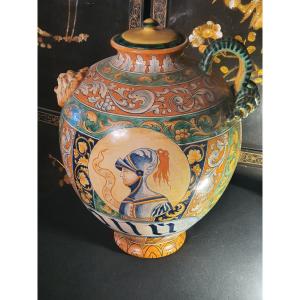




J. Vieillard & Cie And A. De Caranza, Presentation Bowl, France, Circa 1880
Artist: J. Vieillard & Cie
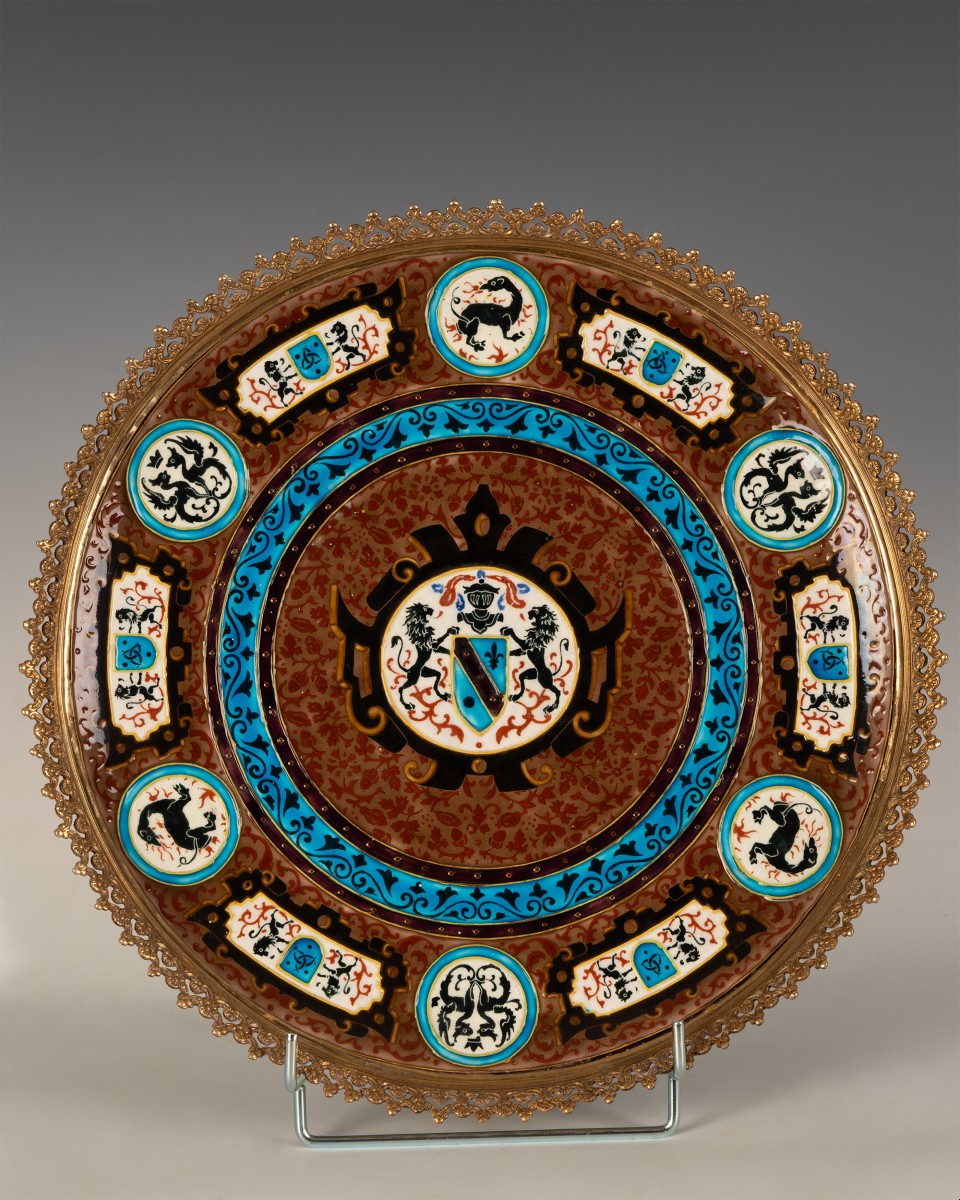
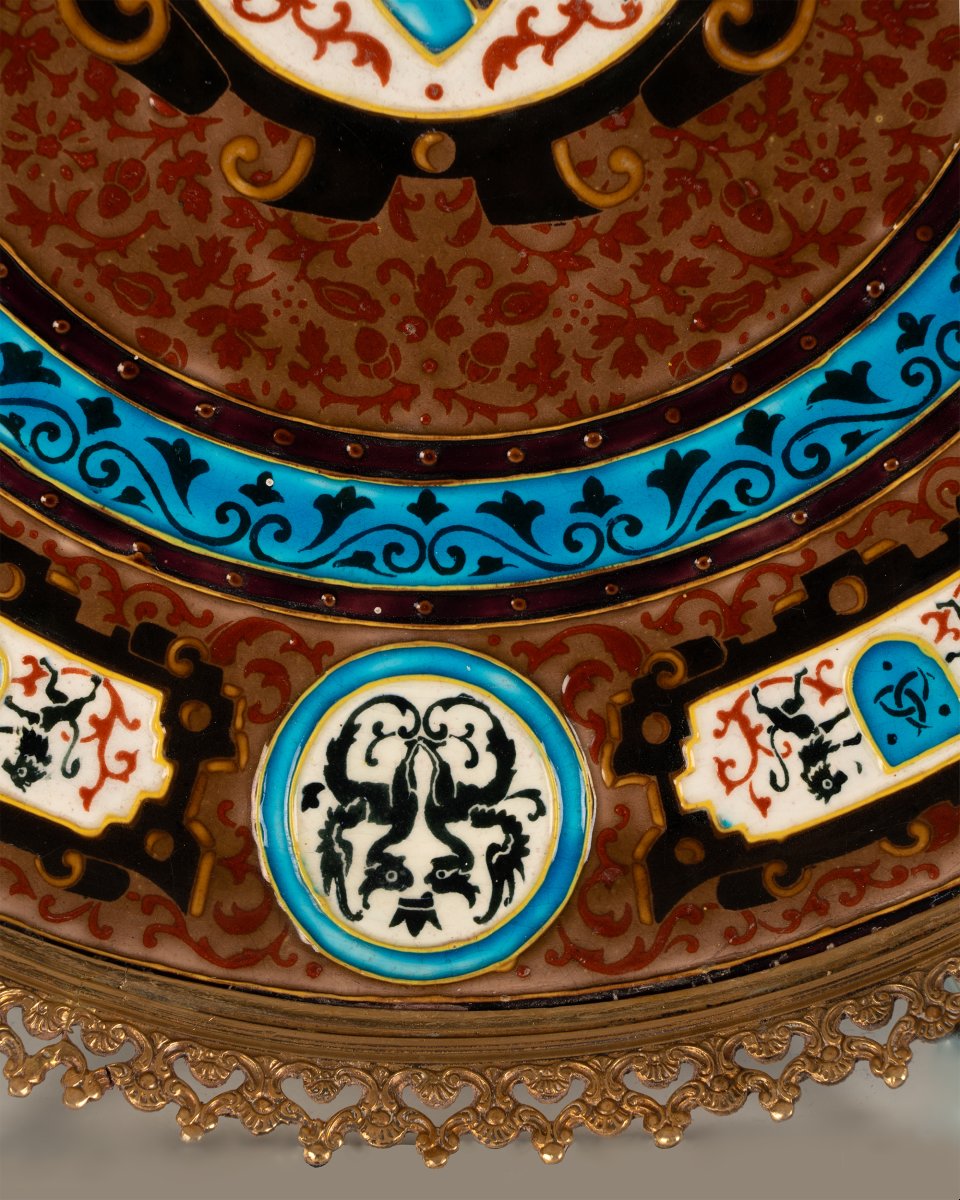
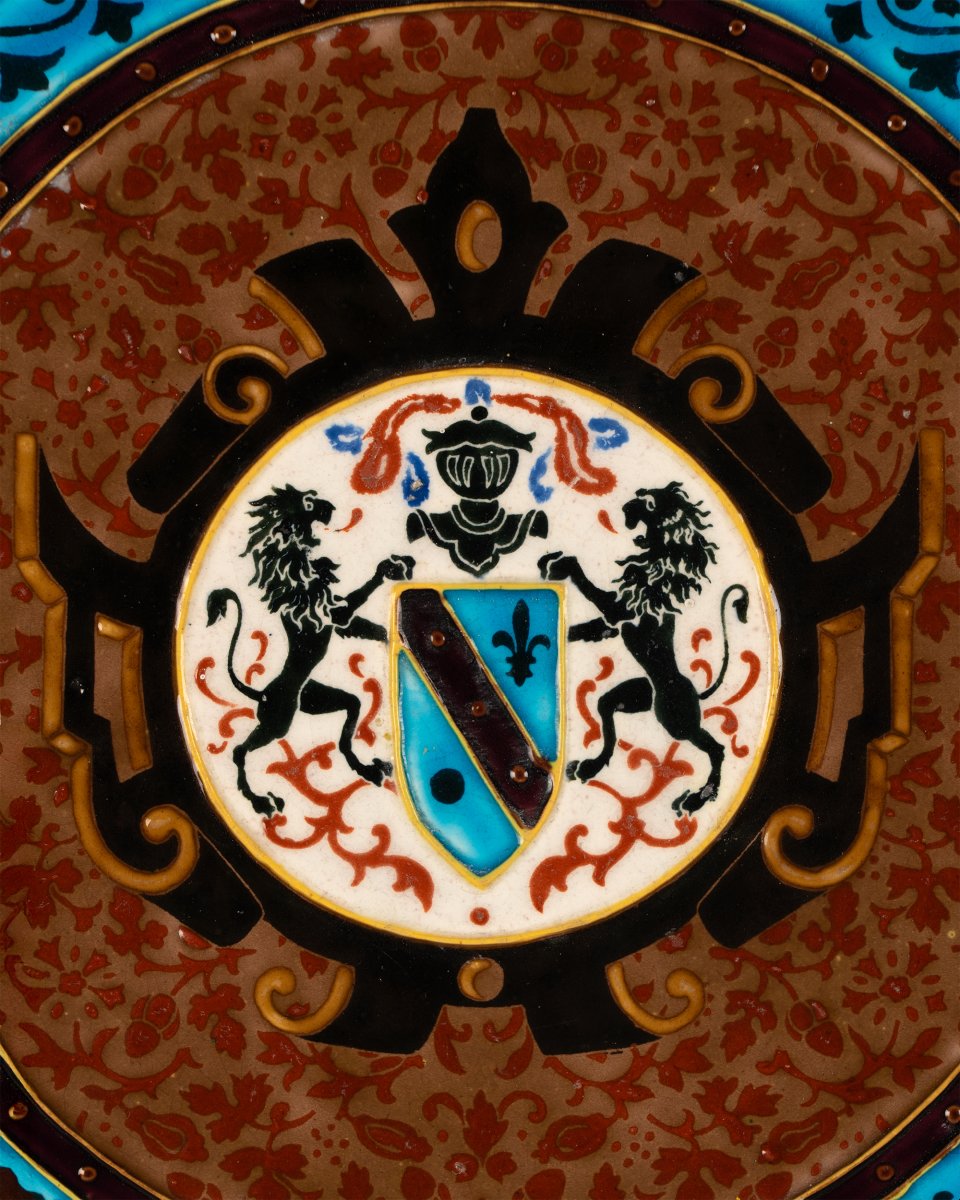
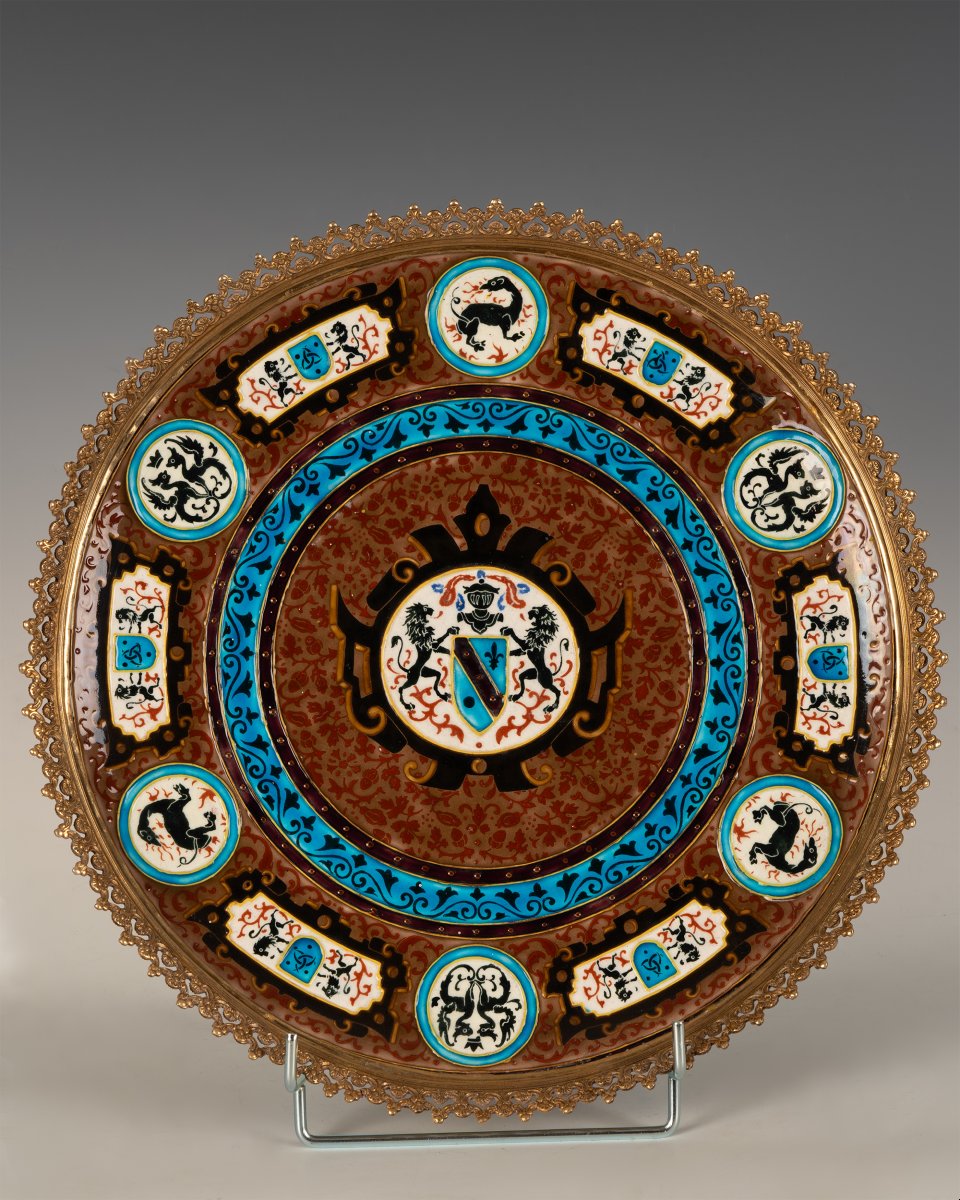
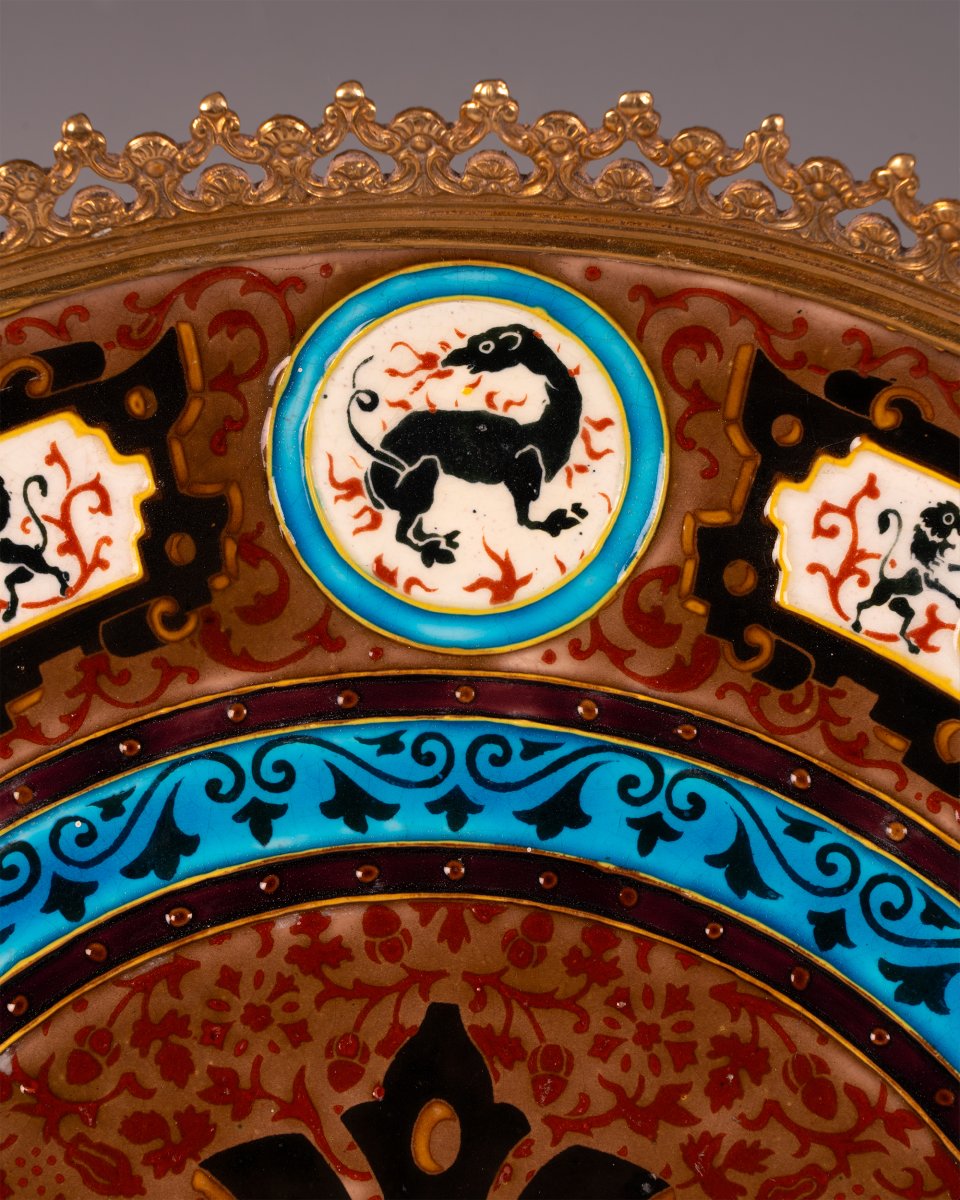
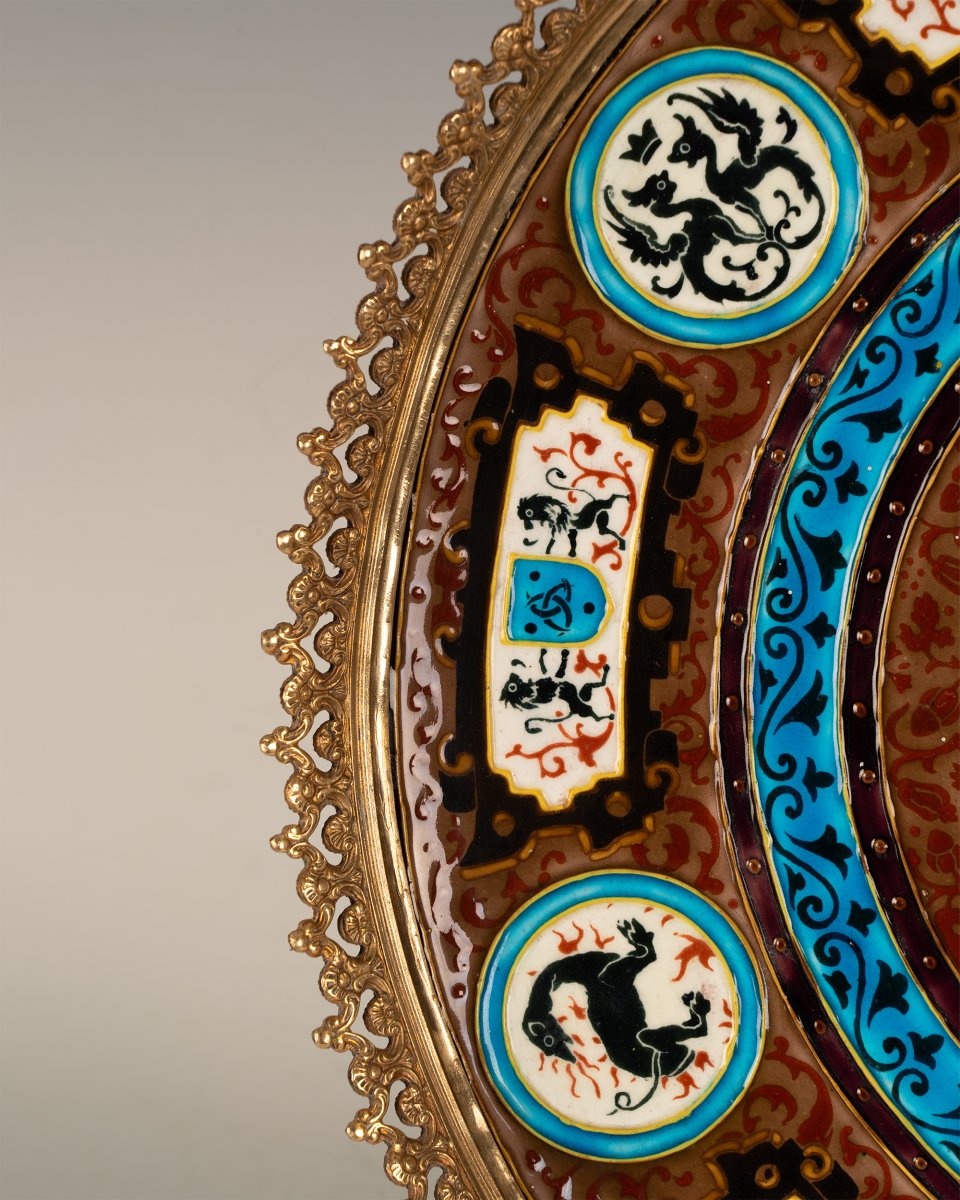
Beautiful circular earthenware bowl with polychrome decoration painted under glaze and heightened with manganese-brown lines. The rim and background are adorned with a rich, compartmentalized historicist design, alternating rectangular cartouches and circular medallions. The latter feature stylized zoomorphic figures (confronted lions and chimeras), rendered in black on a white ground encircled in turquoise blue, evoking a heraldic and Neo-Renaissance repertoire.
The center is occupied by a large circular polychrome medallion depicting a coat of arms surmounted by a helmet. This central medallion is framed by an architectural motif in black and ochre reminiscent of cut leatherwork, with pronounced scrolls and projections, set against a dense reddish-brown ground covered with a repetitive vegetal design of scrolling foliage and leaves.
A wide circular turquoise-blue frieze with black scrollwork separates the central decoration from the rim. The chromatic palette (turquoise blue, black, reddish-brown, ochre, and white) is characteristic of the productions of the Jules Vieillard & Cie manufactory, which here draws inspiration from Italian Renaissance maiolica and Hispano-Moresque decorative arts, reinterpreted in an eclectic idiom typical of the 19th century.
The bowl is set within a finely chased and pierced gilt-bronze mount forming an openwork border decorated with regular scrolls and interlace, resting on three feet shaped as dog heads terminating in scrolls.
This mount, probably contemporary with the object, reflects the practice of enhancing decorative earthenware with gilt-bronze mounts intended for prestigious display in a bourgeois or collectors’ context. The whole illustrates the high technical and decorative standards achieved by the Bordeaux manufactory under the direction of Jules Vieillard, as well as its taste for learned historical references adapted to the decorative arts of its time.
Biography
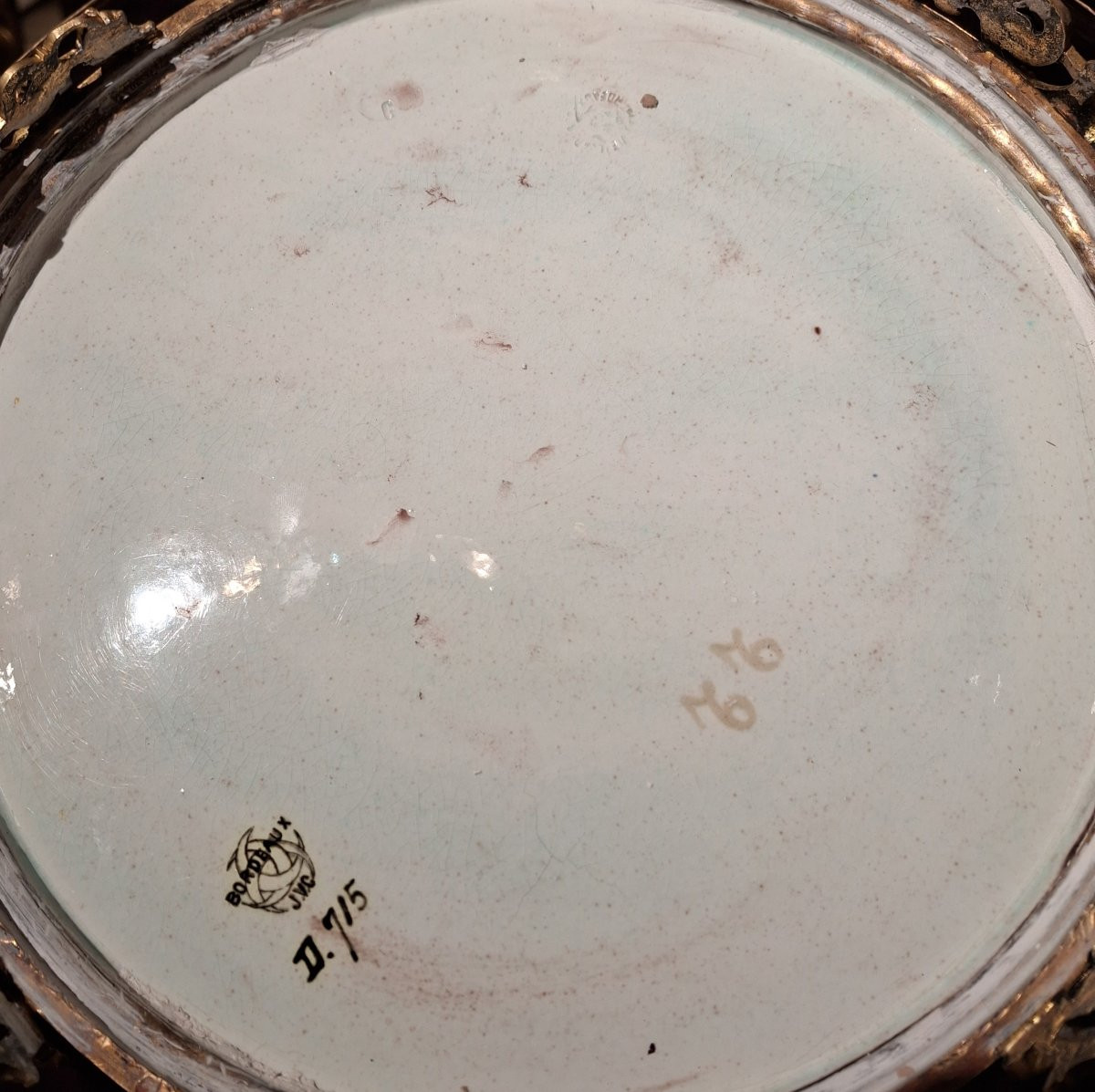
Bordeaux knew at the beginning of the 19th century a great development of fine earthenware due to the establishment of a manufacture by Boudon de Saint-Amans. That factory was however quickly sold to David Johnston, whom opened a factory in Bacalan that counted then up to 700 workers. The production became industrial, with printed patterns of varied colors. Jules Vieillard took after in 1845 David Johnston’s company. His work was crucial to the industrial success of the Bacalan manufacture and also to the artistic quality, which was unanimously celebrated during the famous Universal Exhibitions. His earthenware even earned the generic name of « Vieillard ceramics ». In his last period, Jules Vieillard developed an exceptional Orientalism through his creations. In 1865, his sons Charles and Albert, took after the factory under the company name of « Manufacture Jules Vieillard et Cie », and produced a lot of various designed pieces, particularly decorated with birds and flowers. However, their printed decors were of quite poor quality. To solve that problem, they decided to renew the forms of the pieces, evolving towards fashionable decorative pieces, such as lamps, jardinieres and vases. As for the oldfashioned decoration, the artistic department worked hard under the direction of Amédée de Caranza newly arrived around 1875. This ceramist from Longwy, launched there in 1872 the famous eponymous enamels « Emaux de Longwy », renewing the ornemental vocabulary with his technique of partitioned enamel. His decorations mainly evoked the brilliance of Persian and Japanese objects. But, as Caranza left Longwy to Bordeaux, Longwy couldn’t keep any longer its exclusivity. Caranza became then the manager of the Vieillard factory workshop in 1882, which knew thus a new momentum, until his departure a few years later, probably in 1885. The Vieillard factory closed down in 1895.
The center is occupied by a large circular polychrome medallion depicting a coat of arms surmounted by a helmet. This central medallion is framed by an architectural motif in black and ochre reminiscent of cut leatherwork, with pronounced scrolls and projections, set against a dense reddish-brown ground covered with a repetitive vegetal design of scrolling foliage and leaves.
A wide circular turquoise-blue frieze with black scrollwork separates the central decoration from the rim. The chromatic palette (turquoise blue, black, reddish-brown, ochre, and white) is characteristic of the productions of the Jules Vieillard & Cie manufactory, which here draws inspiration from Italian Renaissance maiolica and Hispano-Moresque decorative arts, reinterpreted in an eclectic idiom typical of the 19th century.
The bowl is set within a finely chased and pierced gilt-bronze mount forming an openwork border decorated with regular scrolls and interlace, resting on three feet shaped as dog heads terminating in scrolls.
This mount, probably contemporary with the object, reflects the practice of enhancing decorative earthenware with gilt-bronze mounts intended for prestigious display in a bourgeois or collectors’ context. The whole illustrates the high technical and decorative standards achieved by the Bordeaux manufactory under the direction of Jules Vieillard, as well as its taste for learned historical references adapted to the decorative arts of its time.
Biography
Bordeaux knew at the beginning of the 19th century a great development of fine earthenware due to the establishment of a manufacture by Boudon de Saint-Amans. That factory was however quickly sold to David Johnston, whom opened a factory in Bacalan that counted then up to 700 workers. The production became industrial, with printed patterns of varied colors. Jules Vieillard took after in 1845 David Johnston’s company. His work was crucial to the industrial success of the Bacalan manufacture and also to the artistic quality, which was unanimously celebrated during the famous Universal Exhibitions. His earthenware even earned the generic name of « Vieillard ceramics ». In his last period, Jules Vieillard developed an exceptional Orientalism through his creations. In 1865, his sons Charles and Albert, took after the factory under the company name of « Manufacture Jules Vieillard et Cie », and produced a lot of various designed pieces, particularly decorated with birds and flowers. However, their printed decors were of quite poor quality. To solve that problem, they decided to renew the forms of the pieces, evolving towards fashionable decorative pieces, such as lamps, jardinieres and vases. As for the oldfashioned decoration, the artistic department worked hard under the direction of Amédée de Caranza newly arrived around 1875. This ceramist from Longwy, launched there in 1872 the famous eponymous enamels « Emaux de Longwy », renewing the ornemental vocabulary with his technique of partitioned enamel. His decorations mainly evoked the brilliance of Persian and Japanese objects. But, as Caranza left Longwy to Bordeaux, Longwy couldn’t keep any longer its exclusivity. Caranza became then the manager of the Vieillard factory workshop in 1882, which knew thus a new momentum, until his departure a few years later, probably in 1885. The Vieillard factory closed down in 1895.
5 800 €
Period: 19th century
Style: Renaissance, Louis 13th
Condition: Good condition
Material: Earthenware
Diameter: 38
Height: 11
Reference (ID): 1706294
Availability: In stock
Print