



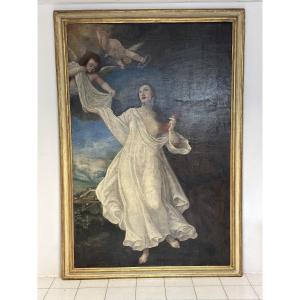


Saint Barbara. Dosso Dossi (manner Of), 17th Century.
Subject: Saint Barbara.
Author: Dosso Dossi (manner of), 17th century.
Technique and Dimensions: Oil on canvas; 238 x 164 cm. Contemporary frame.
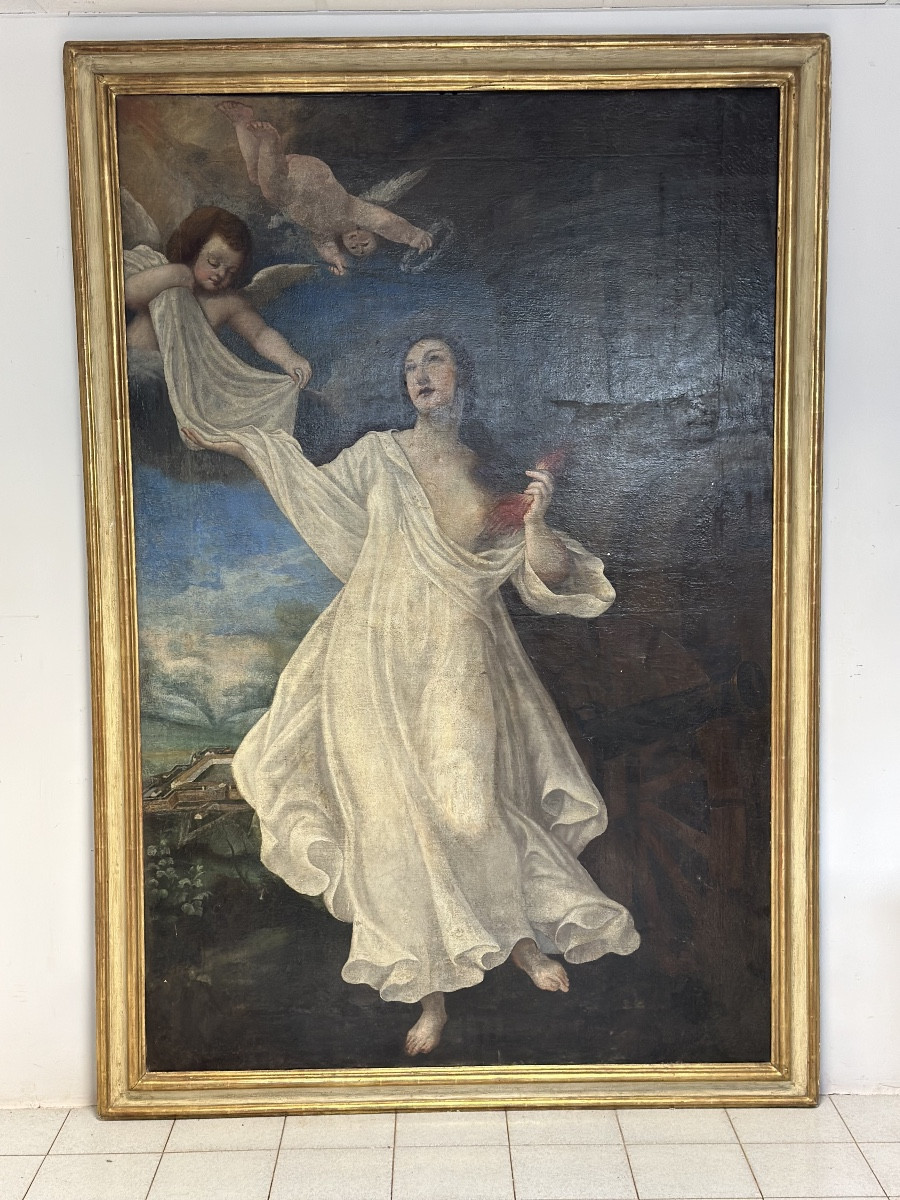
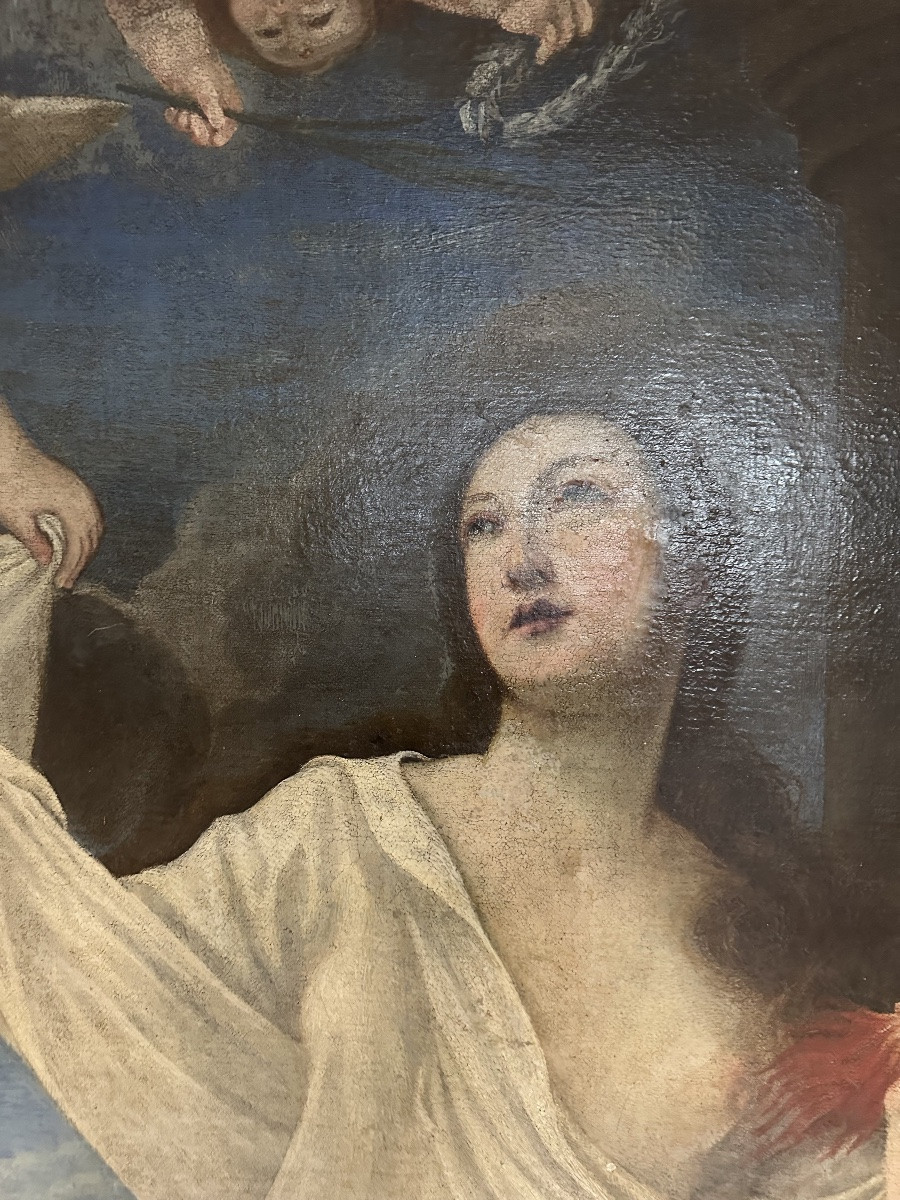
The rigorous perspective, rich colors, classicism, and monumental layout suggest an attribution of our painting to the workshop of Dosso Dossi, the principal artist active at the Este court in Ferrara.
The early 17th-century painter of the work in question appropriates and reworks some of Dossi's key achievements, primarily his chromaticism and landscape exploration, while also providing interesting points of contact with the finest examples of the 17th-century Bolognese school, whose classicism is imbued in the work.
Direct parallels with Dossi's religious works, especially in terms of color and the attention paid to the sacred figure, always portrayed flat, can be found in mirrored parallels with Saint Julian (Hampton Court, Royal Collection), Saint George (Los Angeles, Getty Museum), and Saint Lucretia (National Gallery of Art, Washington).
Regarding landscapes, Dossi's apparition of the Madonna and Child to the Brothers of the Snow between Saints Francis and Bernardino is noteworthy.
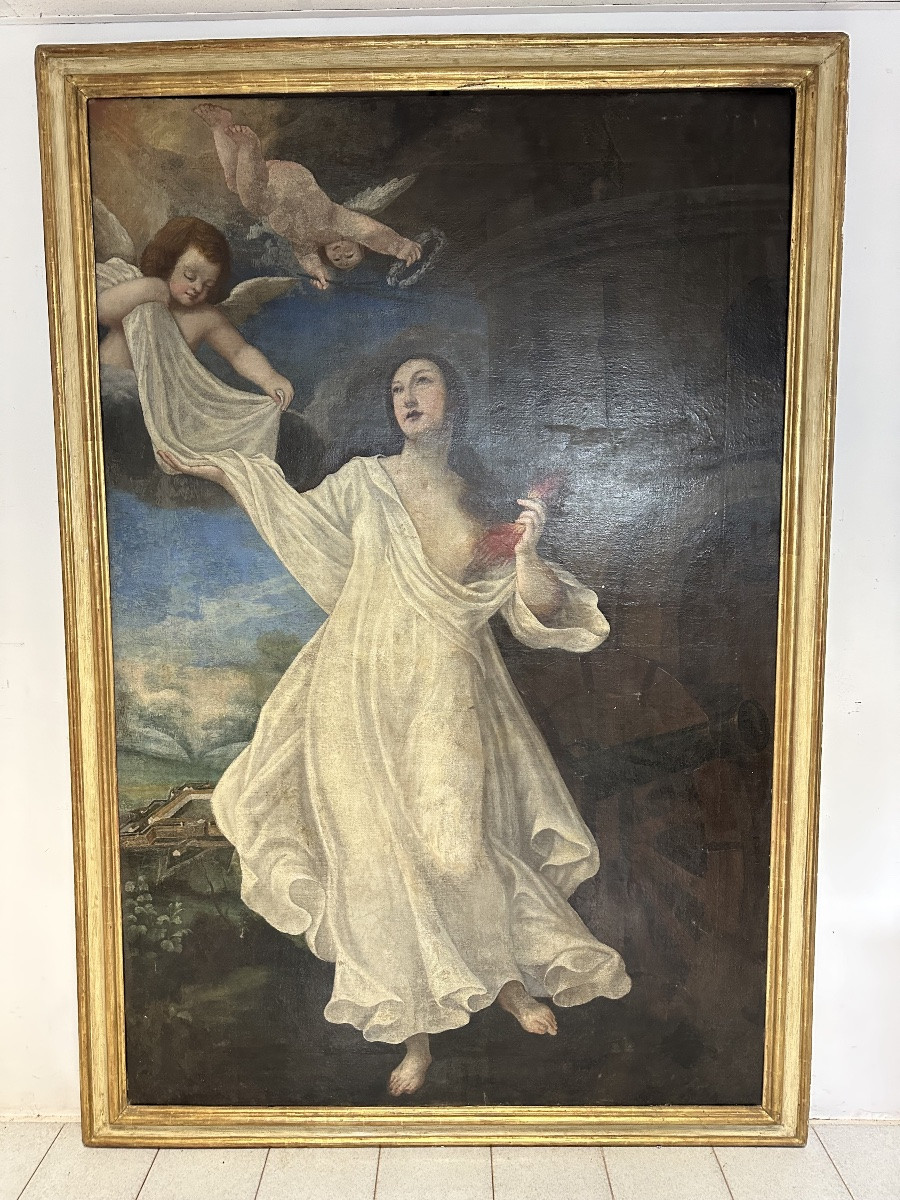
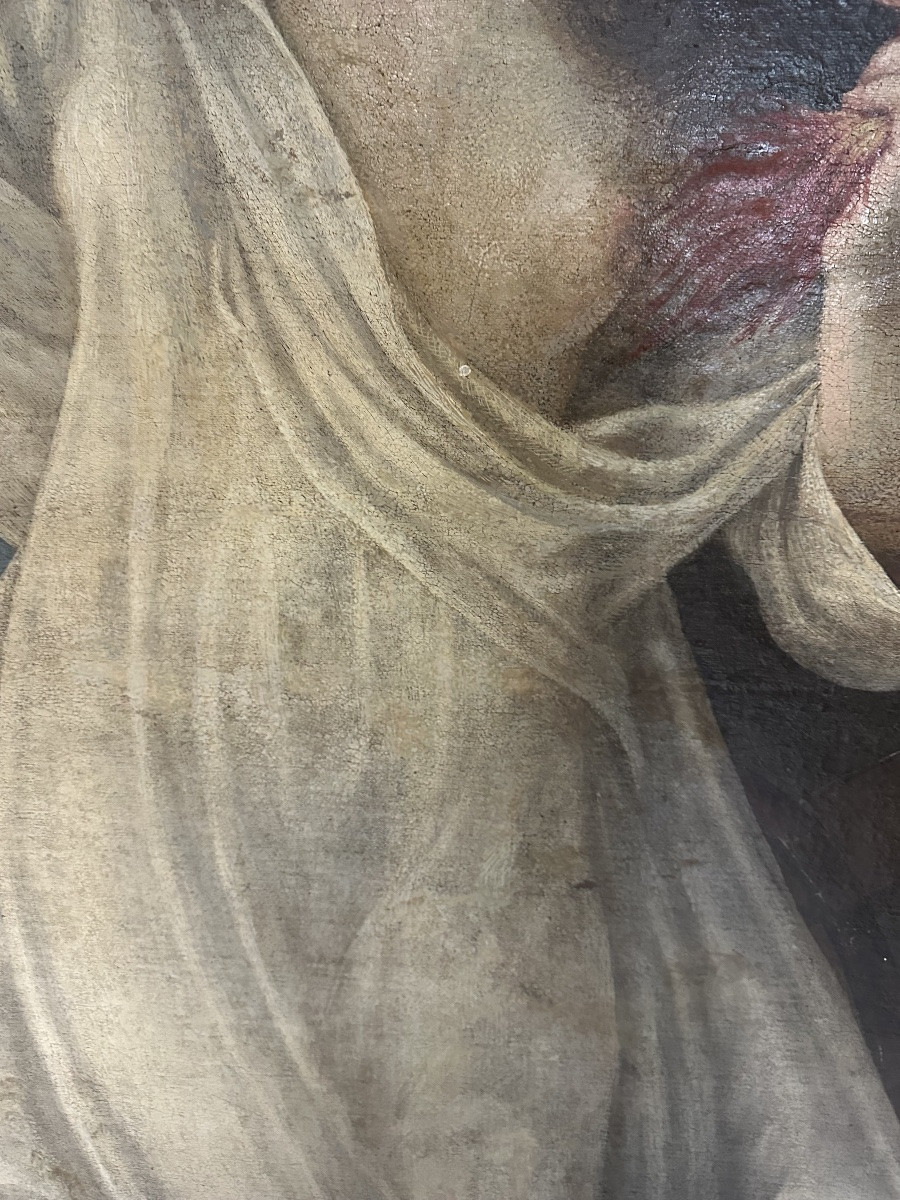
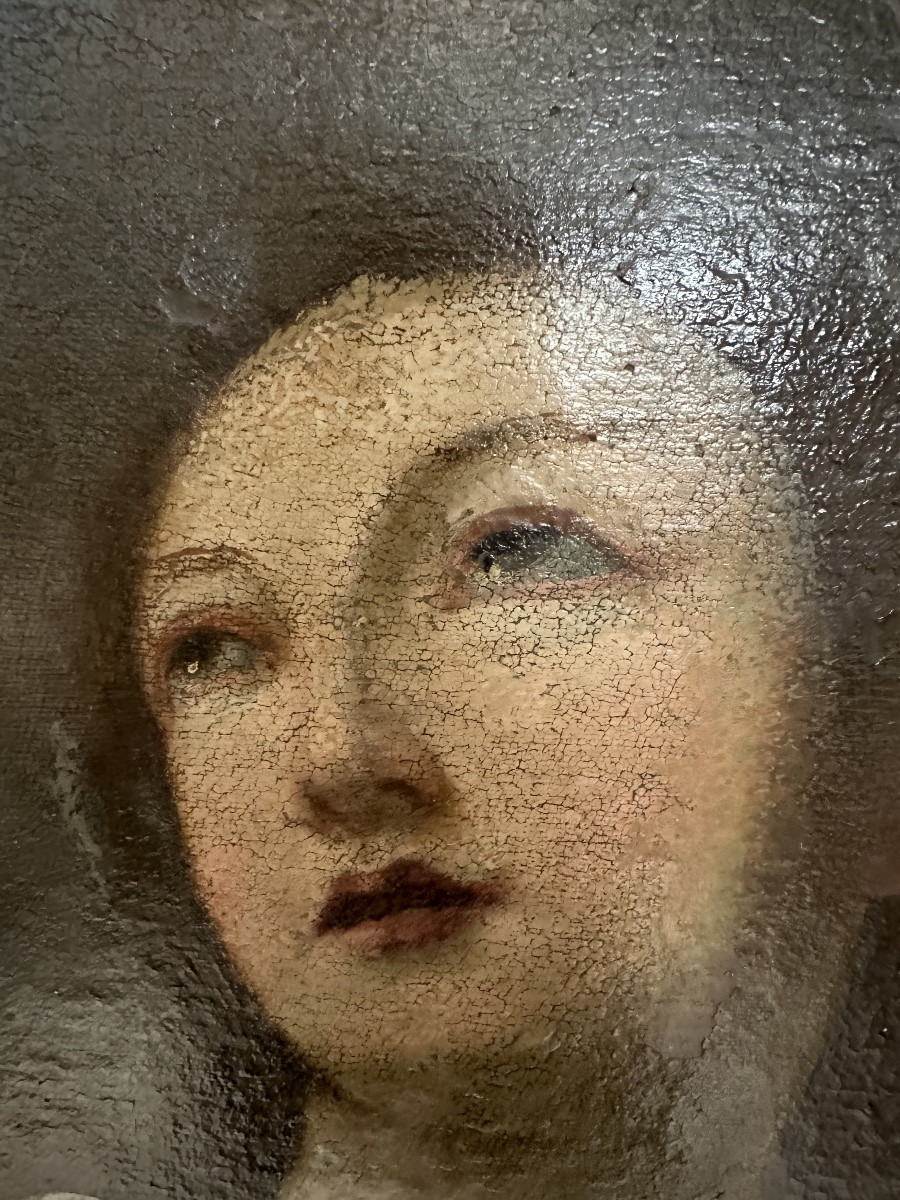
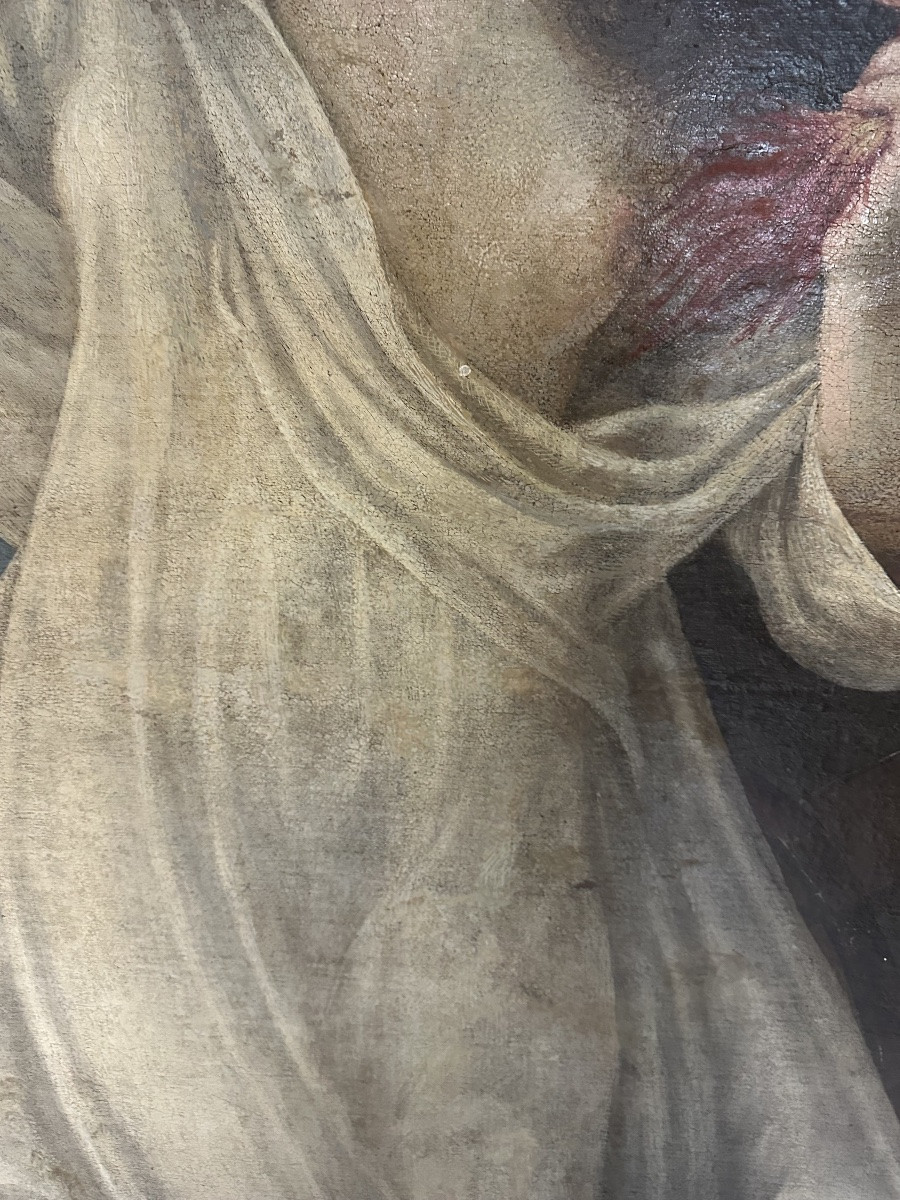
We are witnessing a style, that of Dossi, constantly updated with the latest developments from the artistic hubs of the peninsula thanks to his frequent travels (Florence, Rome, and Venice), a style also nourished by the fruitful dialogue with Titian: a certain parallel can be discerned between the pagan pose of our Saint (the implicit figurative reference to a pagan image of a Sibyl or Vestal Virgin) with her slightly exposed breast and the Lucretia of the "Suicide of Lucretia" in works developed in the Venetian pictorial climate: in our painting, as dictated by the hagiographic subject in question, the dagger has been replaced by thunderbolts.
Some biographical details of the saint, martyred by beheading by her own father (the pagan Dioscurus, who had her locked up in a tower—depicted behind the saint on the right side of our painting—for having consecrated herself to Christ by choosing virginity rather than marrying a rich lord of the same pagan faith), suggest parallels with other pagan mythical figures such as the mysterious "bona dea," celebrated in Rome by women on December 4th after being flogged and killed by her father Faunus.
As for the iconographic element of the thunderbolts, held by the saint in her left hand, they constitute a further hagiographic reference (the oldest sources are Greek and place her martyrdom in Asia Minor in Nicomedia, one of the capitals of the Tetrarchy; other, later, Latin sources place it in Sabina in Scandriglia, near Rieti, which proudly claims her remains venerated in the cathedral): Dioscurus, after beheading his daughter, was immediately struck by a A bolt of lightning fell from the sky, leaving nothing but ashes. In memory of this event, after the discovery of gunpowder, the saint became the patron saint of artillerymen (as well as firefighters, miners, and pyrotechnicians).
Today, the word "santabarbara" is synonymous with a powder magazine, a place in a barracks used to store war munitions. Despite her sweet, virginal appearance, Barbara is, in fact, the mistress of terrible things like fire, lightning, and thunder.
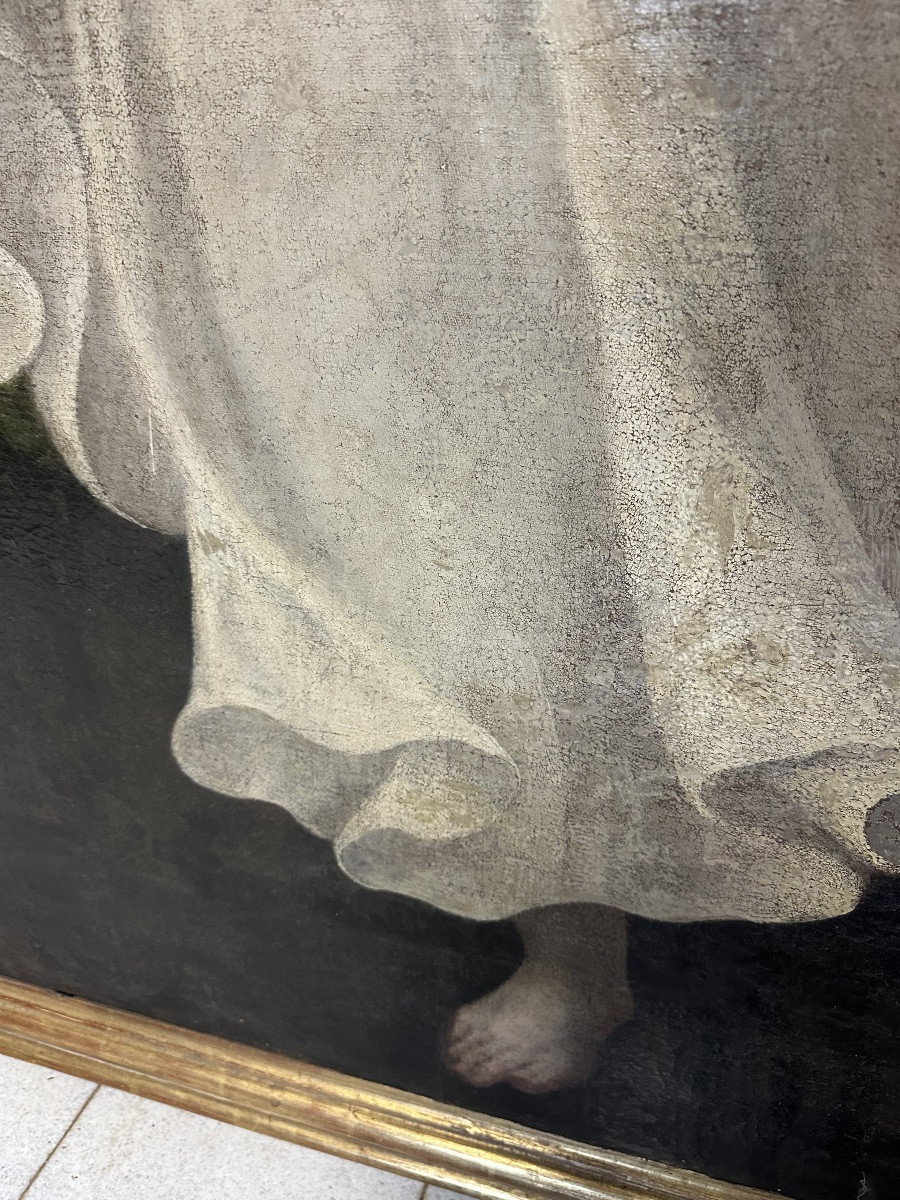
The building depicted in our painting at the bottom left is most likely a barracks, thus confirming an authoritative tradition, figuratively confirmed elsewhere by the presence of the cannon at the saint's feet: eloquent in this regard is the late 16th-century painting by Giovanni Battista Moroni, "The Virgin and Child in Glory with Saints Barbara and Lorenzo."
Last but not least, as a testament to the iconographic success enjoyed by the subject in painting (remember the version by Cosimo Rosselli at the Galleria dell'Accademia in Florence or that by Lucas Cranach the Elder at the Gemäldelgalerie in Dresden), the divine Raphael included our Saint in one of the most famous paintings in the world, the Sistine Madonna (also in Dresden), in which the Saint appears together with Saint Sixtus at the feet of the Virgin, thus destining her portrait to everlasting fame.
Author: Dosso Dossi (manner of), 17th century.
Technique and Dimensions: Oil on canvas; 238 x 164 cm. Contemporary frame.
The rigorous perspective, rich colors, classicism, and monumental layout suggest an attribution of our painting to the workshop of Dosso Dossi, the principal artist active at the Este court in Ferrara.
The early 17th-century painter of the work in question appropriates and reworks some of Dossi's key achievements, primarily his chromaticism and landscape exploration, while also providing interesting points of contact with the finest examples of the 17th-century Bolognese school, whose classicism is imbued in the work.
Direct parallels with Dossi's religious works, especially in terms of color and the attention paid to the sacred figure, always portrayed flat, can be found in mirrored parallels with Saint Julian (Hampton Court, Royal Collection), Saint George (Los Angeles, Getty Museum), and Saint Lucretia (National Gallery of Art, Washington).
Regarding landscapes, Dossi's apparition of the Madonna and Child to the Brothers of the Snow between Saints Francis and Bernardino is noteworthy.
We are witnessing a style, that of Dossi, constantly updated with the latest developments from the artistic hubs of the peninsula thanks to his frequent travels (Florence, Rome, and Venice), a style also nourished by the fruitful dialogue with Titian: a certain parallel can be discerned between the pagan pose of our Saint (the implicit figurative reference to a pagan image of a Sibyl or Vestal Virgin) with her slightly exposed breast and the Lucretia of the "Suicide of Lucretia" in works developed in the Venetian pictorial climate: in our painting, as dictated by the hagiographic subject in question, the dagger has been replaced by thunderbolts.
Some biographical details of the saint, martyred by beheading by her own father (the pagan Dioscurus, who had her locked up in a tower—depicted behind the saint on the right side of our painting—for having consecrated herself to Christ by choosing virginity rather than marrying a rich lord of the same pagan faith), suggest parallels with other pagan mythical figures such as the mysterious "bona dea," celebrated in Rome by women on December 4th after being flogged and killed by her father Faunus.
As for the iconographic element of the thunderbolts, held by the saint in her left hand, they constitute a further hagiographic reference (the oldest sources are Greek and place her martyrdom in Asia Minor in Nicomedia, one of the capitals of the Tetrarchy; other, later, Latin sources place it in Sabina in Scandriglia, near Rieti, which proudly claims her remains venerated in the cathedral): Dioscurus, after beheading his daughter, was immediately struck by a A bolt of lightning fell from the sky, leaving nothing but ashes. In memory of this event, after the discovery of gunpowder, the saint became the patron saint of artillerymen (as well as firefighters, miners, and pyrotechnicians).
Today, the word "santabarbara" is synonymous with a powder magazine, a place in a barracks used to store war munitions. Despite her sweet, virginal appearance, Barbara is, in fact, the mistress of terrible things like fire, lightning, and thunder.
The building depicted in our painting at the bottom left is most likely a barracks, thus confirming an authoritative tradition, figuratively confirmed elsewhere by the presence of the cannon at the saint's feet: eloquent in this regard is the late 16th-century painting by Giovanni Battista Moroni, "The Virgin and Child in Glory with Saints Barbara and Lorenzo."
Last but not least, as a testament to the iconographic success enjoyed by the subject in painting (remember the version by Cosimo Rosselli at the Galleria dell'Accademia in Florence or that by Lucas Cranach the Elder at the Gemäldelgalerie in Dresden), the divine Raphael included our Saint in one of the most famous paintings in the world, the Sistine Madonna (also in Dresden), in which the Saint appears together with Saint Sixtus at the feet of the Virgin, thus destining her portrait to everlasting fame.
4 600 €
Period: 17th century
Style: Louis 14th, Regency
Condition: Excellent condition
Material: Oil painting
Reference (ID): 1699472
Availability: In stock
Print