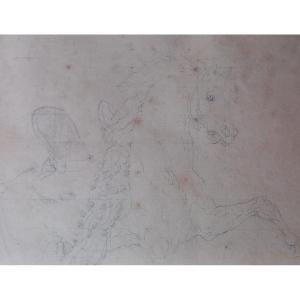


"Equestrian Academy 19th Century Drawing: Horse At A School Walk Or Parade"
This drawing offers a highly accurate and representative glimpse into the artistic creation process of the mid-19th century. It is a preparatory pencil sketch depicting a rearing horse (also known as a "school canter"), a classic subject in equestrian and military art of that period. A saddle horse, likely a stallion of noble breed (such as a Purebred Spanish or Arabian, highly prized in 19th-century portraiture), is shown in profile. The horse is in a dynamic pose, with one foreleg raised. Its head is brought back towards its chest (a sign of being in hand), suggesting a horse trained for haute école or a military parade. The outline of a saddle with a high cantle (typical of riding or military saddles) is discernible, as are perhaps elements of ceremonial harnesses on the chest. Horizontal lines and small reference points along the edges: this grid technique allows the artist to transfer their drawing to a larger scale (onto a painting canvas, for example) while maintaining proportions. The pencil lines are light, precise in places (the head, the hooves) and more blurred on the hindquarters, which is characteristic of a search for movement. The style evokes Romanticism or Neoclassicism. One could see the influence of artists like Théodore Géricault or Eugène Delacroix, who were obsessed with anatomy and equestrian spirit. The draftsman, probably a student at the École des Beaux-Arts, has produced a beautiful work of equestrian composition. Dimensions: 34.1 x 25.5 cm. Note that the paper has foxing (small brown spots of oxidation due to age) and a patina that confirm its age. It was previously secured at the corners with pieces of gum. 












 Le Magazine de PROANTIC
 TRÉSORS Magazine
 Rivista Artiquariato