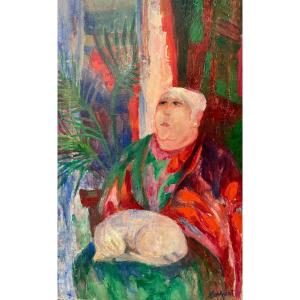
Auguste Chabaud (1882 - 1955) — The Stable, Circa 1910
Artist: Auguste Chabaud
The Stable, circa 1910
Oil on cardboard, studio stamp lower right.
102 x 73 cm.
Auguste Chabaud – Between Earthy Provence and Pictorial Modernity
Born in Nîmes in 1882, Auguste Chabaud entered the École des Beaux-Arts in Avignon at the age of 15, where he was trained by Pierre Grivolas, a renowned master who had already taught René Seyssaud. At the dawn of the 20th century, he moved to Paris, but preferred the lively atmosphere of the cafés in the Latin Quarter to Cormon's academic lessons. It was in these vibrant spaces that his eye was honed, nourished by everyday life, forging a personal, incisive, and modern graphic style. The Parisian night fascinated Chabaud. The city's artificial lights excited his palette: they drew out powerful tones and contrasts pushed to the extreme. But his native South, with its blazing sun, beckoned. Unlike other Provençal painters who celebrated light, Chabaud perceived an absorbing light, one that engulfed color more than it revealed it. He inherited a darker vision, in the tradition of Émile Loubon, Monticelli, and Prosper Grésy. Returning to the family farmhouse in Graveson, Chabaud left behind the cabarets and the women of the brothels to observe rural life. He now painted peasants, herds, and agricultural work with the same intensity he had previously devoted to urban life. The draft horse replaced the carriage, and sensuality gave way to rusticity. This evolution also marked a shift in perspective: a disconnected and cynical world faded away, replaced by an ancestral rural order, linked to the seasons, the nourishing earth, and the rhythm of life. This strict framework became the foundation of his art, both a constraint and a source of inspiration. In Chabaud's paintings, the limited palette concentrates the tension: a deep blue, sharp blacks, grayish whites, conveying raw emotion. Far removed from Provençal folklore, his work stands out for its rugged modernity, its instinctive truth. Chabaud does not paint to seduce: he paints life, in its harshness, its beauty, its organic mystery. His work, humble in appearance, expresses a profound ambition: to probe primal urges, to evoke sexuality as a vital force, death as an inescapable horizon. In January 2014, the Alexis Pentcheff Gallery dedicated a major retrospective exhibition to him: Auguste Chabaud, the Instinct for Life, paying tribute to a singular artist, independent of trends, whose painting continues to resonate with rare power.
Discover more works by this artist on the gallery's website: https://www.galeriepentcheff.fr/fr/peintre-auguste-chabaud
Oil on cardboard, studio stamp lower right.
102 x 73 cm.
Auguste Chabaud – Between Earthy Provence and Pictorial Modernity
Born in Nîmes in 1882, Auguste Chabaud entered the École des Beaux-Arts in Avignon at the age of 15, where he was trained by Pierre Grivolas, a renowned master who had already taught René Seyssaud. At the dawn of the 20th century, he moved to Paris, but preferred the lively atmosphere of the cafés in the Latin Quarter to Cormon's academic lessons. It was in these vibrant spaces that his eye was honed, nourished by everyday life, forging a personal, incisive, and modern graphic style. The Parisian night fascinated Chabaud. The city's artificial lights excited his palette: they drew out powerful tones and contrasts pushed to the extreme. But his native South, with its blazing sun, beckoned. Unlike other Provençal painters who celebrated light, Chabaud perceived an absorbing light, one that engulfed color more than it revealed it. He inherited a darker vision, in the tradition of Émile Loubon, Monticelli, and Prosper Grésy. Returning to the family farmhouse in Graveson, Chabaud left behind the cabarets and the women of the brothels to observe rural life. He now painted peasants, herds, and agricultural work with the same intensity he had previously devoted to urban life. The draft horse replaced the carriage, and sensuality gave way to rusticity. This evolution also marked a shift in perspective: a disconnected and cynical world faded away, replaced by an ancestral rural order, linked to the seasons, the nourishing earth, and the rhythm of life. This strict framework became the foundation of his art, both a constraint and a source of inspiration. In Chabaud's paintings, the limited palette concentrates the tension: a deep blue, sharp blacks, grayish whites, conveying raw emotion. Far removed from Provençal folklore, his work stands out for its rugged modernity, its instinctive truth. Chabaud does not paint to seduce: he paints life, in its harshness, its beauty, its organic mystery. His work, humble in appearance, expresses a profound ambition: to probe primal urges, to evoke sexuality as a vital force, death as an inescapable horizon. In January 2014, the Alexis Pentcheff Gallery dedicated a major retrospective exhibition to him: Auguste Chabaud, the Instinct for Life, paying tribute to a singular artist, independent of trends, whose painting continues to resonate with rare power.
Discover more works by this artist on the gallery's website: https://www.galeriepentcheff.fr/fr/peintre-auguste-chabaud
8 000 €
Period: 20th century
Style: Modern Art
Condition: Good condition
Material: Oil painting on cardboard
Reference (ID): 1678236
Availability: In stock
Print