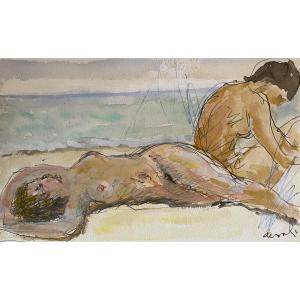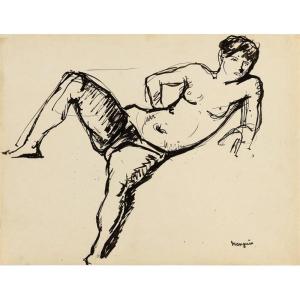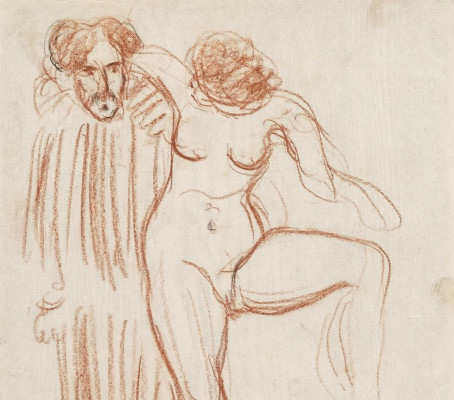
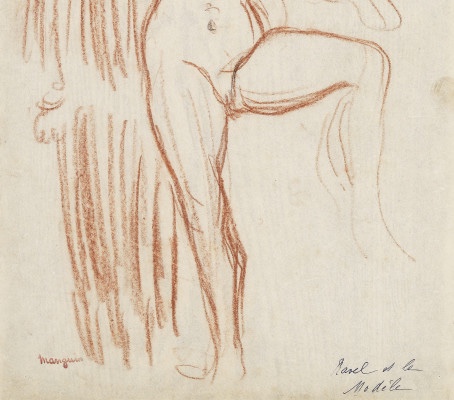


Henri Manguin (1874 - 1949) — Ravel And The Model, Circa 1900
Artist: Henri Manguin
Ravel and the Model, circa 1900
Red chalk on paper, signature stamped lower left.
32.5 x 24.5 cm.
Provenance:
Artist's family
Private collection, France
Henri Manguin, the pacified Fauve
Henri Manguin was one of the original Fauves, represented in the outrageous room at the 1905 Salon d'Automne by five of his paintings, whose evocative titles hinted at themes that would occupy him throughout his life. La Sieste (The Nap), Sur le balcon (On the Balcony), Sous les arbres (Under the Trees), Les chênes lièges (The Cork Oaks) and Le pré (The Meadow) all promise a landscape that is omnipresent in a body of work that does not neglect the human figure. What is immediately striking in Manguin's paintings is his treatment of the outdoors as if it were indoors. More precisely, without detracting from the wildness that characterizes the landscapes he depicts, the painter allows his models to evolve more comfortably than in any interior. The boundary between inside and outside thus disappears in his art in the simplest and most skillful way possible.
This possibility of a door constantly open onto the landscape was made possible by the mild climate of the South of France, or more precisely, the skies of Saint-Tropez, where, after staying for the first time in 1904, he settled from May to October the following year at Villa Demière with his wife Jeanne and their children. His friend Albert Marquet joined him there. In Manguin's paintings, the landscape appears lush, even primitive, but never wild. It is intended to be a reassuring evocation of a rediscovered Eden, which at that time was a recurring theme for many painters, such as Henri Matisse, Pierre Bonnard, Paul Signac, Edmond Cross, and others. We can also see, particularly through the attachment he reveals for his models, the fullness of marital and family happiness. The difficulty for the master, throughout his research, was to “harmonize.” Not only to harmonize bodies with nature, but also to harmonize the rendering of pictorial expression with the emotions felt. Finally, he sought to harmonize the colors on the canvas. He did not seek this balance in tones according to academic precepts, but according to personal and innovative concepts, which did not exclude the juxtaposition of certain stridencies. These were gradually attenuated by the increasingly frequent use of areas of violet, which he assigned the role of binding agent in the composition.
As with his peers, whose convictions had been forged in Gustave Moreau's studio a few years earlier, contrasting tones were the order of the day. Each artist, in their own way, assigned a new role to color. In Manguin's work, the rigorous construction borrowed from Cézanne (whose 1895 retrospective at Vollard's had made a great impression on him) is combined with the use of bold colors and a simplification of forms that never goes so far as to distort them. These elements serve compositions that give pride of place to the artist's sensitive view of the world. Manguin's painting is more emotional than intellectual in nature. Few writings, apart from correspondence with his painter friends, bear witness to the artist's reflections on his journey, which was much more instinctive than spiritual. The emotion born of observing nature, where the flesh of the models melts away, seems to govern what the artist projects onto the canvas.
By 1906, he was already enjoying success with dealers and collectors. That year, Ambroise Vollard bought 142 of his paintings, as well as pastels and drawings, while the following year, Bernheim-Jeune acquired a collection of paintings and drawings and the Druet gallery offered him a solo exhibition.
Manguin traveled: with Henri Matisse, he discovered Collioure, and with Albert Marquet, Italy. From the 1910s onwards, he regularly visited Switzerland, where he became close to a famous couple of collectors, the Hahnlosers-Bühler, who particularly appreciated his work. He spent his life with his family, between Paris and the South of France, where he felt at home and enjoyed working, in Saint-Tropez and Sanary. After the Fauvist explosion, he left the avant-garde for a more nuanced aesthetic. He kept his distance from the emerging trends, continuing his research on the fringes of Parisian artistic life, in a permanence that did not exclude constantly renewed emotion. Despite this relative distance, dealers and collectors continued to champion his work, and the artist remained in contact with his painter friends, particularly Albert Marquet, with whom he maintained a lifelong relationship of sincere affection and artistic emulation.
Discover more works by this artist on the gallery's website: https://www.galeriepentcheff.fr/fr/peintre-henri-manguin#Oeuvres
Red chalk on paper, signature stamped lower left.
32.5 x 24.5 cm.
Provenance:
Artist's family
Private collection, France
Henri Manguin, the pacified Fauve
Henri Manguin was one of the original Fauves, represented in the outrageous room at the 1905 Salon d'Automne by five of his paintings, whose evocative titles hinted at themes that would occupy him throughout his life. La Sieste (The Nap), Sur le balcon (On the Balcony), Sous les arbres (Under the Trees), Les chênes lièges (The Cork Oaks) and Le pré (The Meadow) all promise a landscape that is omnipresent in a body of work that does not neglect the human figure. What is immediately striking in Manguin's paintings is his treatment of the outdoors as if it were indoors. More precisely, without detracting from the wildness that characterizes the landscapes he depicts, the painter allows his models to evolve more comfortably than in any interior. The boundary between inside and outside thus disappears in his art in the simplest and most skillful way possible.
This possibility of a door constantly open onto the landscape was made possible by the mild climate of the South of France, or more precisely, the skies of Saint-Tropez, where, after staying for the first time in 1904, he settled from May to October the following year at Villa Demière with his wife Jeanne and their children. His friend Albert Marquet joined him there. In Manguin's paintings, the landscape appears lush, even primitive, but never wild. It is intended to be a reassuring evocation of a rediscovered Eden, which at that time was a recurring theme for many painters, such as Henri Matisse, Pierre Bonnard, Paul Signac, Edmond Cross, and others. We can also see, particularly through the attachment he reveals for his models, the fullness of marital and family happiness. The difficulty for the master, throughout his research, was to “harmonize.” Not only to harmonize bodies with nature, but also to harmonize the rendering of pictorial expression with the emotions felt. Finally, he sought to harmonize the colors on the canvas. He did not seek this balance in tones according to academic precepts, but according to personal and innovative concepts, which did not exclude the juxtaposition of certain stridencies. These were gradually attenuated by the increasingly frequent use of areas of violet, which he assigned the role of binding agent in the composition.
As with his peers, whose convictions had been forged in Gustave Moreau's studio a few years earlier, contrasting tones were the order of the day. Each artist, in their own way, assigned a new role to color. In Manguin's work, the rigorous construction borrowed from Cézanne (whose 1895 retrospective at Vollard's had made a great impression on him) is combined with the use of bold colors and a simplification of forms that never goes so far as to distort them. These elements serve compositions that give pride of place to the artist's sensitive view of the world. Manguin's painting is more emotional than intellectual in nature. Few writings, apart from correspondence with his painter friends, bear witness to the artist's reflections on his journey, which was much more instinctive than spiritual. The emotion born of observing nature, where the flesh of the models melts away, seems to govern what the artist projects onto the canvas.
By 1906, he was already enjoying success with dealers and collectors. That year, Ambroise Vollard bought 142 of his paintings, as well as pastels and drawings, while the following year, Bernheim-Jeune acquired a collection of paintings and drawings and the Druet gallery offered him a solo exhibition.
Manguin traveled: with Henri Matisse, he discovered Collioure, and with Albert Marquet, Italy. From the 1910s onwards, he regularly visited Switzerland, where he became close to a famous couple of collectors, the Hahnlosers-Bühler, who particularly appreciated his work. He spent his life with his family, between Paris and the South of France, where he felt at home and enjoyed working, in Saint-Tropez and Sanary. After the Fauvist explosion, he left the avant-garde for a more nuanced aesthetic. He kept his distance from the emerging trends, continuing his research on the fringes of Parisian artistic life, in a permanence that did not exclude constantly renewed emotion. Despite this relative distance, dealers and collectors continued to champion his work, and the artist remained in contact with his painter friends, particularly Albert Marquet, with whom he maintained a lifelong relationship of sincere affection and artistic emulation.
Discover more works by this artist on the gallery's website: https://www.galeriepentcheff.fr/fr/peintre-henri-manguin#Oeuvres
5 000 €
Period: 19th century
Style: Modern Art
Condition: Good condition
Material: Paper
Reference (ID): 1678219
Availability: In stock
Print