THIS OBJECT WAS SOLD
Portrait Of A Man Holding A Skull, Spanish School, 1607
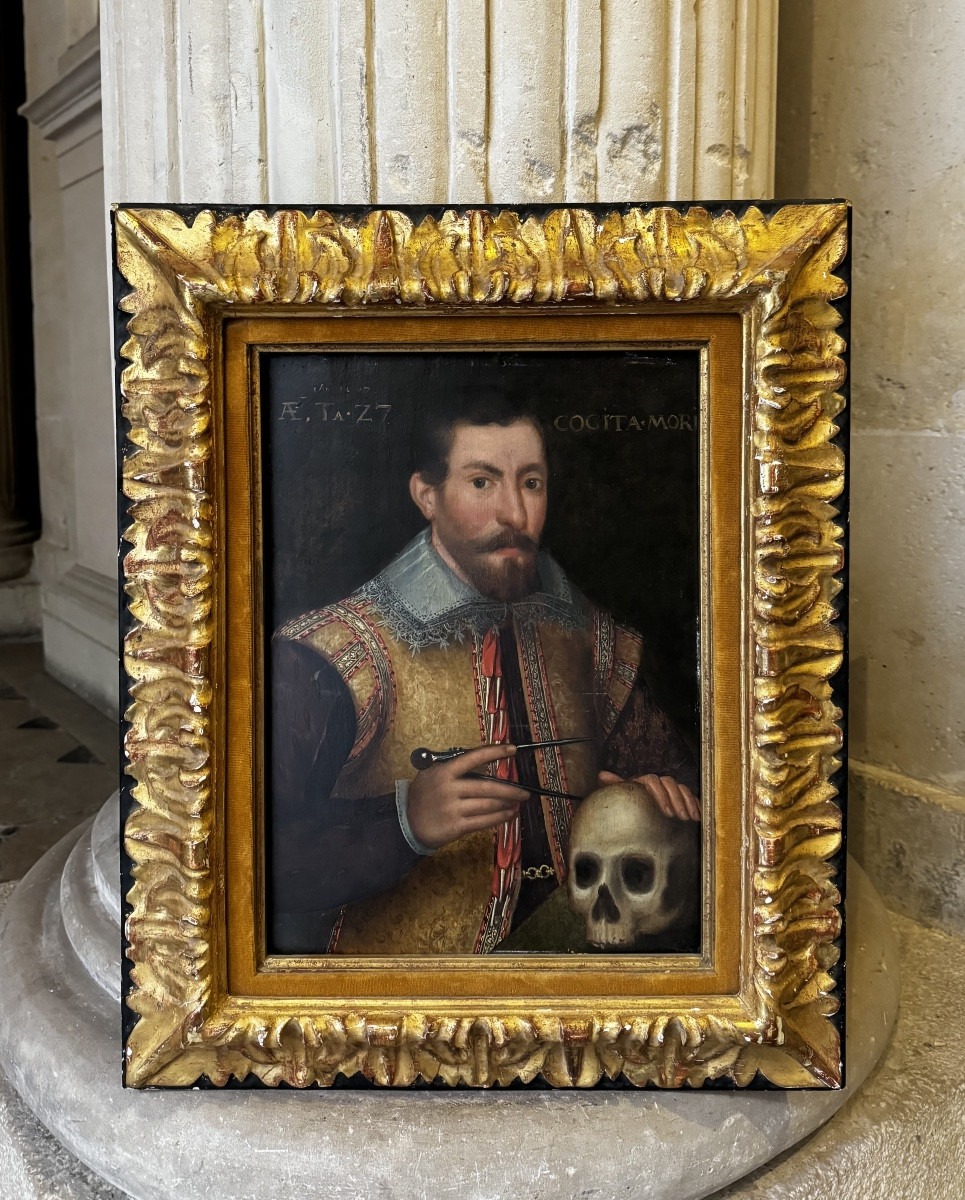


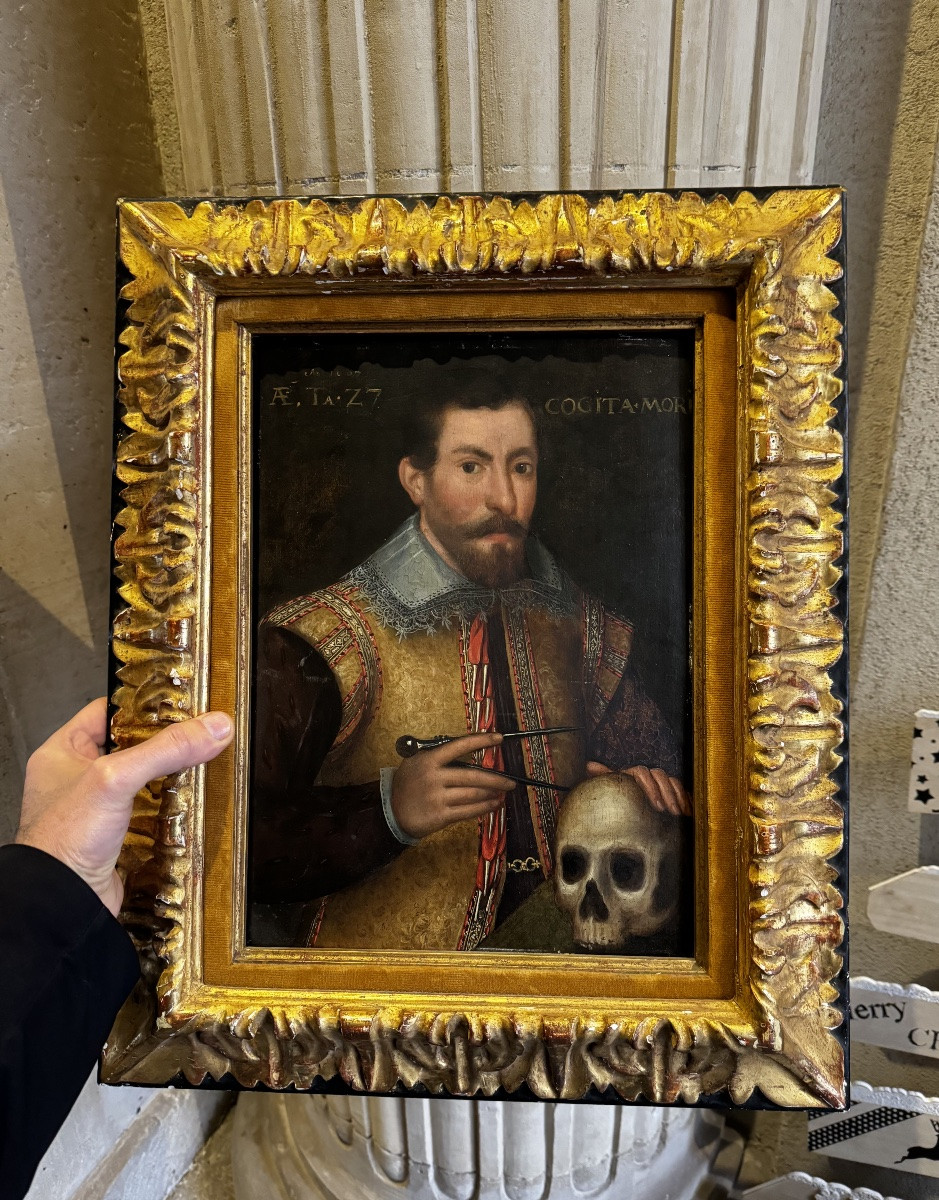


Portrait of a 27-Year-Old Man Holding a Skull and Compasses,
Accompanied by the Latin Motto “Cogita mori”
Oil on panel.
Later antique carved and gilded wooden frame.
Dimensions with frame: 51 x 60 cm., panel 40x27 cm
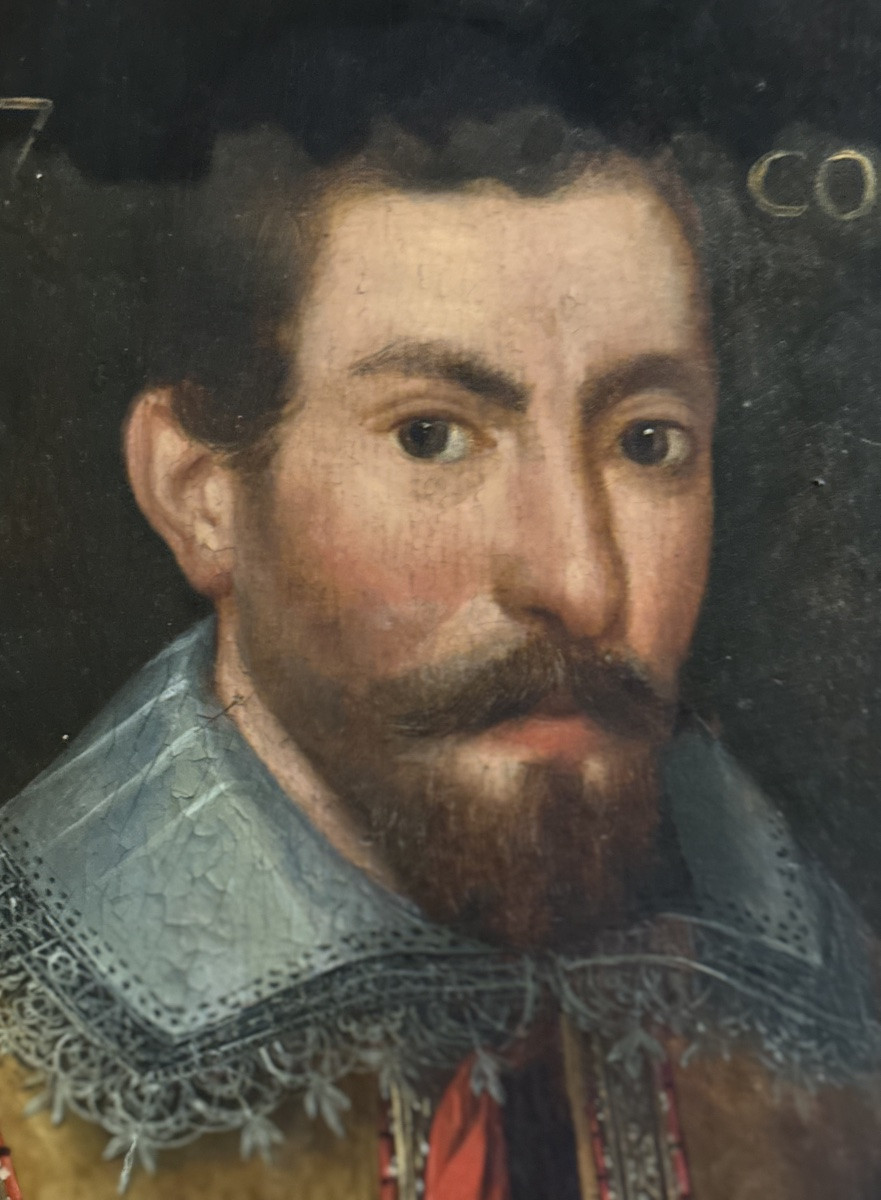
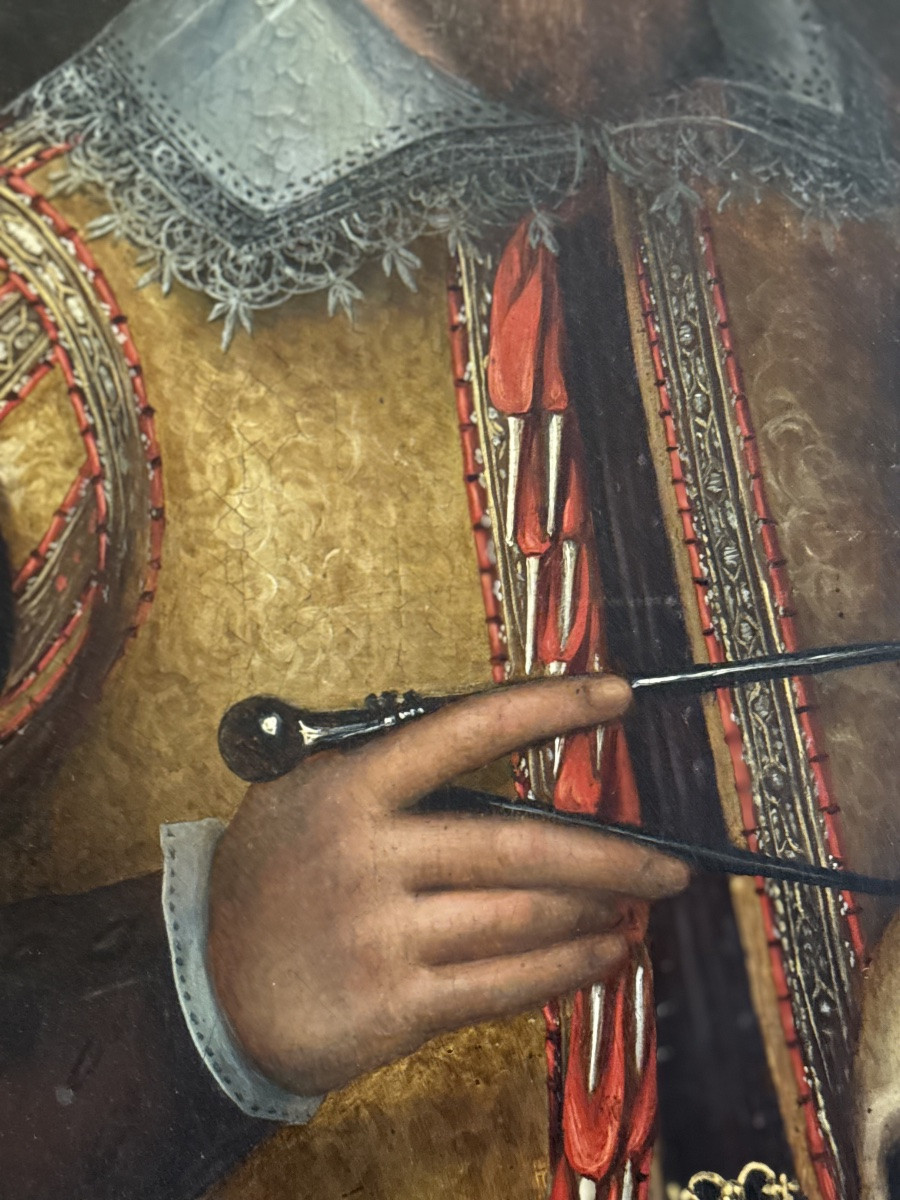
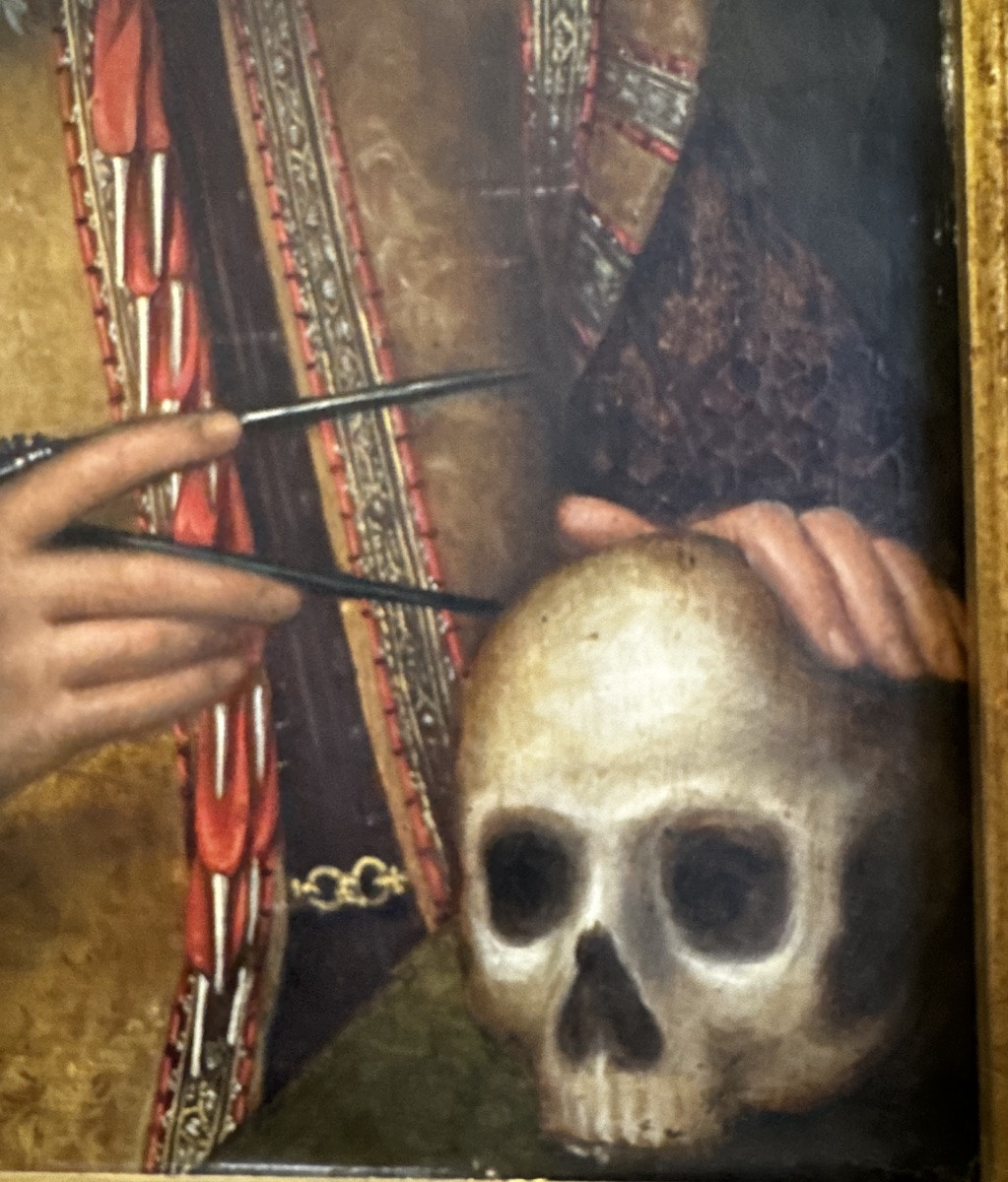
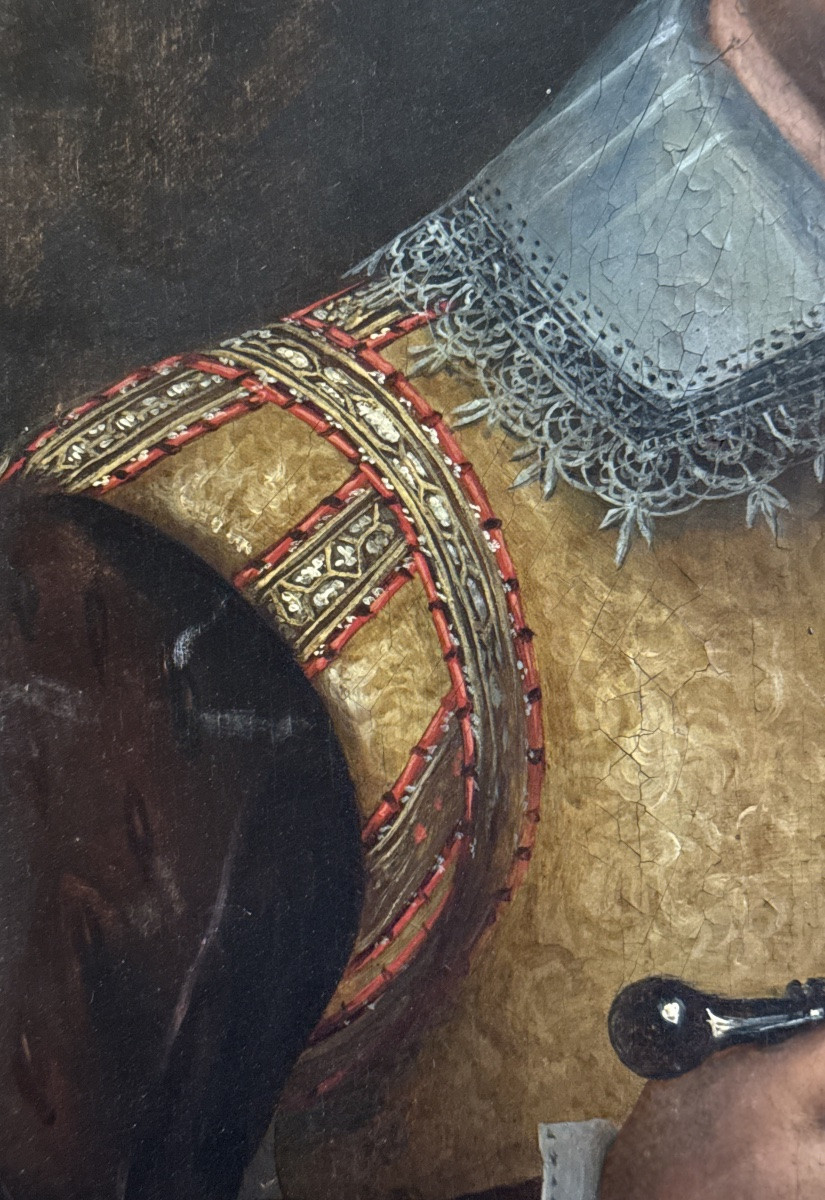
Dated 1607, this portrait depicts a bearded young man of 27, shown half-length against a dark background, wearing a rich doublet in warm tones enhanced with braid, and a finely scalloped white ruff. The sitter holds a skull and presents a compass in his right hand, an instrument of measurement and science, while the painted inscription “COGITA MORI”—literally “Think of death”—explains the profound meaning of the composition. The iconography takes on a particularly resonant resonance when the work is placed in its historical context. At the turn of the 16th and 17th centuries, Spain was still reeling from major epidemics, notably the plague of 1596–1602, which ravaged many regions of the peninsula and sometimes decimated up to a third of the population of certain cities. In 1607, the memory of these catastrophes was still fresh: death was not an abstraction, but a daily, brutal, and unpredictable presence.
In such a context, the life of a 27-year-old man was anything but secure; even youth was exposed to epidemics, fevers, famines, and the lack of effective healthcare. The motto Cogita mori was not simply a scholarly exercise or an intellectual stance; it was fully embedded in a classical culture of meditation on the brevity of life, nourished by both ancient and Christian texts, which were then widely circulated.
The philosophers' reflections on the brevity of life find direct visual expression here. The skull recalls the finitude of humankind, while the compass, a symbol of reason, science, and the mastery of the world through measurement, underscores that neither knowledge nor intelligence can protect against death.
The fact that this message is associated with a young man further reinforces the significance of this image. It is not a belated reminder of old age, but a lucid and precocious reflection, typical of the spirituality and moral humanism of Counter-Reformation Spain.
The sitter's grave gaze, the restraint of his demeanor, and the absence of any anecdotal background all contribute to this internalized gravity. Beyond a general interpretation of the Vanitas, one can legitimately question the personal reasons that led the sitter to have himself depicted in this way, at such a young age, and to have such a statement explicitly inscribed. In 1607, Spain was still deeply scarred by the great epidemics of the late 19th century, and death was a daily reality. However, the deliberate nature of this image suggests a conscious, thoughtful approach, perhaps intimately connected to the sitter's life itself. The presence of the compass, a symbol of science, measurement, and rational knowledge, invites us to see in this portrait that of an educated man, perhaps even a scholar. Several hypotheses can be considered, without being mutually exclusive. The sitter could belong to those professions that directly confront humanity with the fragility of life: a doctor or surgeon, professions closely linked to the observation of the body, illness, and death; a member of the clergy, familiar with funeral rites, confession, and meditation on salvation; or even a scholar, engineer, or architect, for whom science and reason, symbolized by the compass, do not preclude a profound awareness of human finitude.
Accompanied by the Latin Motto “Cogita mori”
Oil on panel.
Later antique carved and gilded wooden frame.
Dimensions with frame: 51 x 60 cm., panel 40x27 cm
Dated 1607, this portrait depicts a bearded young man of 27, shown half-length against a dark background, wearing a rich doublet in warm tones enhanced with braid, and a finely scalloped white ruff. The sitter holds a skull and presents a compass in his right hand, an instrument of measurement and science, while the painted inscription “COGITA MORI”—literally “Think of death”—explains the profound meaning of the composition. The iconography takes on a particularly resonant resonance when the work is placed in its historical context. At the turn of the 16th and 17th centuries, Spain was still reeling from major epidemics, notably the plague of 1596–1602, which ravaged many regions of the peninsula and sometimes decimated up to a third of the population of certain cities. In 1607, the memory of these catastrophes was still fresh: death was not an abstraction, but a daily, brutal, and unpredictable presence.
In such a context, the life of a 27-year-old man was anything but secure; even youth was exposed to epidemics, fevers, famines, and the lack of effective healthcare. The motto Cogita mori was not simply a scholarly exercise or an intellectual stance; it was fully embedded in a classical culture of meditation on the brevity of life, nourished by both ancient and Christian texts, which were then widely circulated.
The philosophers' reflections on the brevity of life find direct visual expression here. The skull recalls the finitude of humankind, while the compass, a symbol of reason, science, and the mastery of the world through measurement, underscores that neither knowledge nor intelligence can protect against death.
The fact that this message is associated with a young man further reinforces the significance of this image. It is not a belated reminder of old age, but a lucid and precocious reflection, typical of the spirituality and moral humanism of Counter-Reformation Spain.
The sitter's grave gaze, the restraint of his demeanor, and the absence of any anecdotal background all contribute to this internalized gravity. Beyond a general interpretation of the Vanitas, one can legitimately question the personal reasons that led the sitter to have himself depicted in this way, at such a young age, and to have such a statement explicitly inscribed. In 1607, Spain was still deeply scarred by the great epidemics of the late 19th century, and death was a daily reality. However, the deliberate nature of this image suggests a conscious, thoughtful approach, perhaps intimately connected to the sitter's life itself. The presence of the compass, a symbol of science, measurement, and rational knowledge, invites us to see in this portrait that of an educated man, perhaps even a scholar. Several hypotheses can be considered, without being mutually exclusive. The sitter could belong to those professions that directly confront humanity with the fragility of life: a doctor or surgeon, professions closely linked to the observation of the body, illness, and death; a member of the clergy, familiar with funeral rites, confession, and meditation on salvation; or even a scholar, engineer, or architect, for whom science and reason, symbolized by the compass, do not preclude a profound awareness of human finitude.
Explore similar pieces and discover your ideal find:
Portraits