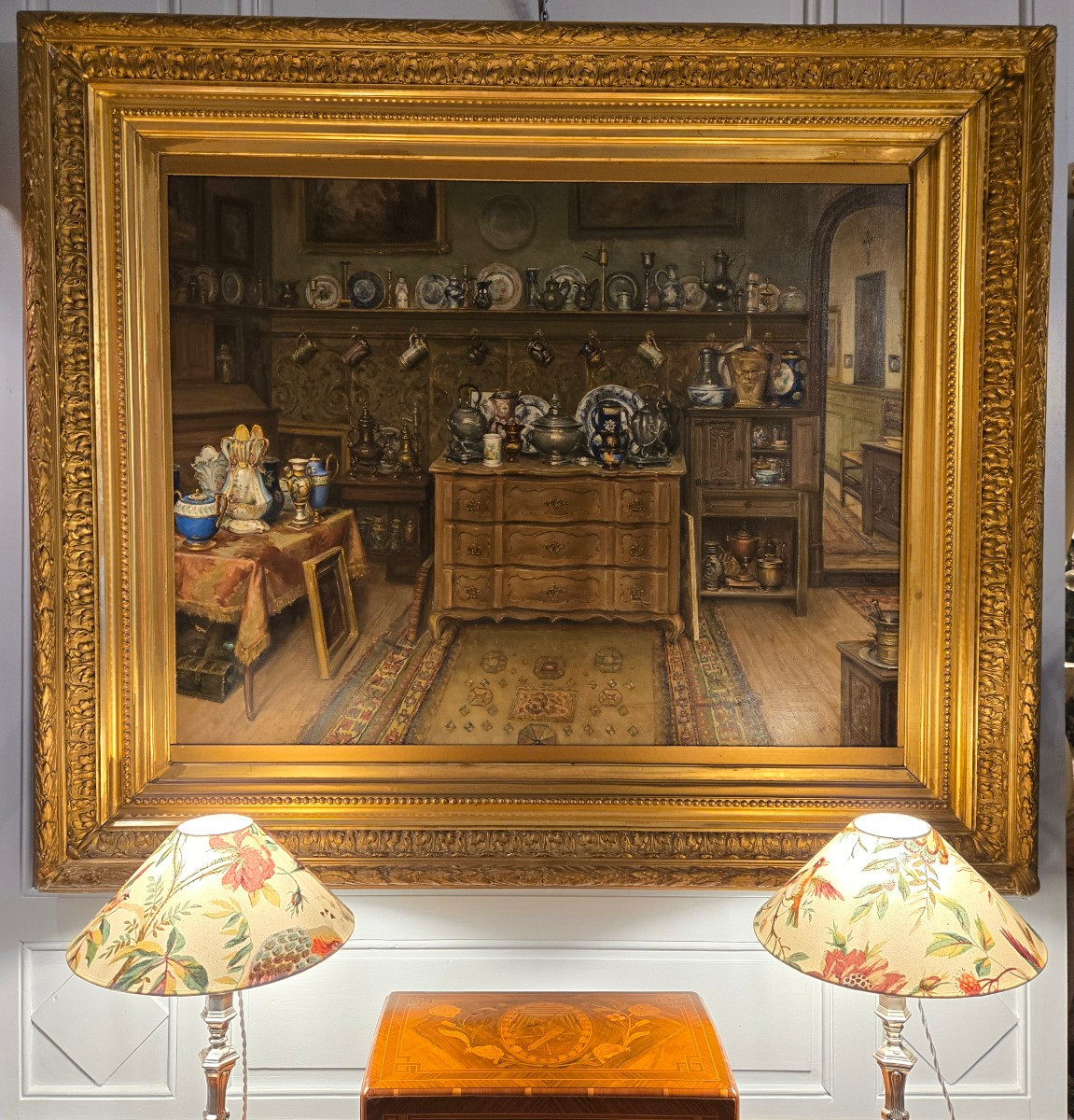
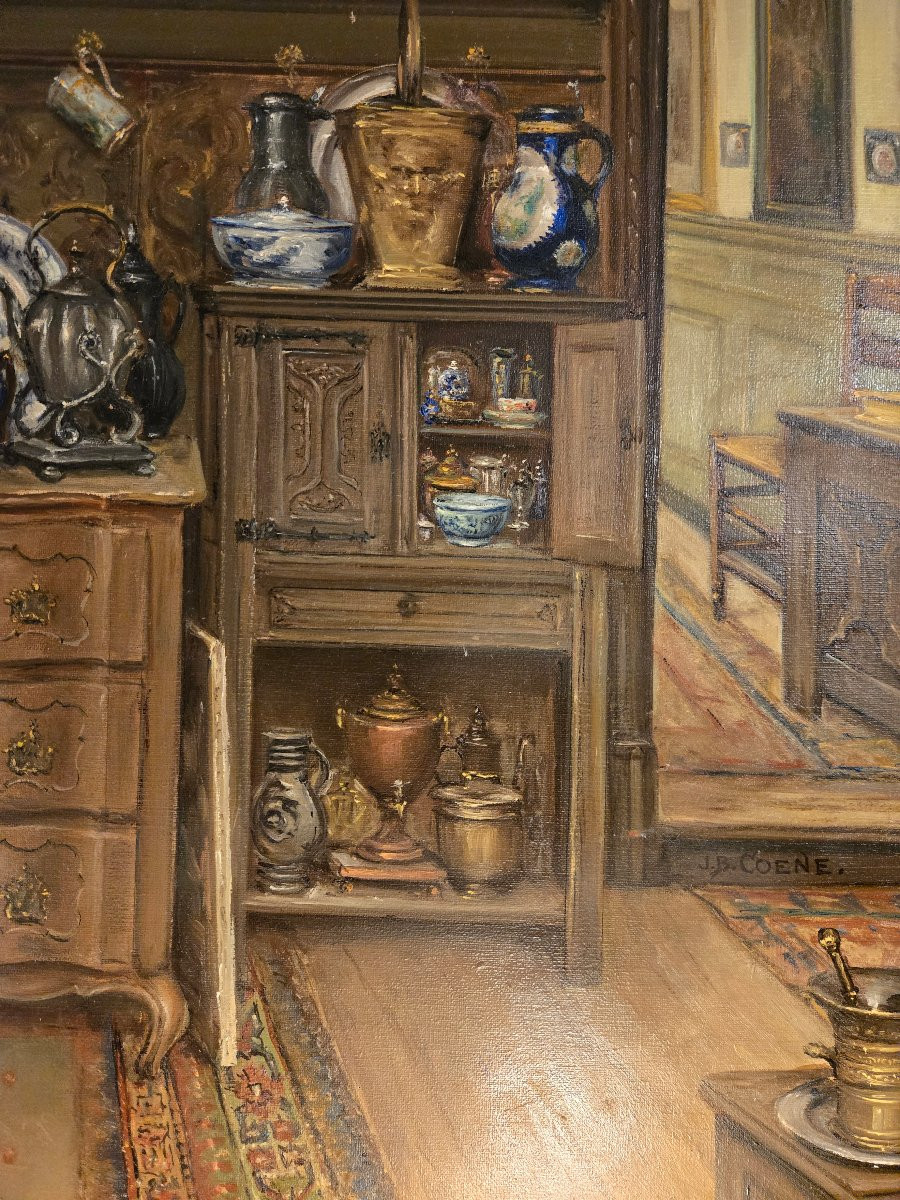
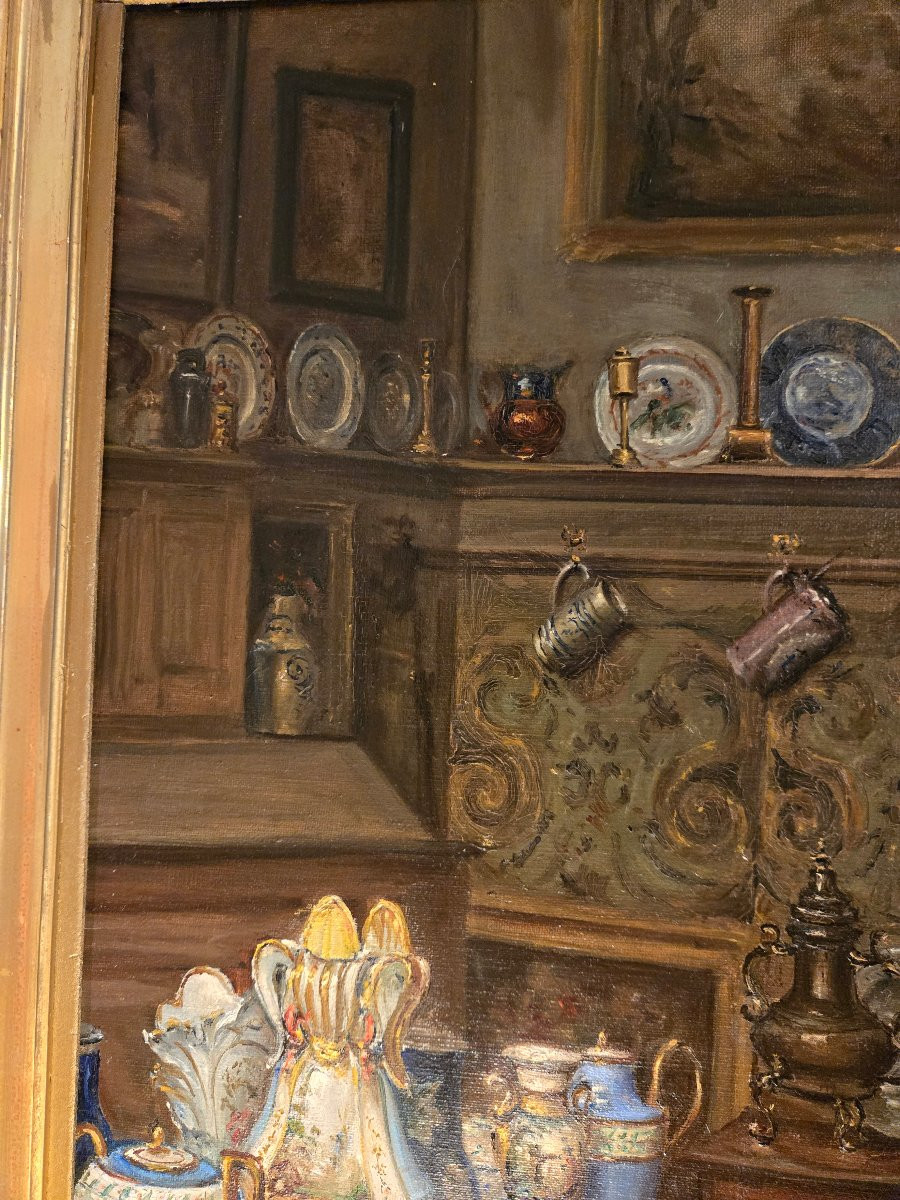
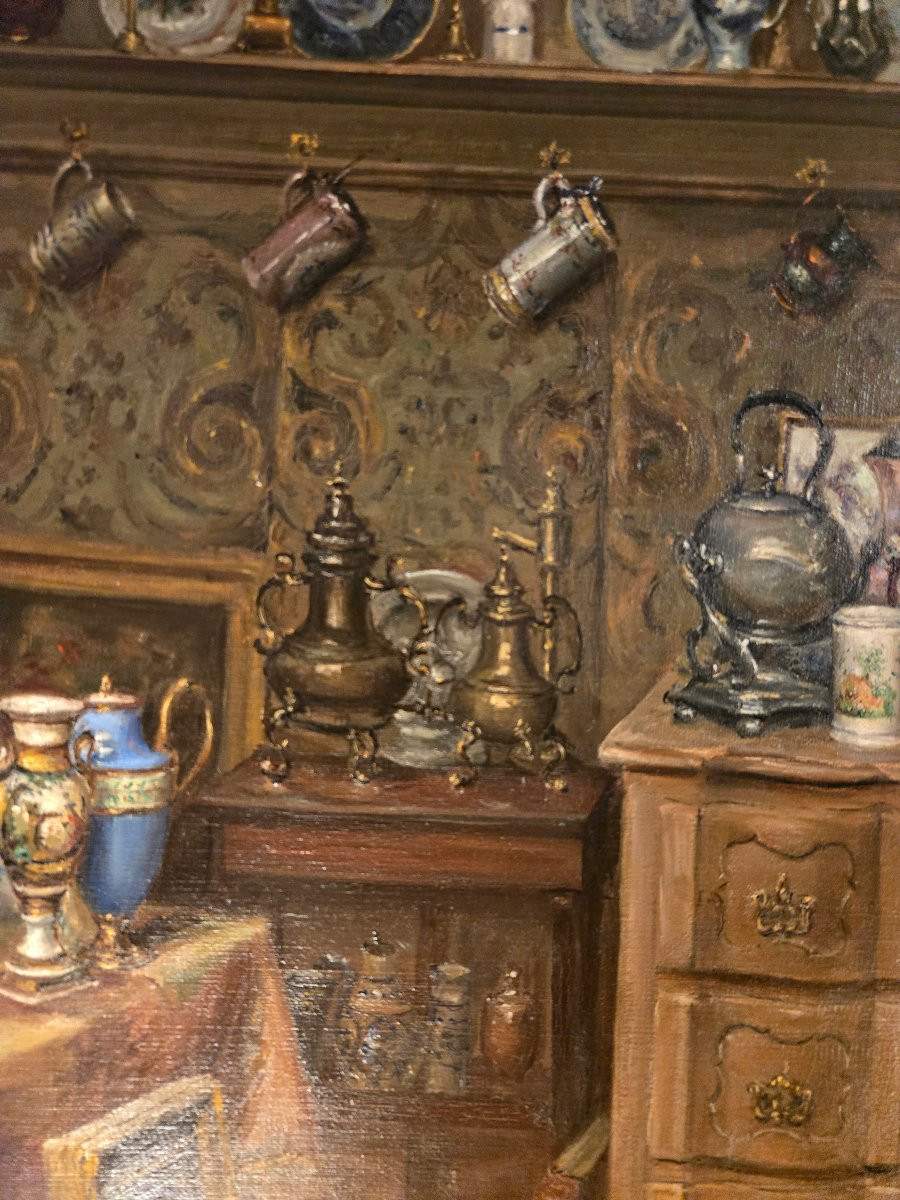
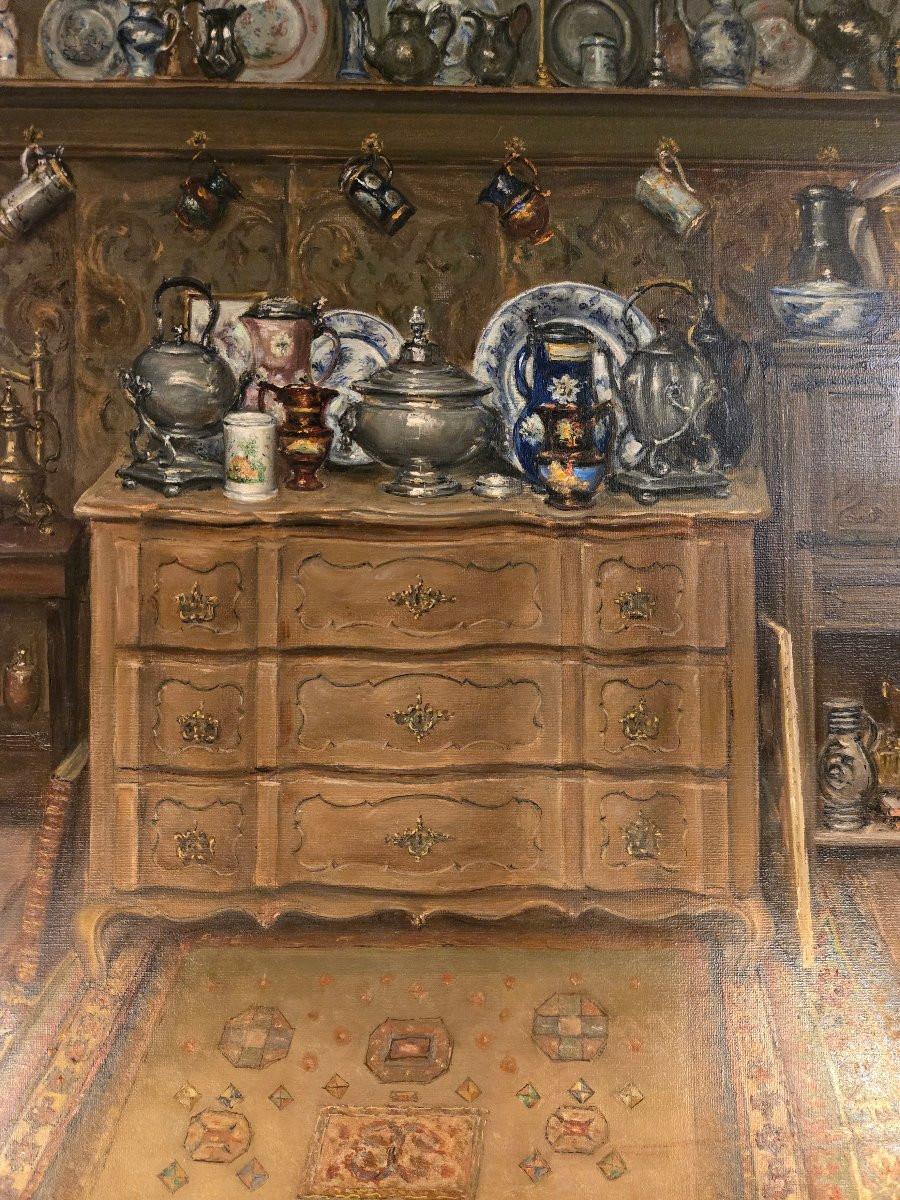
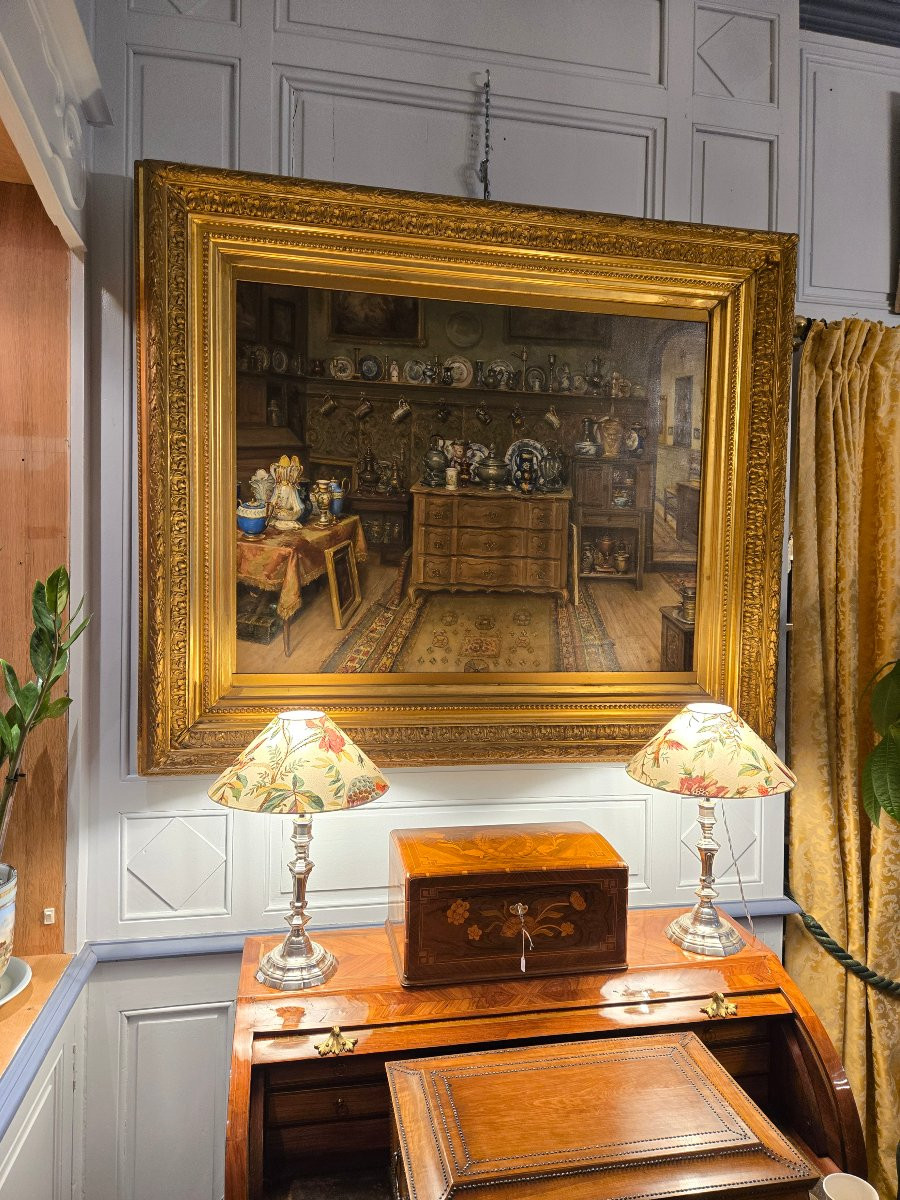
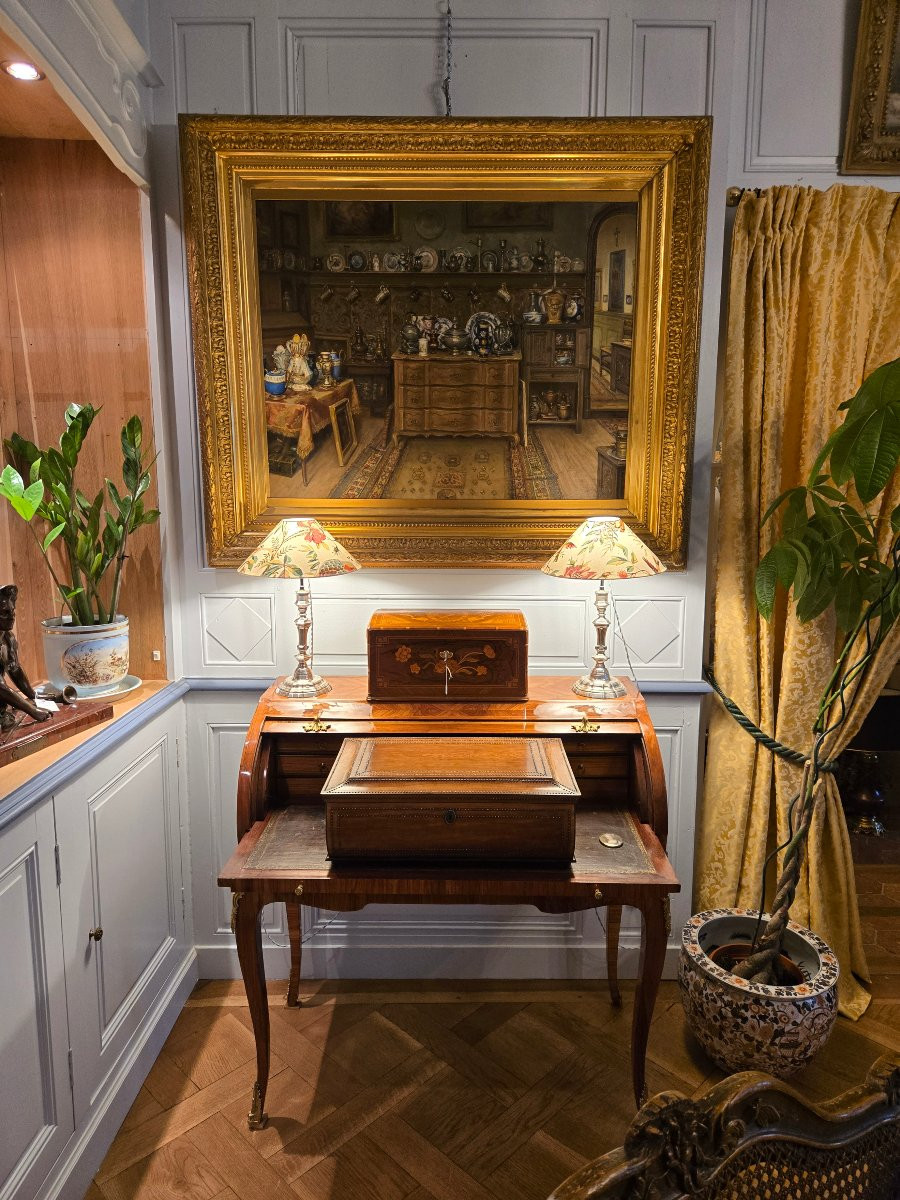
"Interior Of An Antique Shop, Jean-baptiste Coene (1805–1850). "
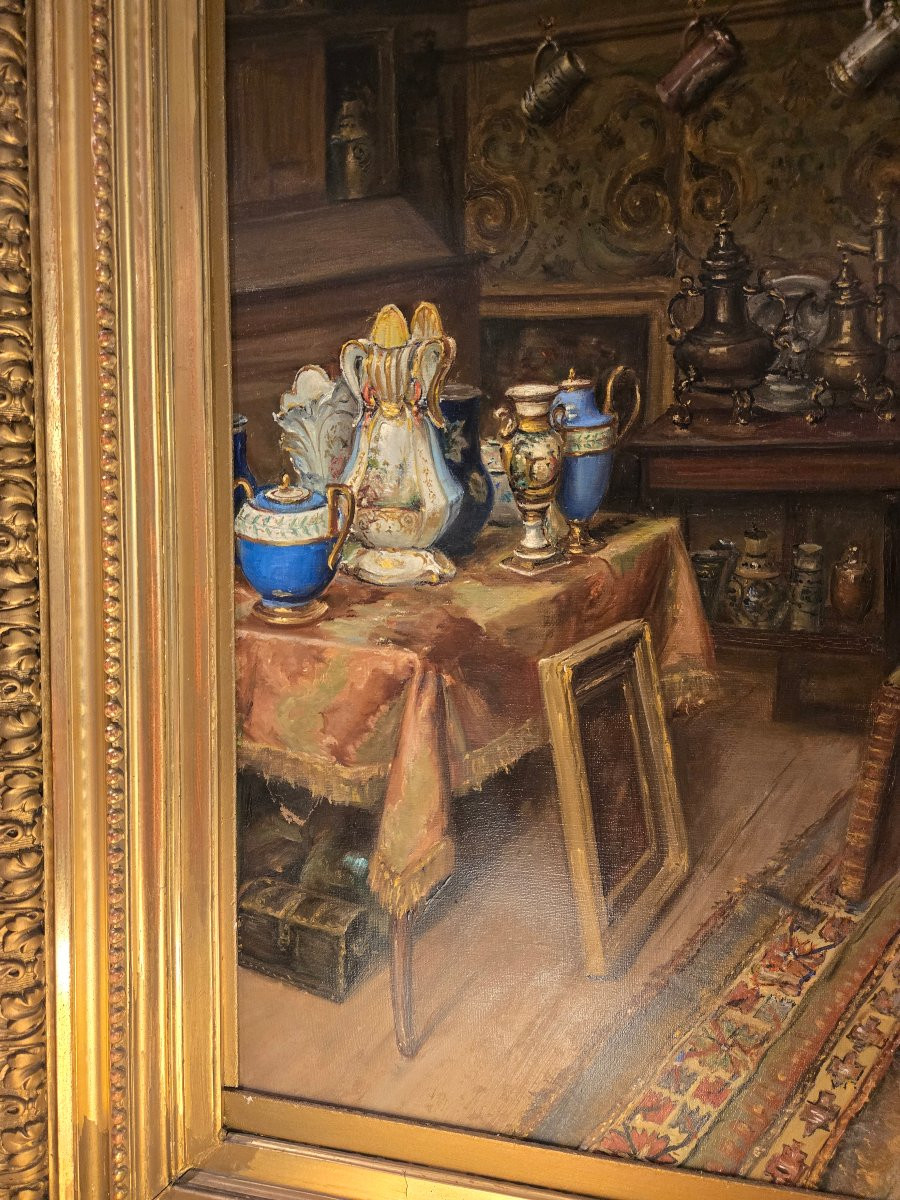
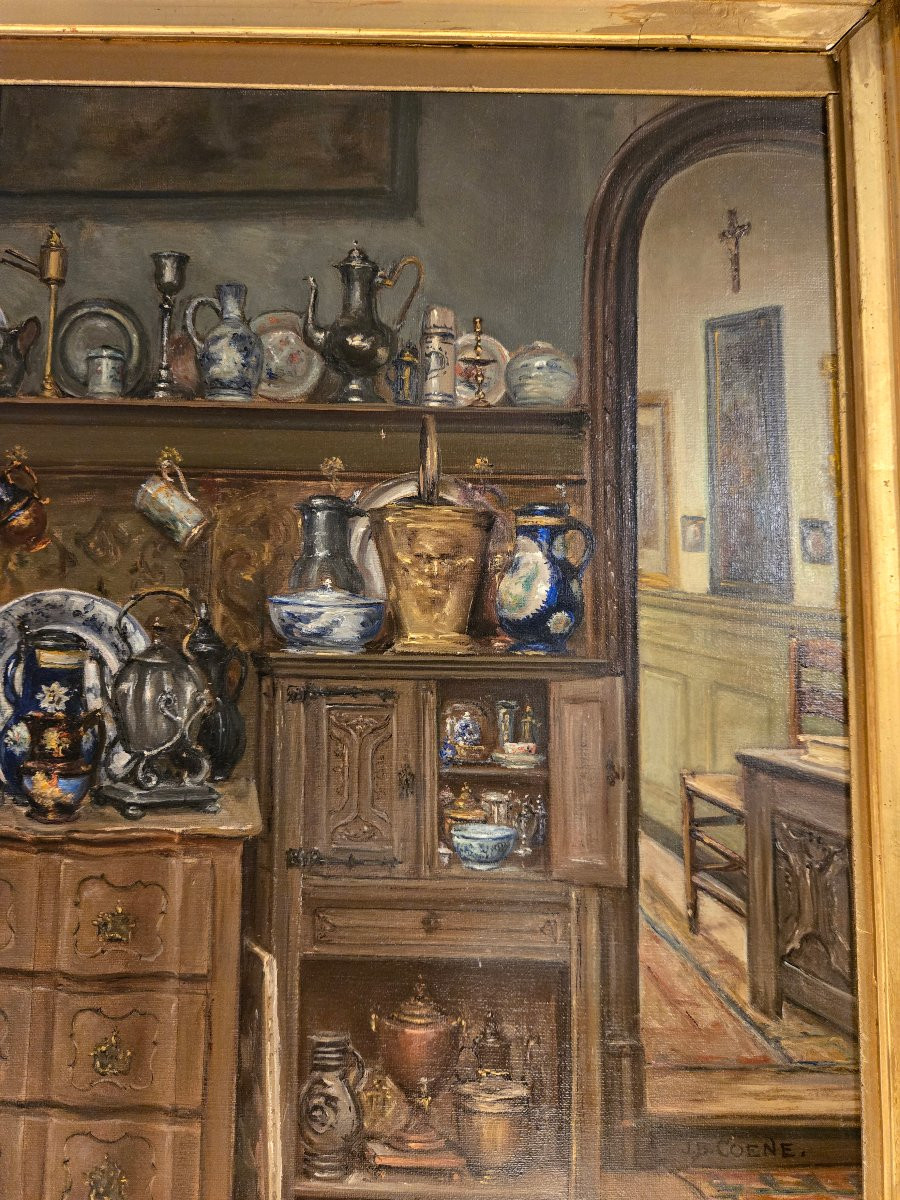
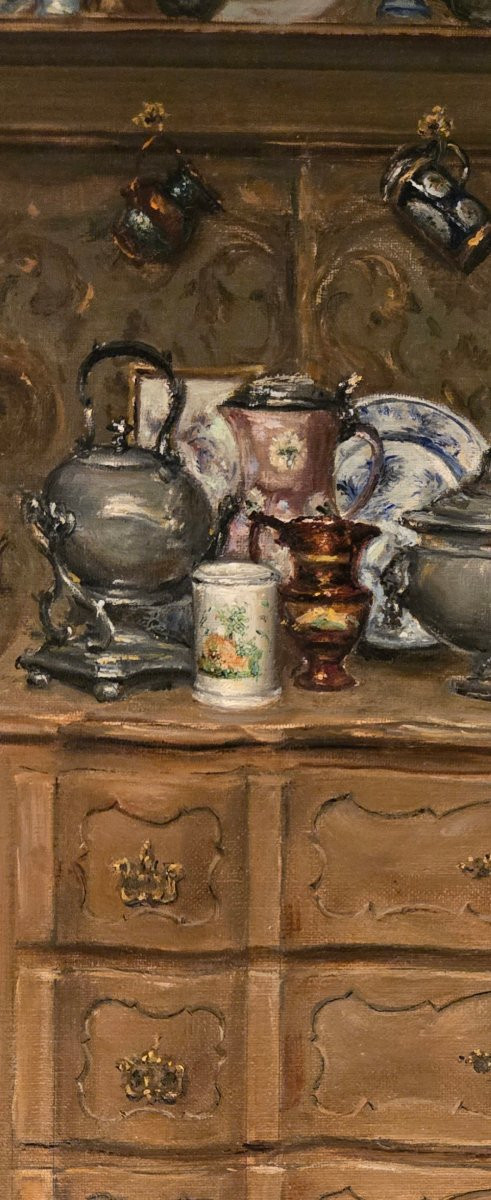
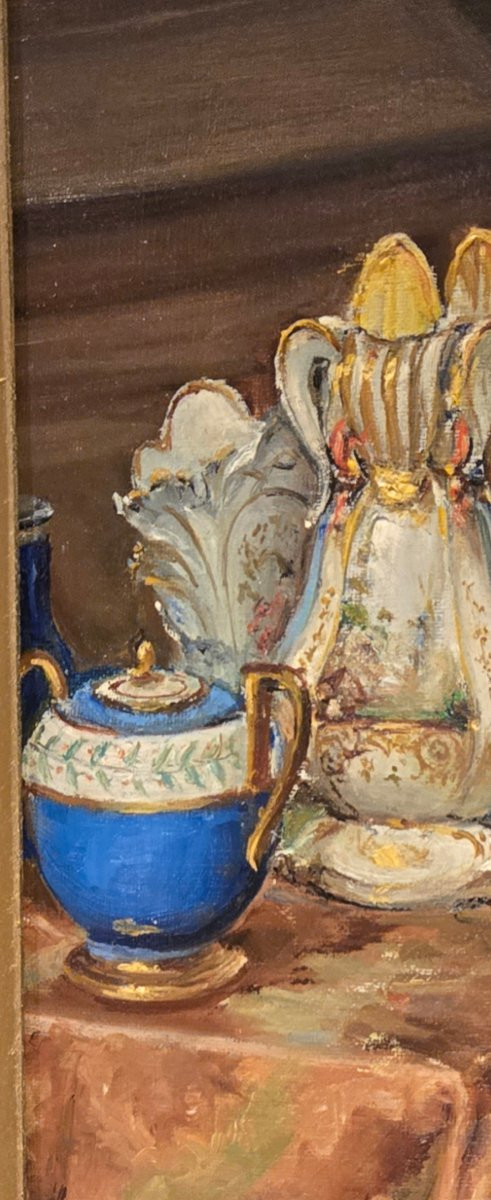
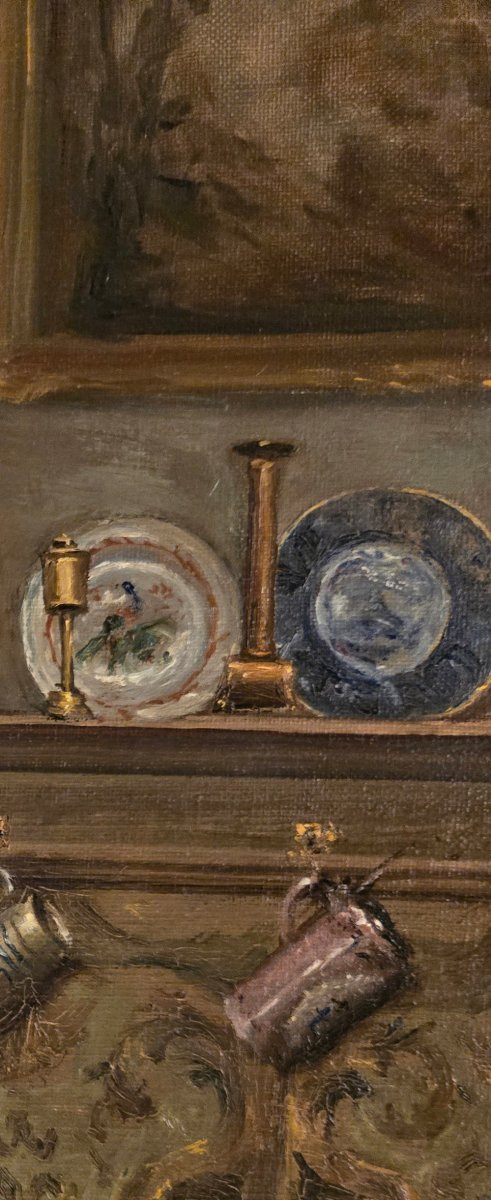
An important and interesting oil painting on canvas, depicting a richly furnished merchant's interior, straddling the line between a collector's cabinet and an antique shop, a theme Jean-Baptiste Coene explored repeatedly in his work, notably in well-known compositions such as The Carpet Merchant. The scene unfolds in a deliberately cluttered space, where the accumulation of objects becomes the true subject of the painting. The artist composes a veritable theater of things, in the grand Flemish and Belgian tradition of the 19th century. - Detailed analysis of the subject: In the foreground and on the furniture, numerous pieces of ceramic and earthenware are piled up: dishes, plates, cups, bowls, pitchers, and covered pots, rendered with great finesse in the glazes, deep blues, milky whites, and painted decorations. Some pieces appear to be arranged in groups, as if to be compared or presented to the eye of the connoisseur. Metal objects play a fundamental role in the composition: copper, tin, and possibly silver or silver-plated items are recognizable, their matte or shiny reflections structuring the light. Teapots, jugs, dishes, containers, and utensils are arranged not for everyday use, but for display. Several caskets, boxes, and small precious objects appear among the accumulation, reinforcing the idea of a shop or a store of antiques. These items, often placed in the background or on shelves, evoke the world of necessities, curiosities, and portable works of art. The furniture—chest of drawers, wall shelves, storage units—is not domestic decor, but a display surface. The closed drawers, the laden shelves, and the absence of any staging of daily life clearly preclude the idea of an inhabited interior. The walls, laden with objects and paintings hung close together, are reminiscent of the displays in 19th-century galleries or merchants' shops. The eye is invited to wander, compare, and linger on each detail. Finally, some objects are placed directly on the floor, a particularly revealing detail: far from being a mere decorative effect, it suggests a space for storage, transit, or temporary display, characteristic of the interior of a merchant, antique dealer, or curiosities dealer. - Artistic context: Jean-Baptiste Coene (1805–1850) was a Belgian painter from a family of artists. Son of the genre and history painter Constantin Coene (1779–1841), a professor at the Royal Academy of Fine Arts in Antwerp, and younger brother of the painter Jean Coene, he received a solid academic training, evident in the precision of his drawing and his mastery of materials. While primarily known for his exquisitely executed romantic landscapes, he also developed a remarkable body of work depicting interior scenes, particularly the homes of shopkeepers, workshops, and trading places. He exhibited several times at the Brussels Salon in the 1840s, attesting to his recognition in mid-19th-century Belgium. -Pictorial qualities: This work is distinguished by: -a warm and subtle palette, -great finesse of execution, especially in the rendering of enamels, metals, and wood, -a dense yet perfectly controlled composition, -a quiet and erudite atmosphere, characteristic of the Belgian Romantic school. Both decorative and intellectual, this painting is a masterful evocation of the world of antique objects, the taste for collecting, and the material culture of the 19th century. -Dimensions: Image size: 97.5 × 85.5 cm Framed: 130 × 110 cm -Condition: Very good overall condition. Canvas well stretched on its original stretcher. 19th century period frame in wood and gilt stucco, richly molded, with a beautiful patina. 






 Le Magazine de PROANTIC
 TRÉSORS Magazine
 Rivista Artiquariato