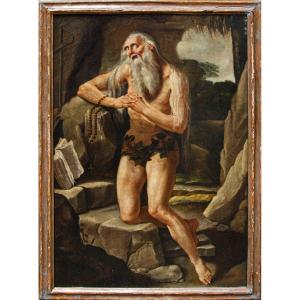


"Central Italian School, 17th Century, Saint Onofrio Penitent"
Central Italian School, 17th centurySaint Onofrio Penitent
Oil on canvas, 110 x 75 cm
With frame, 120 x 83 cm
The accompanying painting, depicting Saint Onuphrius Penitent, is an excellent example of Italian Baroque painting, stylistically approaching the styles of central Italy, most likely seventeenth-century Neapolitan Italy, strongly influenced by Caravaggism and the later art of Jusepe de Ribera. The subject, Saint Onuphrius the Hermit, is presented in a rocky and desolate setting, typical of paintings that exalt the theme of penance and the ascetic life. Onofrio, an Egyptian hermit who lived in the 4th century, is portrayed here according to his traditional iconography: an old man with a long beard and white hair, almost completely naked (covered only by a loincloth of leaves), on his knees, his hands clasped in prayer or in a gesture of deep imploration turned upwards. The work is characterised by strong realism and intense chiaroscuro, elements that distinguish it within the context of Baroque art of Caravaggio origin. The light, far from being diffused, is dramatically concentrated on the skeletal body of the saint, highlighting his musculature, prominent veins and rough skin, as silent witnesses to his life of deprivation. This almost brutal rendering of physical truth, exalted by the artistic current of Tenebrism, constituted a powerful tool for arousing the piety and emotional participation of the spectator in spiritual drama. From a compositional point of view, attention is expertly focused on the saint. Next to him, on a rock step, one can recognize some iconographic attributes that enrich his spiritual meaning, such as an open book, symbol of the Holy Scriptures or meditation, and a cross and a crown of the Rosary visible on the boulder near the saint's elbow, indicating his profound spirituality and dedication. The surrounding landscape, barely hinted at in the upper right with a rough sky, is not distracting but rather serves as a mere stage to enhance Onofrio's solitude and inner drama. Finally, the saint's expression, with wide eyes and a slightly open mouth, forcefully conveys a sense of mystical ecstasy that merges with the profound toil and suffering of his hermitic existence. The stylistic aspects of the work orient towards the artistic trends of central Italy. These painters favored the choice of a subject with a strong emotional and veristic impact (often figures of holy hermits or elderly philosophers), rendered through a robust brushstroke and the prevalent use of earthy and dark colors (brown, ochre, dark gray) that build the rocky background. That approach emphasized aged, suffering flesh as a tangible symbol of the human condition and ascetic mortification. Jusepe de Ribera himself created a Sant'Onofrio (c. 1625, preserved in Palazzo Barberini, Rome), which presents a similar attention to the rendering of meat and the drama of expression.










 Le Magazine de PROANTIC
 TRÉSORS Magazine
 Rivista Artiquariato