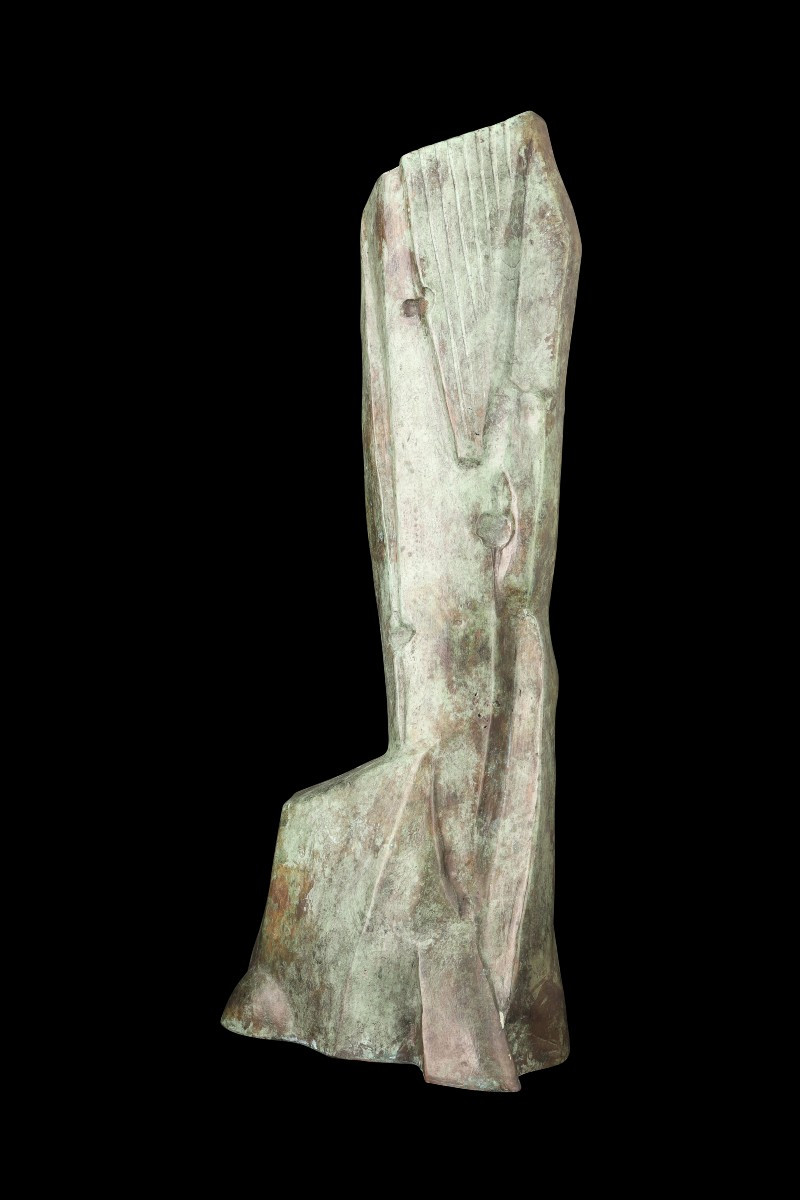
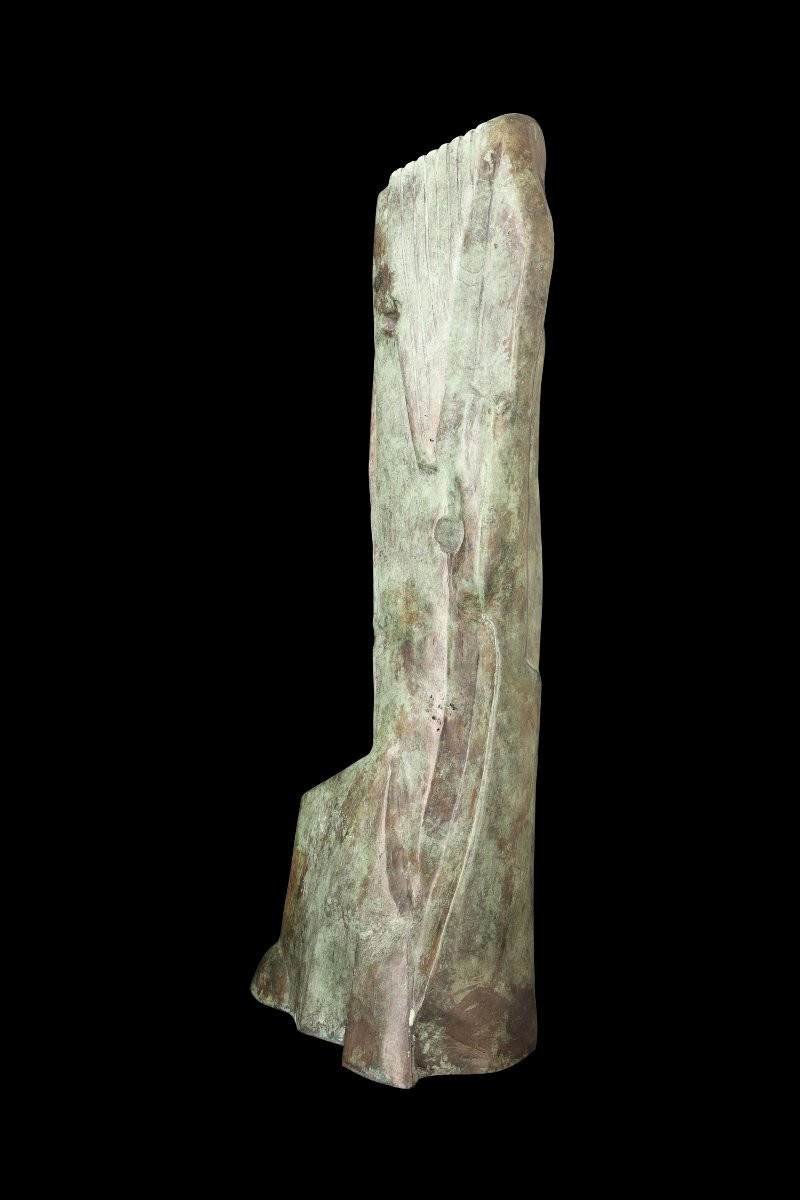

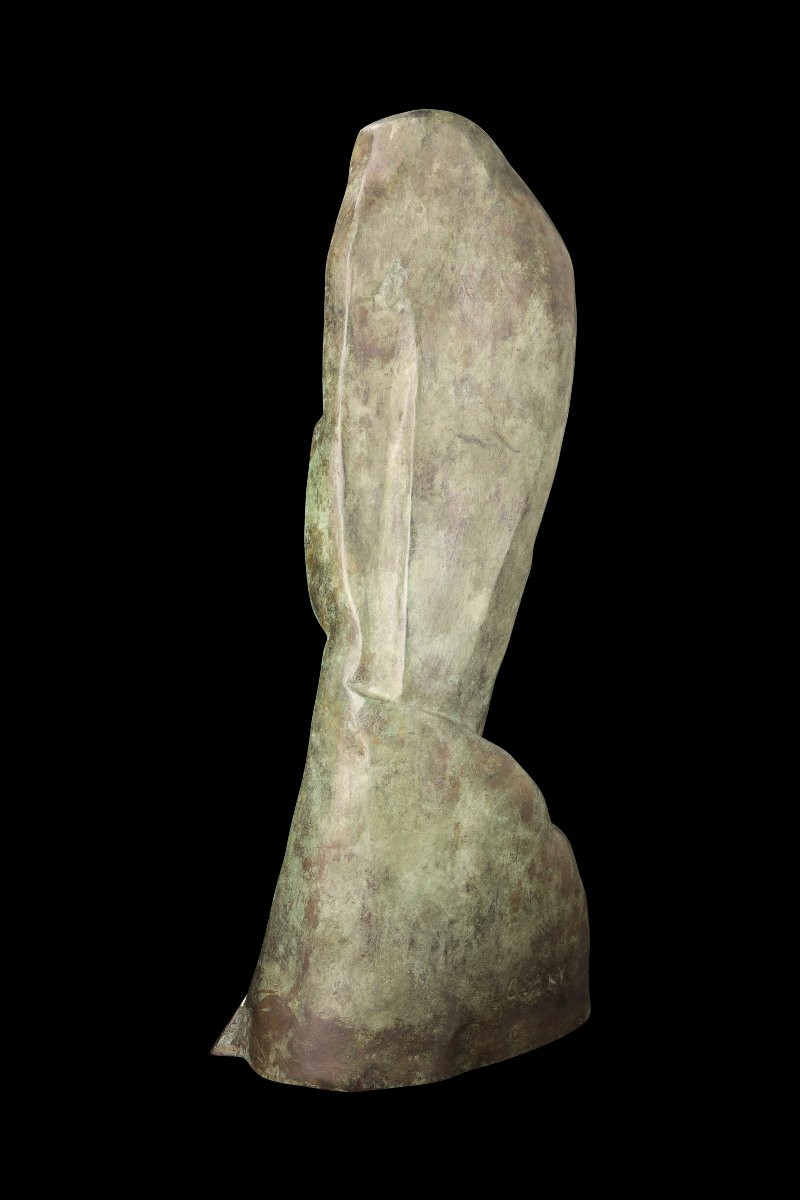

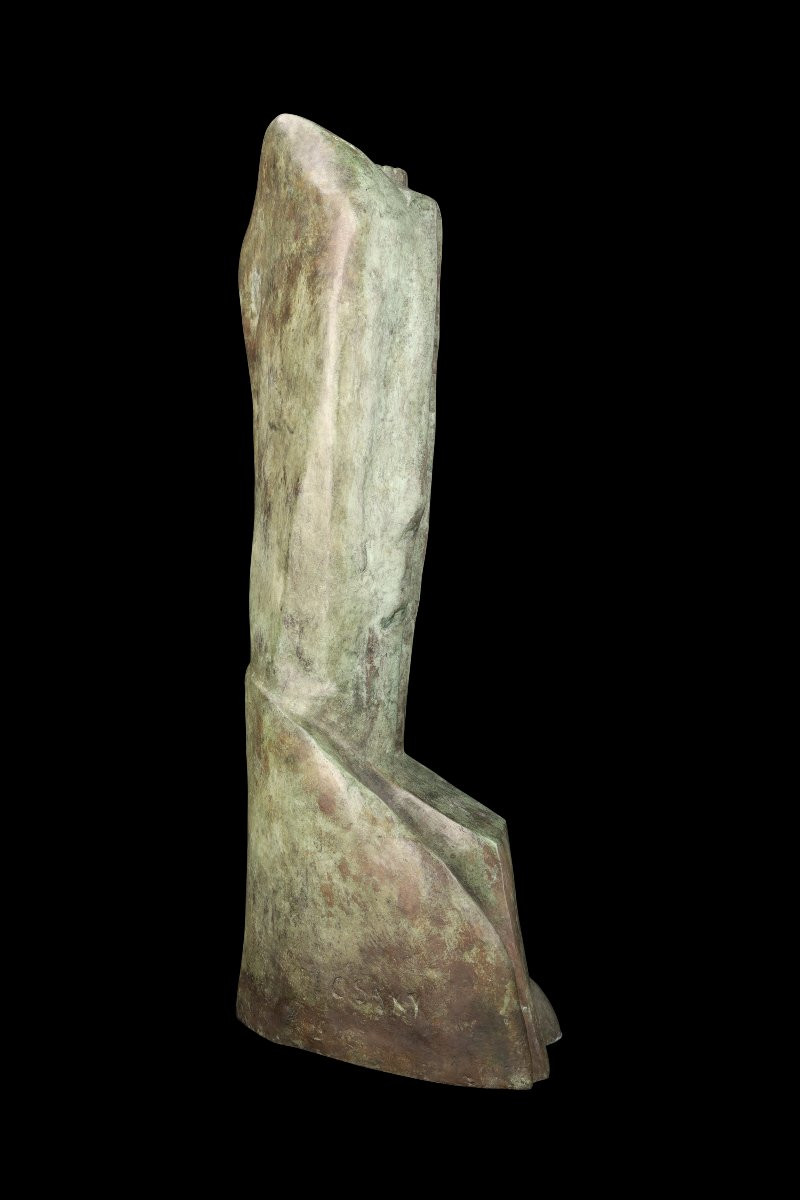
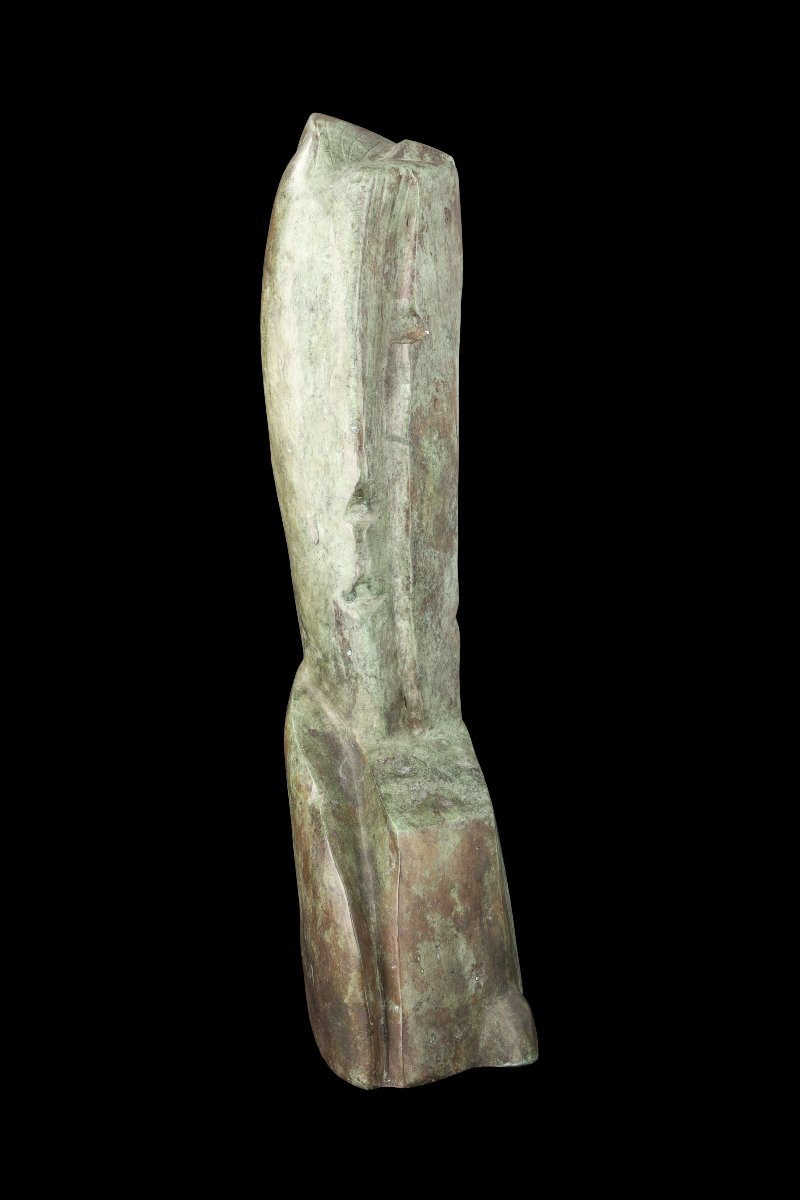
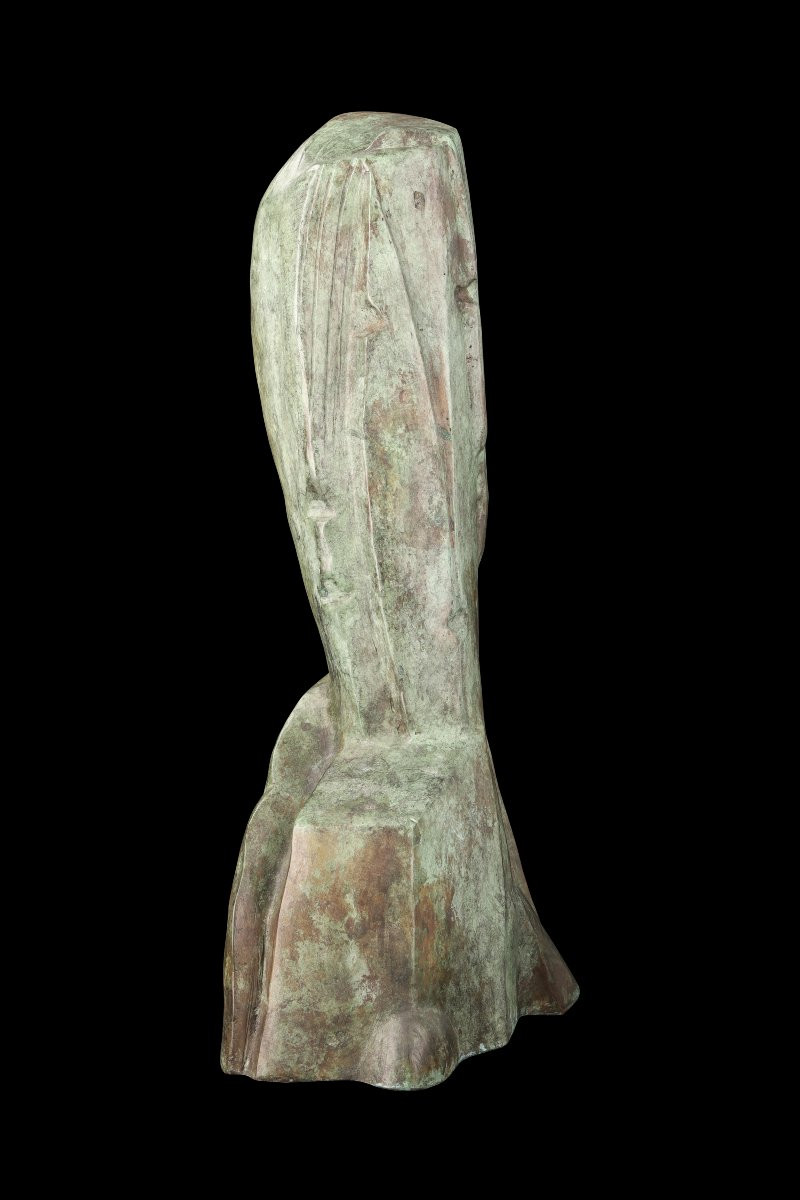
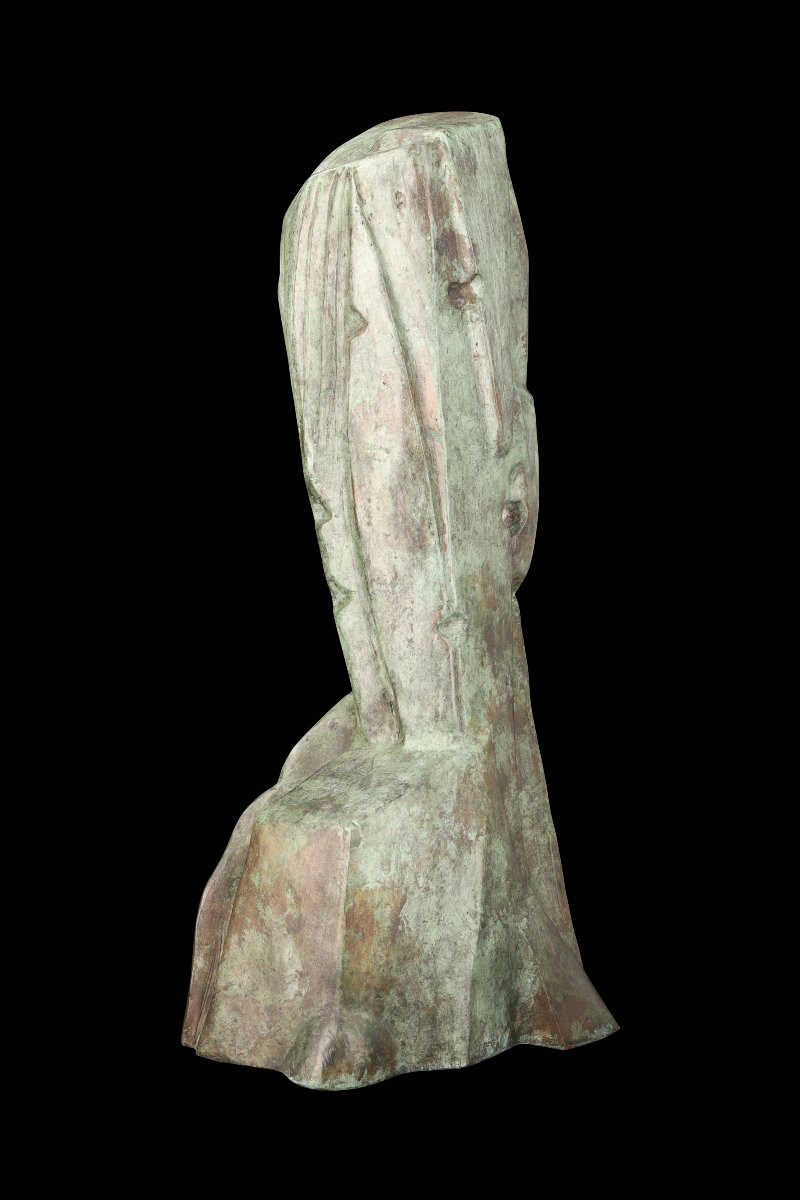
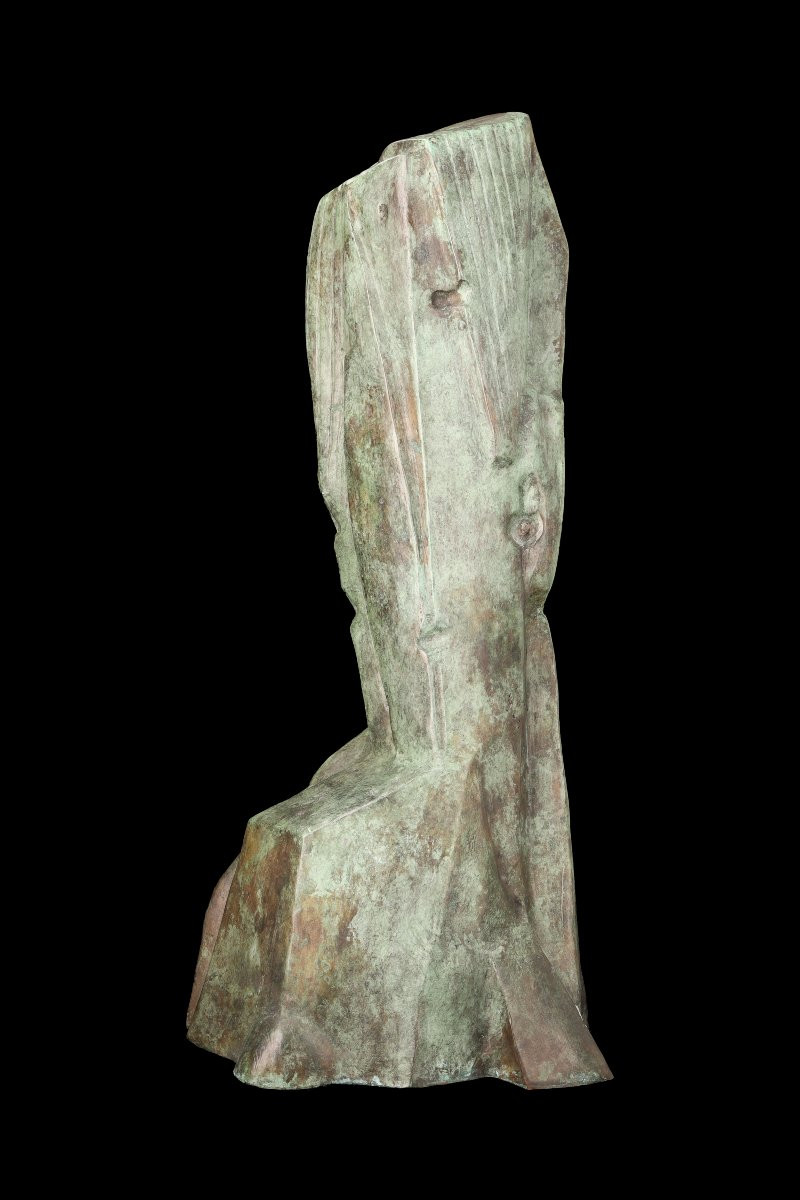

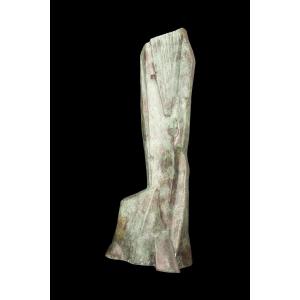


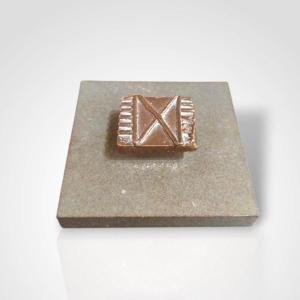
The presented sculpture is a remarkable work due to its monumental simplicity and the way it handles form. It represents a heavily stylized human head or figure.
Material and Patina:The material is bronze, evidenced by the verdigris patina (copper oxidation), which gives it an antique, mineral, and noble appearance, accentuating its volume and edges.
Form and Geometry:The figure is reduced to primary geometric forms: sharp planes, clean edges, and faceted surfaces. The head is elongated, almost totemic, standing vertically like a monolith.
Abstraction and Representation:Although heavily abstracted, subtle clues of the human figure are discernible:
The vertical lines and parallel planes evoke strands of hair or stylized drapery.
Small incised or raised forms may suggest eyes, a nose, or a mouth, but without naturalist detail.
Expression and Movement:The sculpture possesses a static power. It does not convey physical movement, but rather an internal tension due to the juxtaposition of flat and inclined surfaces. It is of an elegant severity and great architectural strength.
The work is fully part of the Cubist movement, and more specifically the phase of Salon Cubism or Sculptural Cubism of the 1910s and 1920s.
2.1.1. Applied Cubist Principles:Fragmentation and Faceting:Csaky breaks down the head into multiple geometric planes and facets, a key Cubist technique that allows the subject to be represented from several angles simultaneously.
Simultaneity and Volume:In sculpture, this translates into highlighting volumes through angle and edge, instead of descriptive curves. The mass is worked from the inside out, like architecture.
Rejection of Traditional Representation:The artist moves away from naturalistic modeling to favor the structure and geometric essence of the subject.
"Cubist Head" (original from 1930, followed by later editions) is one of the emblematic works that established Joseph Csaky as a pioneer of three-dimensional Cubism in Paris.
Autonomous Sculpture:Csaky, along with other artists like Archipenko and Lipchitz, was one of the first to rigorously apply Cubist principles to sculpture, creating an entirely new plastic form, distinct from painting.
Transition to Pure Form:This work clearly shows the transition from Analytical Cubism (extreme fragmentation) towards a more Synthetic and Monumental Cubism (simplified and assembled forms).The verticality and monolithic character even herald the evolution towards Purism and Art Deco (1920s), of which Csaky is also a notable representative.
Joseph Csaky (József Csáky) was a Hungarian sculptor naturalized French, a major figure of the École de Paris and a pioneer of modern sculpture.
Period 1: Youth and Training (1888-1908)
Key Facts and Contribution: Born in Szeged, Hungary. He received initial training in sculpture but was largely self-taught after arriving in Paris.
Period 2: Arrival in Paris (1908)
Key Facts and Contribution: Settled in Paris, working in ceramic and restoration workshops. He discovered avant-garde art. He frequented La Ruche and the Montparnasse district, associating with other émigré artists like Modigliani, Soutine, and Archipenko.
Period 3: Pioneer of Cubism (1911-1914)
Key Facts and Contribution: He was one of the first sculptors to adopt Cubist principles. His works from this period, such as Tête Cubiste, were exhibited at the Salon des Indépendants and the Salon d'Automne, both shocking and fascinating the public. He is often associated with the Puteaux group and the concept of the Section d'Or.
Period 4: Post-War (1918-1930)
Key Facts and Contribution: His style evolved towards greater simplification and smoother forms, aligning with the Purist movement and Art Deco aesthetics. He received important commissions for decorative works and monuments.
Period 5: End of Career (1930-1971)
Key Facts and Contribution: He continued to sculpt, exploring both figurative and abstract themes, while maintaining his preference for powerful and architectural volumes. He was made Chevalier de la Légion d'honneur in 1957. He died in Paris in 1971.










 Le Magazine de PROANTIC
 TRÉSORS Magazine
 Rivista Artiquariato