Clara Porges (1879-1963) German And Swiss "silsersee" Watercolor, Signed Lower Right, 56x77 Cm
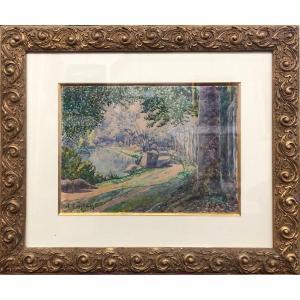
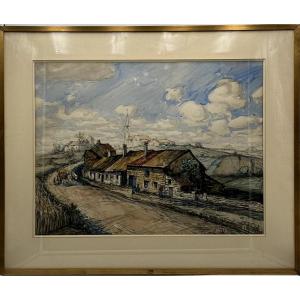
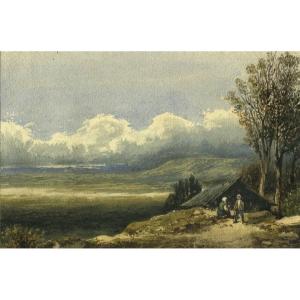
Clara Porges (1879-1963) German and Swiss "Silsersee" Watercolor, signed lower right, 56 x 77 cm. LARGE FORMAT
Clara Porges came from a noble family in Berlin. From 1896, she attended the municipal art school under Max Liebermann and two years later, the Akademie Fehr in Berlin. In 1905, she married the Austrian violinist Friedrich Walter Porges in Vienna. Through their reading of Nietzsche's *So Zarathustra Speaks to the Engadine*, the artist couple began making regular visits to the Upper Engadine in 1911 and settled in Sils Maria in 1918. In 1912, Clara Porges was represented in her first exhibition (Glaspalast, Munich), followed by further participation in group exhibitions (1922 Kunsthaus Zürich and Kunstmuseum St. Gallen, 1928 Kunsthalle Bern). After her husband's death in 1932, Clara Porges led a nomadic life between Bergell, the Engadine, Ticino, and Italy, where she received a scholarship to the German artists' foundation Villa Romana in Florence. Little is known about her later years; even the place of her death cannot be definitively established. In 1985, at the exhibition "Das Oberengadin in der Malerei" in St. Moritz, Clara Porges's work was exhibited again for the first time after her death. The fifty-year artistic output of Clara Porges is characterized by her exploration of nature and natural lighting conditions. Again and again, she painted the same landscapes—especially the lakes and mountains of the Upper Engadine—in vivid and expressive colors. She was influenced by various artistic movements of her time and applied techniques shaped by Impressionism, Pointillism, and Colorism. Particularly in her earlier works, created in the 1910s and 1920s in the Fextal valley, on Lake Silsersee, and also on Piz Lagrev and Piz Julier, she consistently drew heavily on models such as Ferdinand Hodler, Giovanni Segantini, and Giovanni Giacometti. In Lake Sils towards Maloja (unregistered), she employs a horizontal composition reminiscent of Hodler's parallelism, emphasizing the smooth water's surface in which the mountains and forests are reflected. For the interplay of light and shadow, the artist uses complementary, warm shades of blue and orange, outlining the contours of the mountain landscape with beautiful, precise brushstrokes. Other groups of works include Lake Cavloccio near Maloja, a view of the village of Soglio (Bergell) with the Sciora group in the background, and Italian seascapes with heavily branched trees in the foreground, reminiscent of Japanese color woodblock prints. In addition to the landscapes that dominate her body of work, Clara Porges also created floral compositions, as well as classical portraits and portraits of allegorical figures. Until the end, she remained faithful to figurative representation: in the watercolor setting of Soglio with the Sciora Group, which was probably created around 1948, the meadows and mountains almost dissolve into areas of yellow-orange and blue-green. With the naturalistic trees at the center of the image, however, the artist adds a figurative element to the almost abstract composition in order to anchor it in reality. Clara Porges was forced to live off the sale of her paintings due to her precarious financial situation after the death of her husband. This led to incessant painting activity, in which a total of about 400 images—mostly watercolors from the 1930s, since they were cheaper than oil paintings—were created with repetitive motifs, through which her style did not develop much further. Works in institutional collections (selection): Chur, Fundaziun Capauliana; Pontresina, Hotel Walther; Promontogno, Bregalia Health Center; Roggwil, Bromer Art Collection; Sils iE, Hotel Waldhaus. Myriam Walter, 2022.
Lake Sils (German: Silsersee, Romansh: Lej da Segl; named after the locality of Sils im Engadin/Segl on its shore) is located in the canton of Graubünden (Switzerland) on the Engadine plateau at the Maloja Pass, southwest of Lakes Silvaplana and St. Moritz. At an altitude of 1,800 meters, Lake Sils is served by the highest regular navigation service in Europe.
Clara Porges came from a noble family in Berlin. From 1896, she attended the municipal art school under Max Liebermann and two years later, the Akademie Fehr in Berlin. In 1905, she married the Austrian violinist Friedrich Walter Porges in Vienna. Through their reading of Nietzsche's *So Zarathustra Speaks to the Engadine*, the artist couple began making regular visits to the Upper Engadine in 1911 and settled in Sils Maria in 1918. In 1912, Clara Porges was represented in her first exhibition (Glaspalast, Munich), followed by further participation in group exhibitions (1922 Kunsthaus Zürich and Kunstmuseum St. Gallen, 1928 Kunsthalle Bern). After her husband's death in 1932, Clara Porges led a nomadic life between Bergell, the Engadine, Ticino, and Italy, where she received a scholarship to the German artists' foundation Villa Romana in Florence. Little is known about her later years; even the place of her death cannot be definitively established. In 1985, at the exhibition "Das Oberengadin in der Malerei" in St. Moritz, Clara Porges's work was exhibited again for the first time after her death. The fifty-year artistic output of Clara Porges is characterized by her exploration of nature and natural lighting conditions. Again and again, she painted the same landscapes—especially the lakes and mountains of the Upper Engadine—in vivid and expressive colors. She was influenced by various artistic movements of her time and applied techniques shaped by Impressionism, Pointillism, and Colorism. Particularly in her earlier works, created in the 1910s and 1920s in the Fextal valley, on Lake Silsersee, and also on Piz Lagrev and Piz Julier, she consistently drew heavily on models such as Ferdinand Hodler, Giovanni Segantini, and Giovanni Giacometti. In Lake Sils towards Maloja (unregistered), she employs a horizontal composition reminiscent of Hodler's parallelism, emphasizing the smooth water's surface in which the mountains and forests are reflected. For the interplay of light and shadow, the artist uses complementary, warm shades of blue and orange, outlining the contours of the mountain landscape with beautiful, precise brushstrokes. Other groups of works include Lake Cavloccio near Maloja, a view of the village of Soglio (Bergell) with the Sciora group in the background, and Italian seascapes with heavily branched trees in the foreground, reminiscent of Japanese color woodblock prints. In addition to the landscapes that dominate her body of work, Clara Porges also created floral compositions, as well as classical portraits and portraits of allegorical figures. Until the end, she remained faithful to figurative representation: in the watercolor setting of Soglio with the Sciora Group, which was probably created around 1948, the meadows and mountains almost dissolve into areas of yellow-orange and blue-green. With the naturalistic trees at the center of the image, however, the artist adds a figurative element to the almost abstract composition in order to anchor it in reality. Clara Porges was forced to live off the sale of her paintings due to her precarious financial situation after the death of her husband. This led to incessant painting activity, in which a total of about 400 images—mostly watercolors from the 1930s, since they were cheaper than oil paintings—were created with repetitive motifs, through which her style did not develop much further. Works in institutional collections (selection): Chur, Fundaziun Capauliana; Pontresina, Hotel Walther; Promontogno, Bregalia Health Center; Roggwil, Bromer Art Collection; Sils iE, Hotel Waldhaus. Myriam Walter, 2022.
Lake Sils (German: Silsersee, Romansh: Lej da Segl; named after the locality of Sils im Engadin/Segl on its shore) is located in the canton of Graubünden (Switzerland) on the Engadine plateau at the Maloja Pass, southwest of Lakes Silvaplana and St. Moritz. At an altitude of 1,800 meters, Lake Sils is served by the highest regular navigation service in Europe.
6 500 €
Period: 20th century
Style: Other Style
Condition: Condition of use
Material: Water color
Width: 77
Height: 56
Reference (ID): 1655222
Availability: In stock
Print