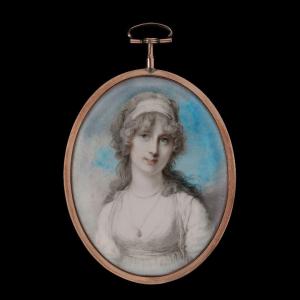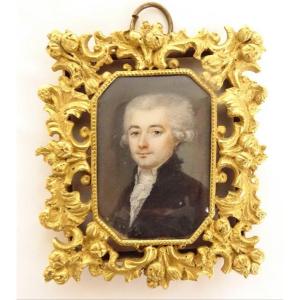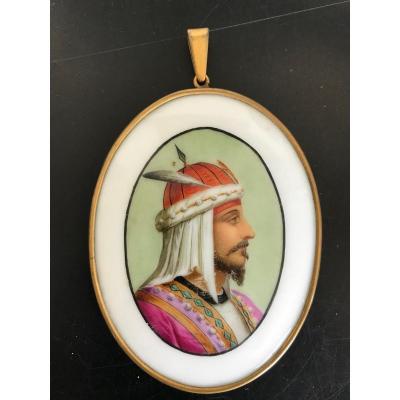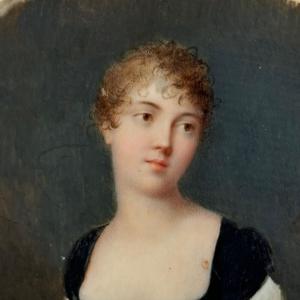
Portrait Miniature Of A Lady Standing In A Wooded Landscape
Artist: Austrian School (19th Century)
Circa 1815
Watercolour on ivory (licence number: G6KW62JL)
Gilt metal frame
Rectangular, 215mm (8 ½ in) high
Provenance:
Private collection.
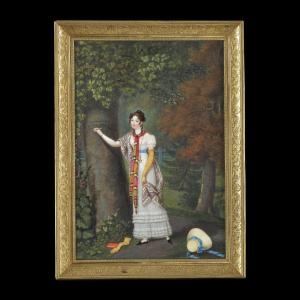
Painted in 1815, this work provides an insight into the political changes and their impact on culture and fashion that emerged in Europe following the French Revolution, and the reign of Napoleon Bonaparte that followed. The handling of this miniature suggests that it was not painted in France, but instead by an Austrian hand. By the time it was painted, Napoleon, who had taken over a large part of Europe following the end of the revolution in France, had seen his downfall, and the Congress of Vienna had left the Austrian Empire as one of the greatest powers in Europe. In the past, the country had fallen under the Holy Roman Empire, though this had collapsed in 1806. This was a time of great political change and instability.
At the same time, culture and fashion had seen a turn back towards classical ideals, and this became a period of fervent neoclassicism. The unknown lady in this picture carves a message into the tree beside her, ‘LA VIE EST LE RÊVE D’UNE OMBRE’ [Life is the dream of a shadow]. The quote may be taken from, or influenced by, the book that she has dropped on the floor. It likely refers to the words of the Ancient Greek poet Pindar, ‘Man is the Dream of a Shade’1, which is also often translated to ‘Man is the Dream of a Shadow’. In the early 19th century, there was a rise of Philhellenism across Europe, which emphasised the basis that Western civilisation had on the Greeks. This was particularly popular in Austria, where in Vienna a Philomuse society had been founded in 1814. Societies like these had links with Greek revolutionary ideals, and their popularity contributed to the outbreak of the Greek War of Independence in 1821.
It is possible that the sitter was a highly educated woman who wished to have such a message attached to her. Around her neck, she has a magnifying glass attached to a necklace, which may have been used to read the book she has dropped, and others. She also clearly wished to be seen as following the fashion trends of the period. Her dress, with a high waistline and slightly puffed sleeves, is typical of the mid-1810s. Furthermore, she is wearing what appears to be a Kashmiri Shawl, and a scarf produced using similar material around her neck. These shawls began to appear in Europe during the reign of Emperor Napoleon, imported from India. Fashionable women of the period, including Napoleon’s wife, Josephine Bonaparte (1763-1814), were often seen wearing these fabrics. Just as when Marie Antoinette was Dauphine, then, women with political power and influence were still having a major impact on what was seen to be ‘fashionable’. Furthermore, political change continued to have an influence on what people were wearing and how they wished to be presented.
1. Taken from the translation by Gregory Nagy, The Center for Hellenic Studies, https://chs.harvard.edu/primary-source/pindar-pythian-8-sb/.
Watercolour on ivory (licence number: G6KW62JL)
Gilt metal frame
Rectangular, 215mm (8 ½ in) high
Provenance:
Private collection.
Painted in 1815, this work provides an insight into the political changes and their impact on culture and fashion that emerged in Europe following the French Revolution, and the reign of Napoleon Bonaparte that followed. The handling of this miniature suggests that it was not painted in France, but instead by an Austrian hand. By the time it was painted, Napoleon, who had taken over a large part of Europe following the end of the revolution in France, had seen his downfall, and the Congress of Vienna had left the Austrian Empire as one of the greatest powers in Europe. In the past, the country had fallen under the Holy Roman Empire, though this had collapsed in 1806. This was a time of great political change and instability.
At the same time, culture and fashion had seen a turn back towards classical ideals, and this became a period of fervent neoclassicism. The unknown lady in this picture carves a message into the tree beside her, ‘LA VIE EST LE RÊVE D’UNE OMBRE’ [Life is the dream of a shadow]. The quote may be taken from, or influenced by, the book that she has dropped on the floor. It likely refers to the words of the Ancient Greek poet Pindar, ‘Man is the Dream of a Shade’1, which is also often translated to ‘Man is the Dream of a Shadow’. In the early 19th century, there was a rise of Philhellenism across Europe, which emphasised the basis that Western civilisation had on the Greeks. This was particularly popular in Austria, where in Vienna a Philomuse society had been founded in 1814. Societies like these had links with Greek revolutionary ideals, and their popularity contributed to the outbreak of the Greek War of Independence in 1821.
It is possible that the sitter was a highly educated woman who wished to have such a message attached to her. Around her neck, she has a magnifying glass attached to a necklace, which may have been used to read the book she has dropped, and others. She also clearly wished to be seen as following the fashion trends of the period. Her dress, with a high waistline and slightly puffed sleeves, is typical of the mid-1810s. Furthermore, she is wearing what appears to be a Kashmiri Shawl, and a scarf produced using similar material around her neck. These shawls began to appear in Europe during the reign of Emperor Napoleon, imported from India. Fashionable women of the period, including Napoleon’s wife, Josephine Bonaparte (1763-1814), were often seen wearing these fabrics. Just as when Marie Antoinette was Dauphine, then, women with political power and influence were still having a major impact on what was seen to be ‘fashionable’. Furthermore, political change continued to have an influence on what people were wearing and how they wished to be presented.
1. Taken from the translation by Gregory Nagy, The Center for Hellenic Studies, https://chs.harvard.edu/primary-source/pindar-pythian-8-sb/.
5 670 €
Period: 19th century
Style: Other Style
Condition: En l'etat
Height: rectangular, 215mm (8 1/2 in) high
Reference (ID): 1654930
Availability: In stock
Print