THIS OBJECT WAS SOLD
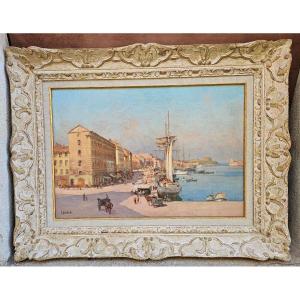
Jean Roque (1880-1925) In The Carenage Basin In Marseille


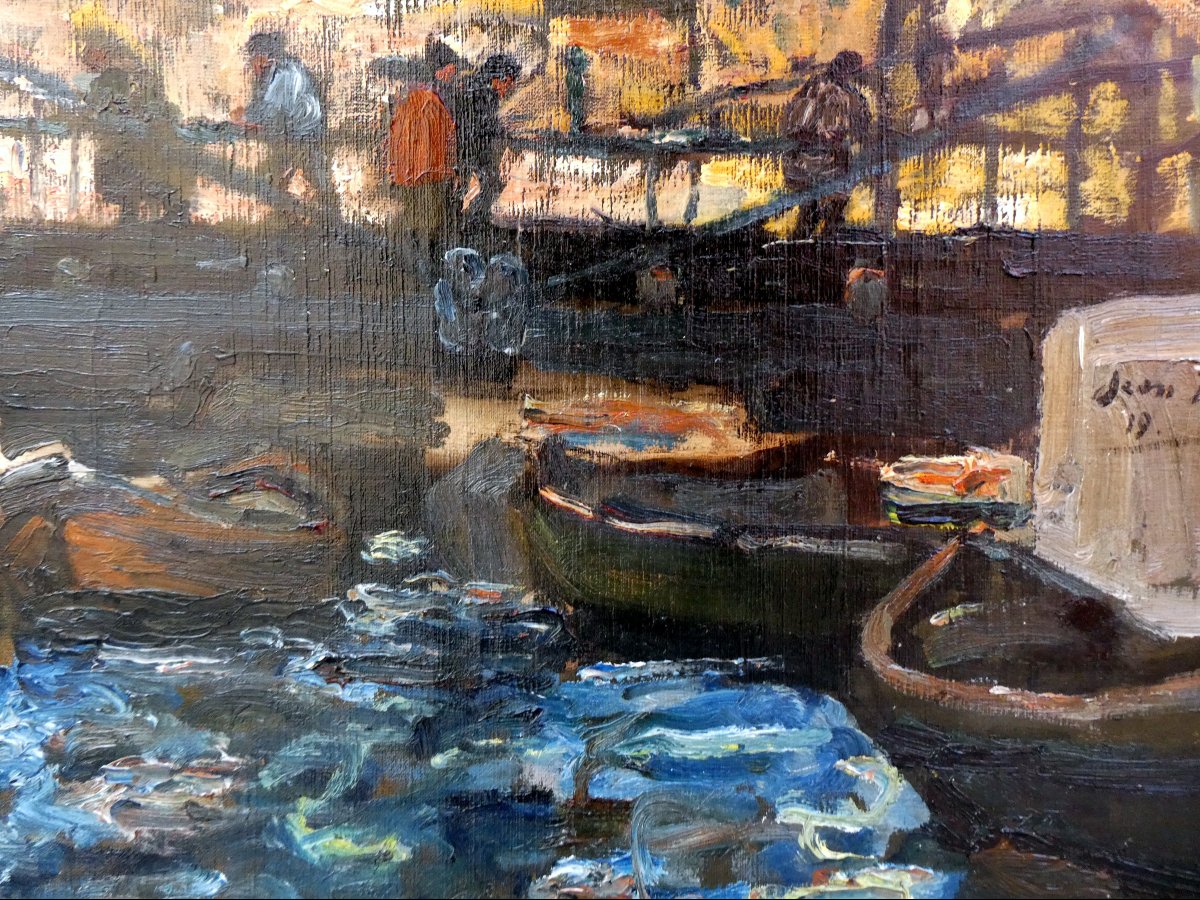
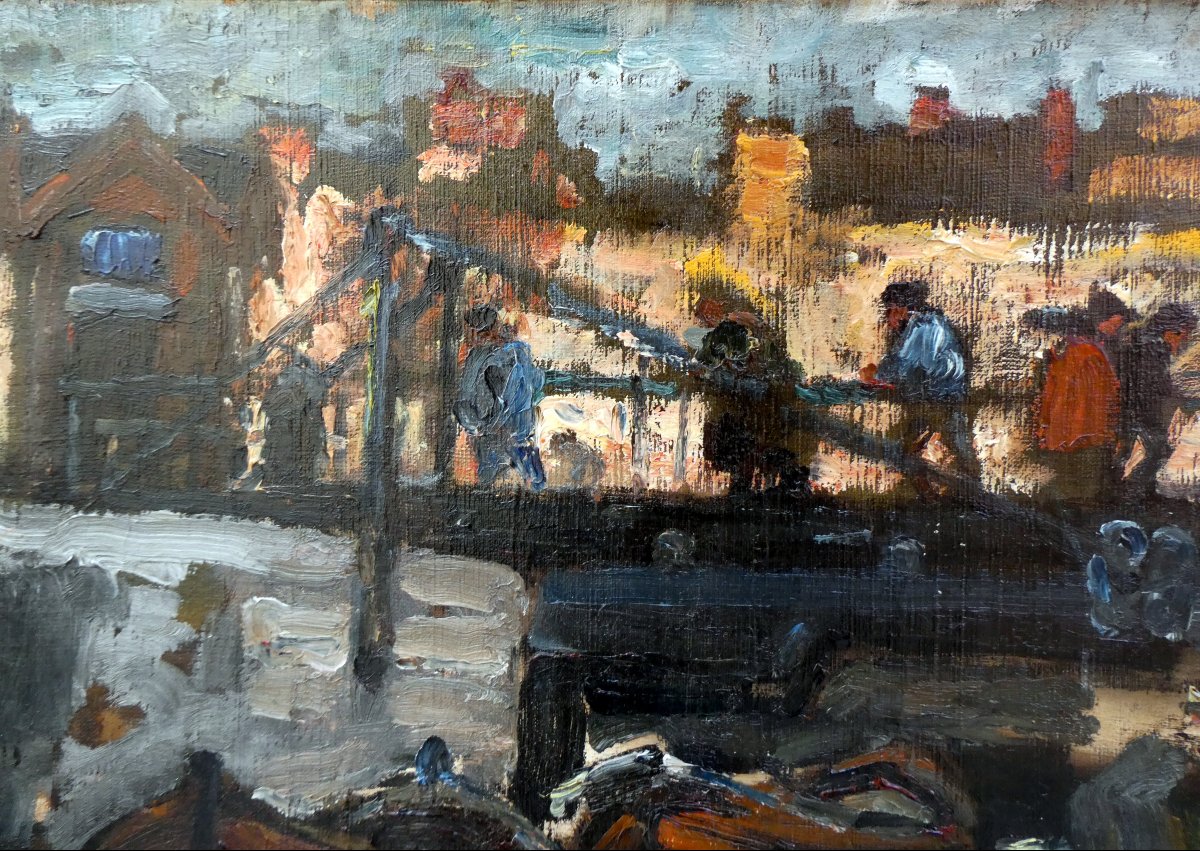


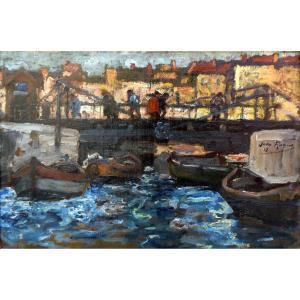


A broad, modern brushstroke in a generous impasto that, in places, gives way to the canvas, as in the lower left of the painting, where the texture of the sea plays with the bare canvas.
The light, emanating from the background of the painting, from the buildings of the Old Quarter, illuminates stylized, sketched figures from the ground, who seem to be struggling across the bridge of the Bassin du Carénage.
On the left is the cabin of the manager of the Bassin's swing bridge, and in the foreground, the fishing boats known as "pointus marseillais."
The work is presented in a beautiful carved Louis XIV-style frame measuring 69 cm by 95 cm, while the canvas itself measures 54 cm by 81 cm.
In good condition, only on the back 4 small old restorations invisible on the painting side, it is signed and dated (19)19 in the middle on the right.
A powerful and expressionist work by a highly talented but unfortunately underestimated artist.
Born in Marseille on January 8, 1880, he spent his entire childhood there and studied under Théodore Jourdan before moving to Paris.
In 1898, he briefly studied under Jean-Léon Gérôme, but quickly distanced himself from him, finding his painting too classical, even "old-fashioned."
He frequented the Montmartre district and met many painters, including Steinlen, who painted his portrait.
He was particularly fond of the landscapes of his native Provence, to which he devoted the majority of his work.
A contemporary of Louis-Mathieu Verdilhan and Albert Marquet, Jean Roque's painting displays the same modernity.
He liked to highlight the energy of simple moments through the purity of his forms, emphasized by the density of the materials and colors.
His work was also inspired by Paul Cézanne and Monticelli in its treatment of light.
He was also a recipient of republican travel grants.
In 1911, he met the art historian Léon Rosenthal, who dedicated an article to him in volume 13 of Armand Dayot's journal, L'Art et les Artistes.
Rosenthal particularly appreciated Jean Roque's sincere interest in life, far removed from any vain formal pursuits.
At the interdisciplinary study day in Dijon on September 22, 2011, Anne-Sophie Aguilar noted that Rosenthal's article fit harmoniously within the journal, which championed a restrained realism rooted in local tradition, far removed from avant-garde concerns.
That same year, at the third quinquennial exhibition of the Prix and the Salon des Boursiers du Voyage (Travel Scholarships Salon), Jean Roque's style was described as "bold to the point of brutality" in volume 14 of the journal L'Art et les Artistes (Art and Artists).
In 1913, he exhibited his painting Le Retour (The Return) at the Salon des Artistes Français, where it earned him a gold medal. He exhibited "Still Life, Seascape, Interior" at the Salon des Indépendants in 1923, and "Landscape, at Jouques, Still Life" in 1924.
He was influenced by Géricault, the Impressionists, Cézanne, and Monticelli.
He worked primarily in oil paint.
In his compositions, generally large-scale, one finds an impetuosity that unfolds in massive strokes of generous impasto.
He used canvas and cardboard as supports at the beginning of his career before turning—always with a concern for modernity—to wooden panels, which appeared around 1920.
In 1924, he became an official painter of the Navy alongside E. Barbaroux, J.R. Carrière, Paul Levéré, M. Moisset, René Quillivic, G. Rollin de Vertury, A. Theunissen, and P. Leconte.
He died on December 6, 1925, in Marseille, his birthplace.
He is buried there in the Saint Pierre cemetery.
The city of Marseille honored Jean Roque by naming a street leading to the Palais des Arts after him.
He also lent his name to a prize awarded by the Academy of Sciences, Letters, and Arts of Marseille.
He was made a Knight of the Legion of Honour in 1924.
Some Museums preserve his works:
Marseille Museum of Fine Arts "Boats and Fishermen"
Nice "Horses at the Watering Place"
Saint Nazaire "Seaweed Carriers"
Museum Regards de Provence "Return from Fishing at Martigues"
The Academy of Marseille owns part of his Studio Collection.
The light, emanating from the background of the painting, from the buildings of the Old Quarter, illuminates stylized, sketched figures from the ground, who seem to be struggling across the bridge of the Bassin du Carénage.
On the left is the cabin of the manager of the Bassin's swing bridge, and in the foreground, the fishing boats known as "pointus marseillais."
The work is presented in a beautiful carved Louis XIV-style frame measuring 69 cm by 95 cm, while the canvas itself measures 54 cm by 81 cm.
In good condition, only on the back 4 small old restorations invisible on the painting side, it is signed and dated (19)19 in the middle on the right.
A powerful and expressionist work by a highly talented but unfortunately underestimated artist.
Born in Marseille on January 8, 1880, he spent his entire childhood there and studied under Théodore Jourdan before moving to Paris.
In 1898, he briefly studied under Jean-Léon Gérôme, but quickly distanced himself from him, finding his painting too classical, even "old-fashioned."
He frequented the Montmartre district and met many painters, including Steinlen, who painted his portrait.
He was particularly fond of the landscapes of his native Provence, to which he devoted the majority of his work.
A contemporary of Louis-Mathieu Verdilhan and Albert Marquet, Jean Roque's painting displays the same modernity.
He liked to highlight the energy of simple moments through the purity of his forms, emphasized by the density of the materials and colors.
His work was also inspired by Paul Cézanne and Monticelli in its treatment of light.
He was also a recipient of republican travel grants.
In 1911, he met the art historian Léon Rosenthal, who dedicated an article to him in volume 13 of Armand Dayot's journal, L'Art et les Artistes.
Rosenthal particularly appreciated Jean Roque's sincere interest in life, far removed from any vain formal pursuits.
At the interdisciplinary study day in Dijon on September 22, 2011, Anne-Sophie Aguilar noted that Rosenthal's article fit harmoniously within the journal, which championed a restrained realism rooted in local tradition, far removed from avant-garde concerns.
That same year, at the third quinquennial exhibition of the Prix and the Salon des Boursiers du Voyage (Travel Scholarships Salon), Jean Roque's style was described as "bold to the point of brutality" in volume 14 of the journal L'Art et les Artistes (Art and Artists).
In 1913, he exhibited his painting Le Retour (The Return) at the Salon des Artistes Français, where it earned him a gold medal. He exhibited "Still Life, Seascape, Interior" at the Salon des Indépendants in 1923, and "Landscape, at Jouques, Still Life" in 1924.
He was influenced by Géricault, the Impressionists, Cézanne, and Monticelli.
He worked primarily in oil paint.
In his compositions, generally large-scale, one finds an impetuosity that unfolds in massive strokes of generous impasto.
He used canvas and cardboard as supports at the beginning of his career before turning—always with a concern for modernity—to wooden panels, which appeared around 1920.
In 1924, he became an official painter of the Navy alongside E. Barbaroux, J.R. Carrière, Paul Levéré, M. Moisset, René Quillivic, G. Rollin de Vertury, A. Theunissen, and P. Leconte.
He died on December 6, 1925, in Marseille, his birthplace.
He is buried there in the Saint Pierre cemetery.
The city of Marseille honored Jean Roque by naming a street leading to the Palais des Arts after him.
He also lent his name to a prize awarded by the Academy of Sciences, Letters, and Arts of Marseille.
He was made a Knight of the Legion of Honour in 1924.
Some Museums preserve his works:
Marseille Museum of Fine Arts "Boats and Fishermen"
Nice "Horses at the Watering Place"
Saint Nazaire "Seaweed Carriers"
Museum Regards de Provence "Return from Fishing at Martigues"
The Academy of Marseille owns part of his Studio Collection.
Explore similar pieces and discover your ideal find:
Seascapes, Marine Paintings