Large "canthara" Vase In "fat Lava" Ceramic, Marius Giuge In Vallauris - 1960s
Artist: Marius Giuge
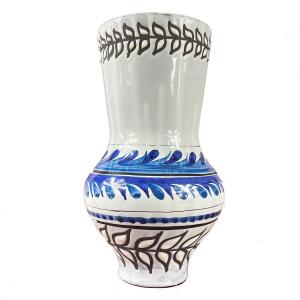
Large and very decorative Greek-style vase, "Kantharos," 50cm tall, decorated with a "foam" pattern.
The white color of this piece is dotted with black alveoli that contrast with the light glaze. The technique used to achieve this effect involved adding chemical components to the glaze: depending on the chosen dosage, this created variations in the size and depth of the craters.
This decorative technique, invented by Marius Giuge, inspired the "Fat Lava" ceramics, very popular in Germany in the late 1960s and 1970s.
This immense decorative vase is an iconic example of Marius Giuge's work from the 1960s and 1970s. It is signed under the base "MG VALLAURIS AM" for "Marius Giuge Vallauris Alpes Maritimes". A minor loss on the enamel at the base but barely visible.
Marius Giuge, a key figure in Vallauris (1909-1980), lived through the post-war boom years with classic forms and glazes that bordered on kitsch. He inherited the know-how of his father, Philippe, who was based in Vallauris and from whom he learned the potter's trade.
In 1947, he opened his own workshop. He initially worked with traditional pottery before turning to decorative ceramics. An excellent craftsman, his workshops prospered.
In the late 1960s, he developed his famous "meerschaum" decoration, created by adding chemical components to the glaze to achieve variations in the size and depth of the craters. This decoration, applied to large pieces with shapes inspired by Greek antiquities, is emblematic of his work. It was adopted in West Germany by the industrialized factories of the post-war period, which in turn developed "Fat Lava."
In 1975, Marius Giuge passed his workshop on to his daughter, also a ceramicist, thus perpetuating the history of a family tradition. Facing the consequences of the oil crises, the workshop closed permanently in 1980 (the year of Marius Giuge's death).
The white color of this piece is dotted with black alveoli that contrast with the light glaze. The technique used to achieve this effect involved adding chemical components to the glaze: depending on the chosen dosage, this created variations in the size and depth of the craters.
This decorative technique, invented by Marius Giuge, inspired the "Fat Lava" ceramics, very popular in Germany in the late 1960s and 1970s.
This immense decorative vase is an iconic example of Marius Giuge's work from the 1960s and 1970s. It is signed under the base "MG VALLAURIS AM" for "Marius Giuge Vallauris Alpes Maritimes". A minor loss on the enamel at the base but barely visible.
Marius Giuge, a key figure in Vallauris (1909-1980), lived through the post-war boom years with classic forms and glazes that bordered on kitsch. He inherited the know-how of his father, Philippe, who was based in Vallauris and from whom he learned the potter's trade.
In 1947, he opened his own workshop. He initially worked with traditional pottery before turning to decorative ceramics. An excellent craftsman, his workshops prospered.
In the late 1960s, he developed his famous "meerschaum" decoration, created by adding chemical components to the glaze to achieve variations in the size and depth of the craters. This decoration, applied to large pieces with shapes inspired by Greek antiquities, is emblematic of his work. It was adopted in West Germany by the industrialized factories of the post-war period, which in turn developed "Fat Lava."
In 1975, Marius Giuge passed his workshop on to his daughter, also a ceramicist, thus perpetuating the history of a family tradition. Facing the consequences of the oil crises, the workshop closed permanently in 1980 (the year of Marius Giuge's death).
2 050 €
Period: 20th century
Style: Design 50's and 60's
Condition: Excellent condition
Material: Ceramic
Width: 43cm
Diameter: 23cm
Height: 50cm
Reference (ID): 1644575
Availability: In stock
Print