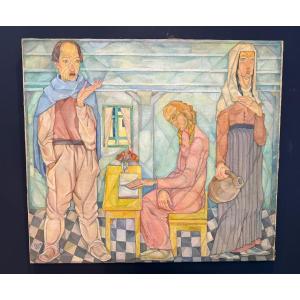


"Nicolas Eekman - Oil On Canvas - Cubist School - 1922"
Nicolas Eekman (1889-1973) was a Belgian painter and printmaker known for a unique body of work that oscillates between expressive figuration and geometric constructions. In the 1920s, in the aftermath of the First World War, he moved to Paris and became close to many avant-garde artists. It was during this time that he developed a particularly pronounced Cubist period, inspired by the formal explorations of Pablo Picasso and Georges Braque. Around 1920-1925, the period in which he moved to Paris, his paintings exhibited a rigorous structuring of space: human and architectural forms were fragmented into prismatic volumes and geometric planes, while retaining a strong poetic and narrative charge. Unlike pure analytical Cubism, Eekman often integrated recognizable elements—peasant figures, harbor scenes, or Flemish landscapes—into an architectural and dynamic composition. This cubic period was a decisive turning point in his career: it allowed him to gain attention on the Parisian scene and participate in avant-garde exhibitions, while preparing the evolution of his style towards a personal and humanist expressionism in the following decades. In this painting, located in Bougivale, where Eekman set up his first studio in 1921. Three figures in an interior structured with geometric rigor: On the left, a standing man, dressed in loose trousers and a light-colored top, hands in his pockets and looking towards the viewer. His angular face is treated in faceted volumes, and a pale blue shawl rests on his shoulders. His attitude, slightly theatrical, suggests a speech or a speech. In the center, a young woman is sitting on a yellow chair, her hair braided, wearing a pink dress. She is slightly leaning towards the table in front of her, where a sheet of paper lies. Her melancholic posture contrasts with the tension of the male figure. On the right, a standing woman holds a jug. Her clothing—brown blouse, long gray skirt, and head veil—suggests a domestic or religious figure. She stares at the viewer with calm and distance. I have not been able to decipher the title of the work with certainty, but I believe I read "The Error," which could totally coincide with the painted scene. Very slight losses to report. 










 Le Magazine de PROANTIC
 TRÉSORS Magazine
 Rivista Artiquariato