Lombard School, 17th Century, Still Life
Artist: école Lombarde Du Xviie Siècle
Lombard School, 17th Century, Still life, oil on canvas, 45x36 cm
With frame: 50 x 41 x 5,5 cm
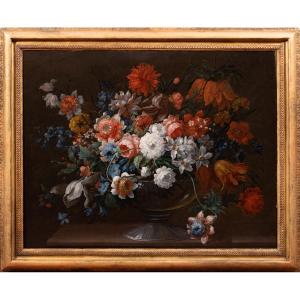
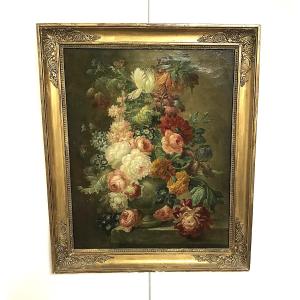
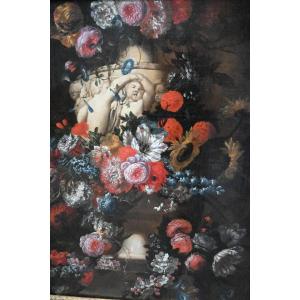
A fascinating example of a 17th-century floral still life, attributed to the Lombard School. The work features a dense and dramatic composition, typical of the taste and aesthetics of the period, particularly its pronounced use of chiaroscuro.
The dark, almost black background obliterates any spatial reference, creating a stage of pure darkness from which the flowers emerge. This technical device not only enhances the volume and plasticity of the individual petals and corollas, but also instills a sense of mystery and a profound meditation on the transience of beauty and life, a central theme in 17th-century still lifes.
The bouquet is rich and varied, although the chromatic tones are predominantly intense reds, deep pinks, and luminous whites, with a few barely visible hints of dark green. At the center of the composition, a large variegated tulip dominates the scene—a symbol of luxury and, given its ephemeral nature, a further allusion to vanitas—with deep red outer petals streaked with white, capturing the light exceptionally well. Surrounding it is a profusion of roses in various shades of red and pink, some already in full bloom and others showing the first signs of wilting, suggesting the passage of time. A pale, almost white or bluish rose stands out for its chromatic contrast in the center left, adding a focal point of cool light.
The flowers are arranged in a gold or bronze vase, barely visible in the shadows at the base of the painting. The textured brushstrokes are particularly effective in conveying the velvety softness of the petals and their fleshy texture. The directional and powerful light strikes the flowers from above or from the side, generating reflections and deep shadows that shape the forms with great realism.
Condition: The painting is in good condition.
We remain at your disposal for further information.
With frame: 50 x 41 x 5,5 cm
A fascinating example of a 17th-century floral still life, attributed to the Lombard School. The work features a dense and dramatic composition, typical of the taste and aesthetics of the period, particularly its pronounced use of chiaroscuro.
The dark, almost black background obliterates any spatial reference, creating a stage of pure darkness from which the flowers emerge. This technical device not only enhances the volume and plasticity of the individual petals and corollas, but also instills a sense of mystery and a profound meditation on the transience of beauty and life, a central theme in 17th-century still lifes.
The bouquet is rich and varied, although the chromatic tones are predominantly intense reds, deep pinks, and luminous whites, with a few barely visible hints of dark green. At the center of the composition, a large variegated tulip dominates the scene—a symbol of luxury and, given its ephemeral nature, a further allusion to vanitas—with deep red outer petals streaked with white, capturing the light exceptionally well. Surrounding it is a profusion of roses in various shades of red and pink, some already in full bloom and others showing the first signs of wilting, suggesting the passage of time. A pale, almost white or bluish rose stands out for its chromatic contrast in the center left, adding a focal point of cool light.
The flowers are arranged in a gold or bronze vase, barely visible in the shadows at the base of the painting. The textured brushstrokes are particularly effective in conveying the velvety softness of the petals and their fleshy texture. The directional and powerful light strikes the flowers from above or from the side, generating reflections and deep shadows that shape the forms with great realism.
Condition: The painting is in good condition.
We remain at your disposal for further information.
1 900 €
Period: 17th century
Style: Louis 14th, Regency
Condition: Re-canvas
Material: Oil painting
Length: 36
Height: 45
Reference (ID): 1626848
Availability: In stock
Print