

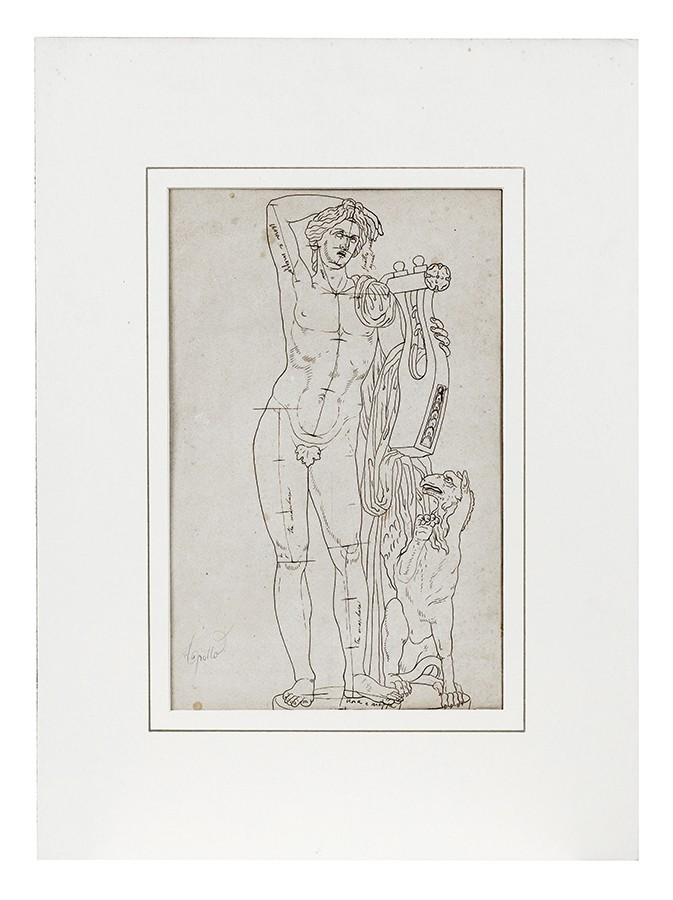
"1820s Italian Artist, Apollo Zithared With Griffin"
ITALIAN ARTIST OF THE 1820sAPOLLO CITHAROEDUS WITH THE GRIFFIN
Paper, brown ink
30 x 19 cm / 11.8 x 7.5 inches; with mat: 47 x 34.5 cm / 18.5 x 13.4 inches, unframed
PROVENANCE
France, private collection
The first half of the 19th century marked an era of revival and deep fascination with ancient art and culture. During this period, artists and sculptors actively turned to classical models, striving to emulate the ideals of beauty and harmony established by the masters of antiquity. One such ideal was the famous sculpture Apollo Citharoedus with the Griffin, housed in the Palazzo Nuovo of the Capitoline Museums in Rome.
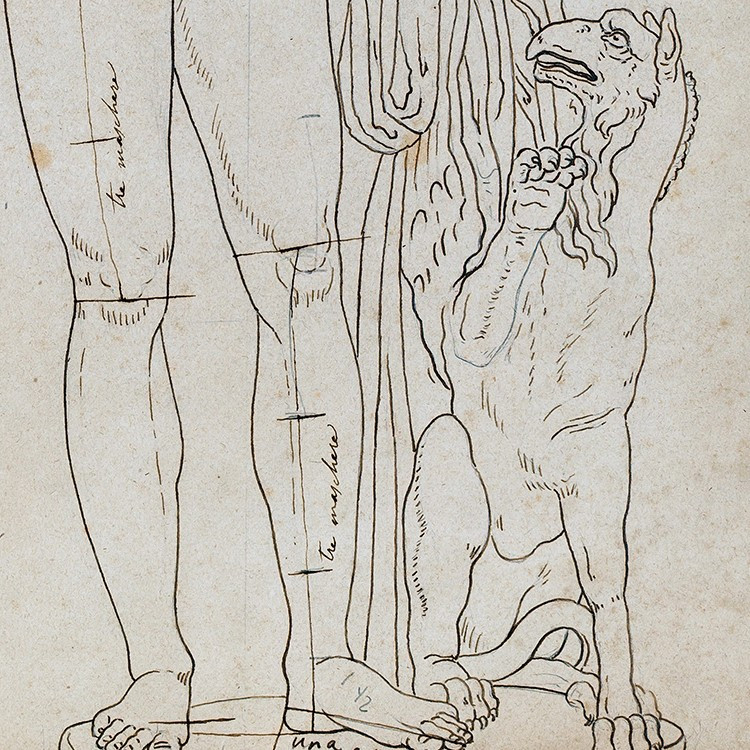
This statue represented the epitome of perfect proportions and grace. At its core lies an original work by the great Praxiteles, one of the most renowned ancient Greek sculptors of the Classical period. The griffin accompanying Apollo is an allusion to the lands of the Hyperboreans — a mythical northern region where, according to legend, Apollo atoned for killing the Python of Delphi.
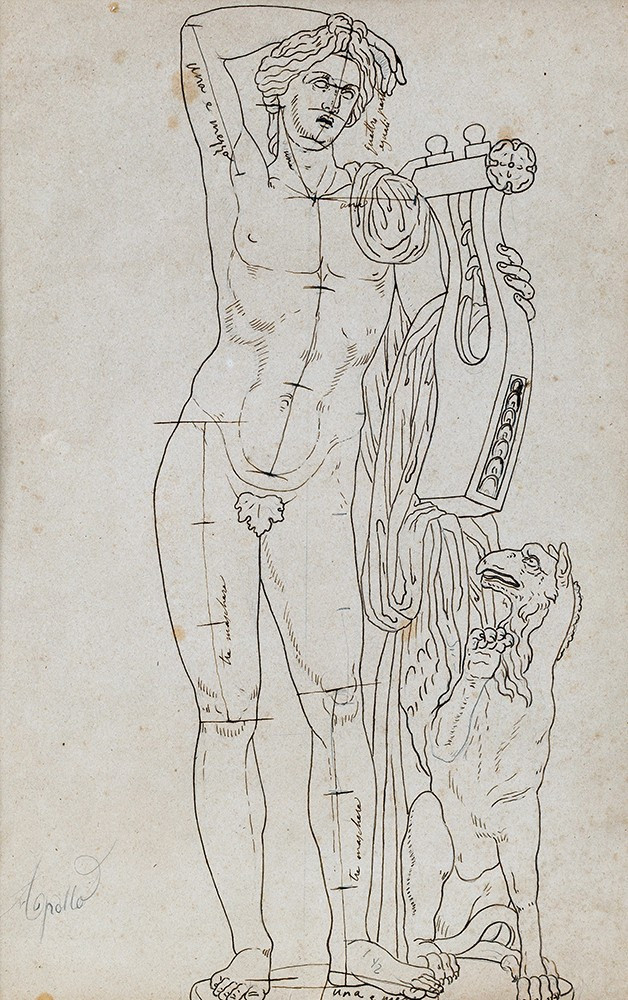
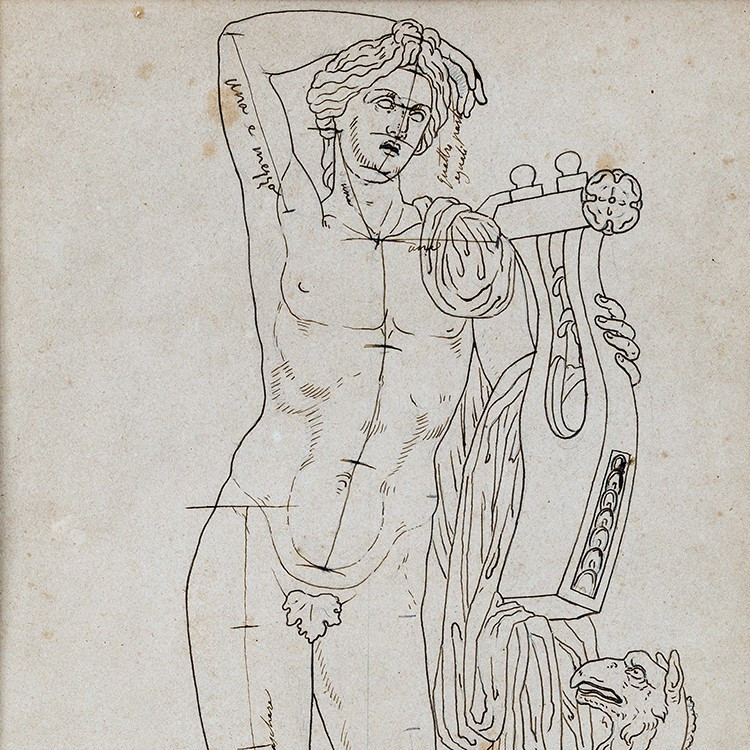
In the sculpture, Apollo is depicted fully nude except for a drapery resting on his left shoulder, which falls lightly over his arm. The figure stands in a contemplative pose, captured in a momentary pause from musical activity. The weight of the body rests entirely on the right leg, while the left leg is drawn back and turned to the side, creating a dynamic yet balanced curve. The right arm, raised above the head, completes the harmonious movement of the figure.
The young god is shown with long braided hair tied in a knot — known as a “krobylos.” In ancient tradition, this hairstyle symbolized free birth and the transition to adulthood: for boys, upon entering the ephebeia, and for girls, before marriage, with the braids dedicated to the gods Apollo and Artemis respectively.
It is important to note that this sculpture is not an exact copy but rather a Roman variation on the theme of the Apollo Lykeios, attributed to the late phase of Praxiteles' work. It dates to after 336-335 BCE, when the institution of ephebeia was reorganized in Athens and a gymnasium was constructed in the Lyceum.
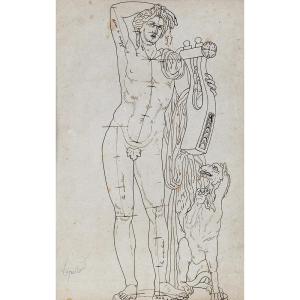
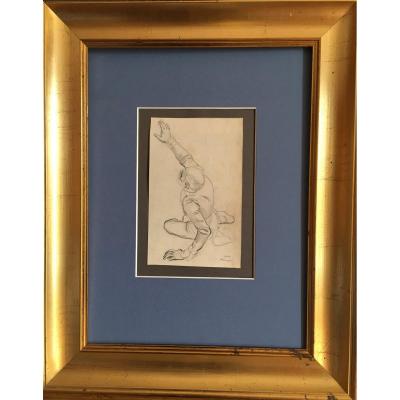
Our drawing, executed in pen and ink, is a vivid example of thoughtful study of the human body's proportions based on ancient sculpture. Throughout the drawing, the artist carefully inscribed notes and markings indicating measurements such as “una e mezza” (one and a half) and “tre misure” (three measures), reflecting classical canons of proportion. These annotations reveal how meticulously the artist analyzed the harmony and balance of the figure, striving to convey the ideals of beauty that have inspired artists and sculptors for centuries.








 Le Magazine de PROANTIC
 TRÉSORS Magazine
 Rivista Artiquariato