THIS OBJECT WAS SOLD
Inkwell In Turned, Cast And Chased Silver, Madrid, 18th Century (1779).

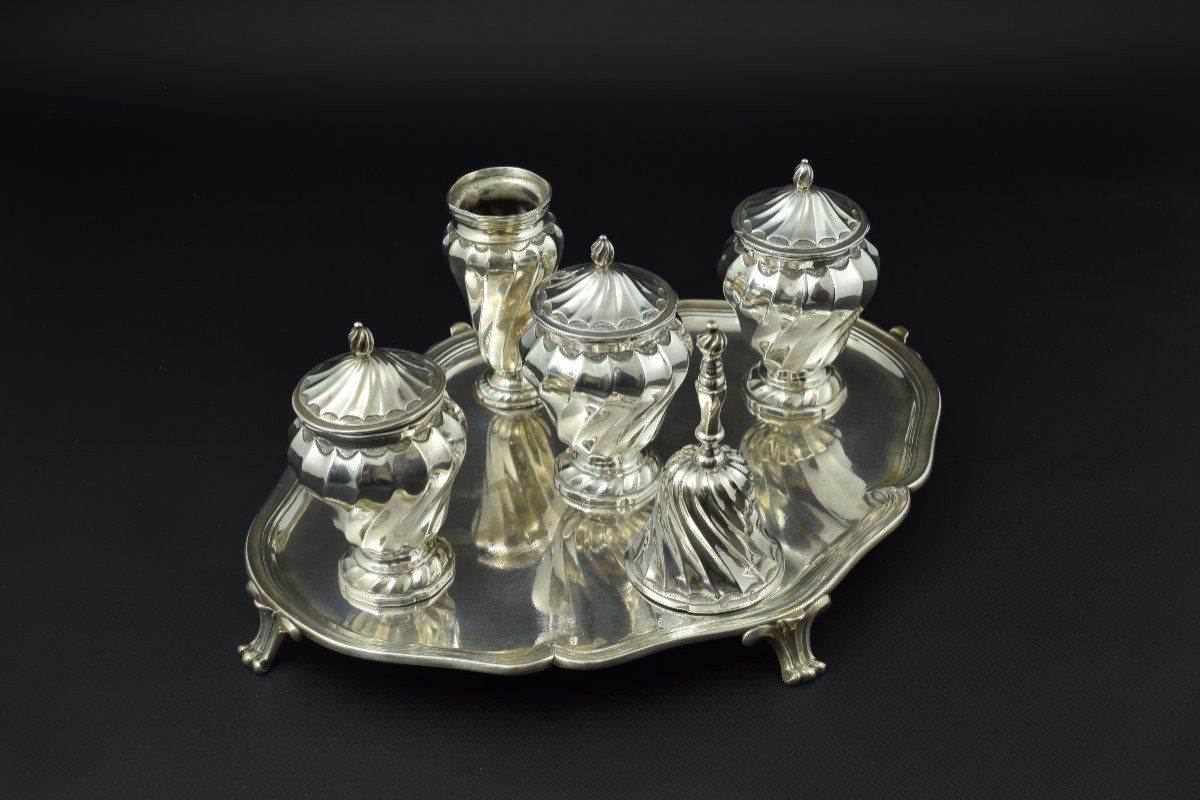




Turned, cast, and chiseled silver inkwell, Madrid, 18th century (1779).
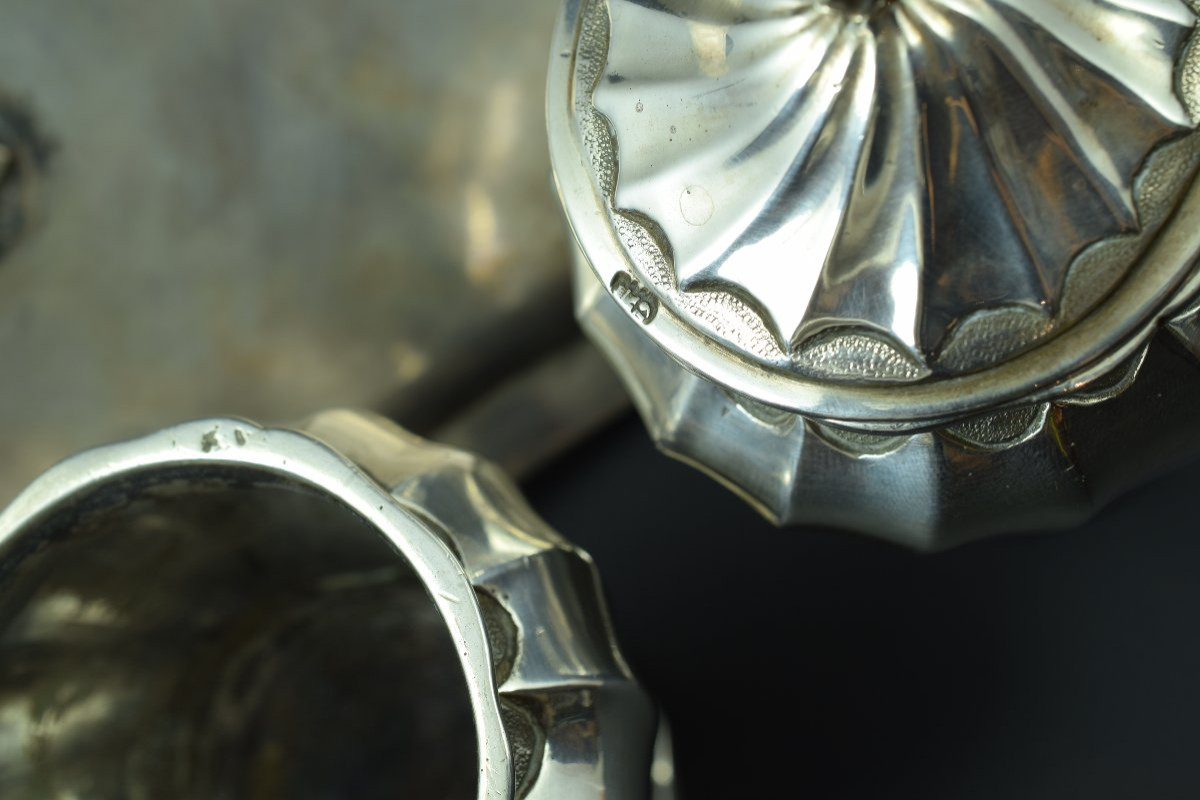
Contrasting marks on the edge of the top, on its underside. Ownership mark "AL". A top with curved profiles is supported by four legs in the shape of plant elements. The four containers that make up the desk are attached to it. These, along with the bell, have a magnificent decoration based on flat turned festoons on their body, base, and lid. It consists of a top, a sandbox (for drying the ink) with a bell (for summoning the servant or the person in charge of carrying the message or written note), and three inkwells or dusters with lids, all attached to the lid by means of through screws. The profiles of the top correspond to works of the period and style of Charles III, while the pots still present some of the movement that characterized the Rococo, while already introducing the clean lines characteristic of Neoclassicism. In the second half of the 18th century, with the accession of Charles III to the throne, Italian influences were evident in silverware, once the masters of that country had established themselves, either as goldsmiths or, in many cases, as bronze makers. By the end of the century, Rococo forms were also abandoned in favor of the Neoclassical style, the peculiarities of which are visible in this desk. These scalloped forms come from decorations based on ancient Roman art on which this second artistic style was based, as do the plant elements. Madrid would set the standard in art as it was the capital of the kingdom, and the continuous movement of pieces and the relative ease of communication and transmission of drawings and engravings make it difficult to distinguish particular styles and trends in many cases. Likewise, it is worth highlighting the great role in improving the quality of silverware designs played by the foundation of the School-Workshop by Antonio Martínez in 1778. It has a town mark, Madrid Corte y Villa 1779, and its creator.
Weight: 1850 gr. · Size: 31x25Xx14 cm
Contrasting marks on the edge of the top, on its underside. Ownership mark "AL". A top with curved profiles is supported by four legs in the shape of plant elements. The four containers that make up the desk are attached to it. These, along with the bell, have a magnificent decoration based on flat turned festoons on their body, base, and lid. It consists of a top, a sandbox (for drying the ink) with a bell (for summoning the servant or the person in charge of carrying the message or written note), and three inkwells or dusters with lids, all attached to the lid by means of through screws. The profiles of the top correspond to works of the period and style of Charles III, while the pots still present some of the movement that characterized the Rococo, while already introducing the clean lines characteristic of Neoclassicism. In the second half of the 18th century, with the accession of Charles III to the throne, Italian influences were evident in silverware, once the masters of that country had established themselves, either as goldsmiths or, in many cases, as bronze makers. By the end of the century, Rococo forms were also abandoned in favor of the Neoclassical style, the peculiarities of which are visible in this desk. These scalloped forms come from decorations based on ancient Roman art on which this second artistic style was based, as do the plant elements. Madrid would set the standard in art as it was the capital of the kingdom, and the continuous movement of pieces and the relative ease of communication and transmission of drawings and engravings make it difficult to distinguish particular styles and trends in many cases. Likewise, it is worth highlighting the great role in improving the quality of silverware designs played by the foundation of the School-Workshop by Antonio Martínez in 1778. It has a town mark, Madrid Corte y Villa 1779, and its creator.
Weight: 1850 gr. · Size: 31x25Xx14 cm
Explore similar pieces and discover your ideal find:
Serveware