THIS OBJECT WAS SOLD
Apoxyomenos In Bronze By Alessandro Nelli, After Lysippos


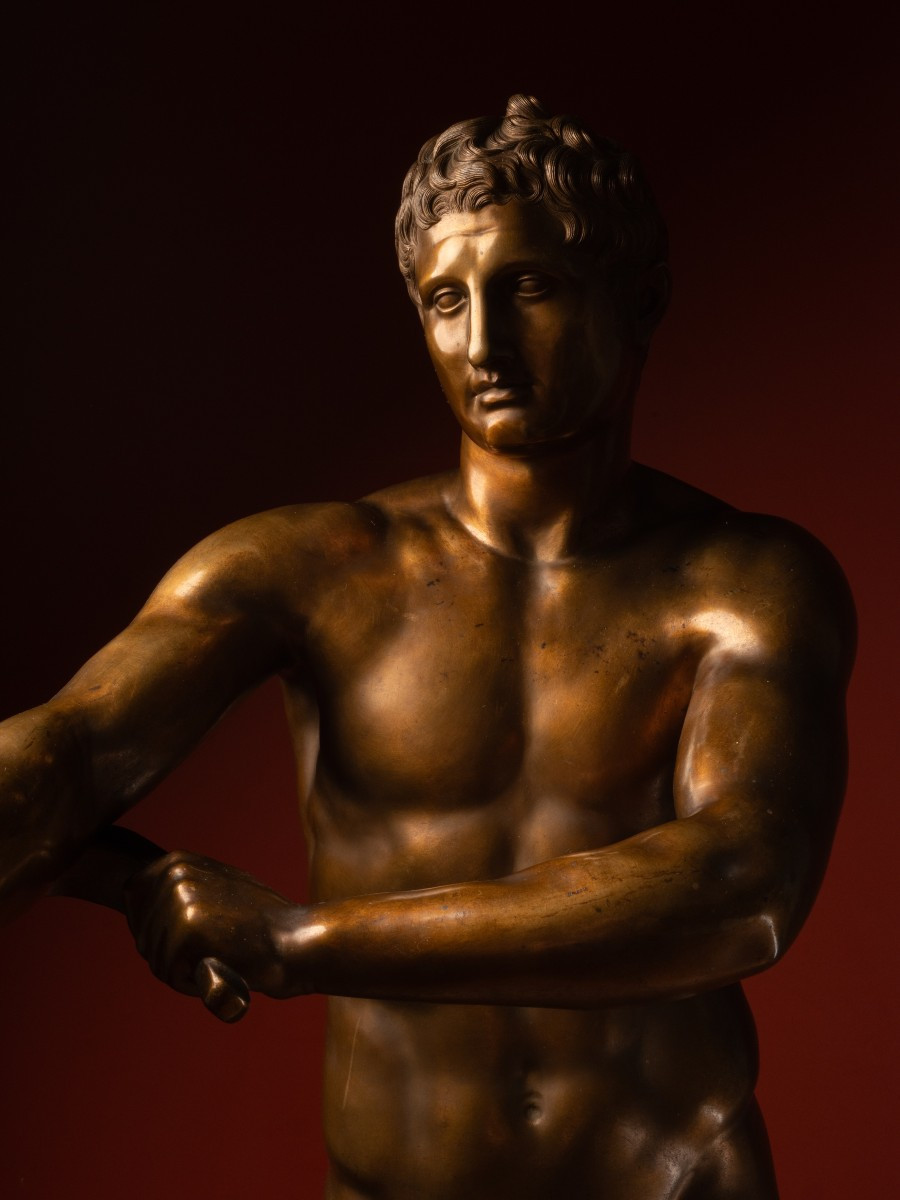

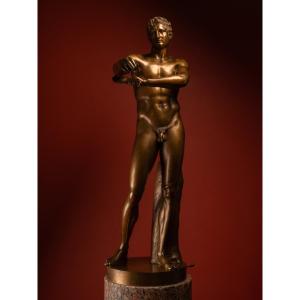


Bronze Apoxyomenos by Alessandro Nelli, after Lysippos.
Bronze.
Rome.
1870s-1880s.
h. 37.4 in. (on a pedestal 20.5 in. high).
This bronze replica of the Apoxyomenos, cast by the Fonderia Artistica of Alessandro Nelli in Rome, is based on the eponymous marble statue discovered in 1849 in the Trastevere district, now in the Museo Pio-Clementino. This is a nude athlete scraping oil and dust off his body with a strigil; replicating a bronze original attributed to Lysippos, that once stood in front of the Baths of Agrippa in Rome, until Tiberius, according to Pliny, taking a great delight in the sculpture, had it removed to his private bedchamber. Indignant at this removal, and although the emperor substituted another statue, the Roman people raised a vehement protest, compelling Tiberius to restore the bronze despite his deep attachment to it.
Pliny also notes that one of Lysippos’s stylistic achievements, as the favored sculptor of Alexander the Great, lay in the rendering of the hair. The strands in Nelli’s cast are thus finely chased, arranged regularly around the forehead and temples, consistent with the style described by Pliny. Lysippos is further distinguished for modifying the proportions established by the Polykleitan canon. Departing from the Polykleitan ratio, where the head was one-seventh of the total height, he adopted, according to Pliny, more elongated proportions, a thinner and leaner body, and a smaller head, corresponding to one-eighth of the height. These altered proportions, evident in the Vatican marble, are faithfully reproduced in Nelli’s bronze. These details confirm that Nelli’s cast was not merely decorative but a meticulous reproduction of the ancient work, executed with care shortly after the marble’s restoration and installation in the Braccio Nuovo of the Vatican Museums.
As for the Fonderia Romana of Alessandro Nelli, established in 1871, it swiftly became a leading center for bronze casting in Rome. Founded in Trastevere—coincidentally the same district where the Apoxyomenos was unearthed—the foundry combined technical mastery, historical accuracy, and artistic refinement, excelling in both monumental public commissions and reproductions of ancient models. Museums, academies, and private collectors acquired Nelli bronzes, some seeking exact replicas of ancient works, others, often nostalgic for the Grand Tour, drawn to the beauty and prestige of these impeccable reproductions of antique sculptures.
Explore similar pieces and discover your ideal find:
bronze sculptures