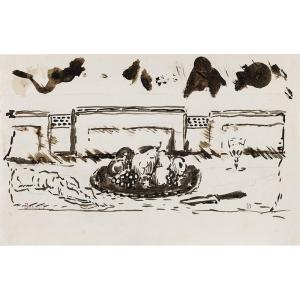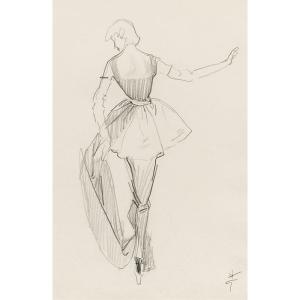

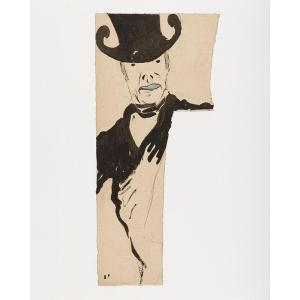


Edouard Vuillard (1868 - 1940) — The Actor Ernest Coquelin Junior In The Role Of Léridon, 1890
Artist: Edouard Vuillard
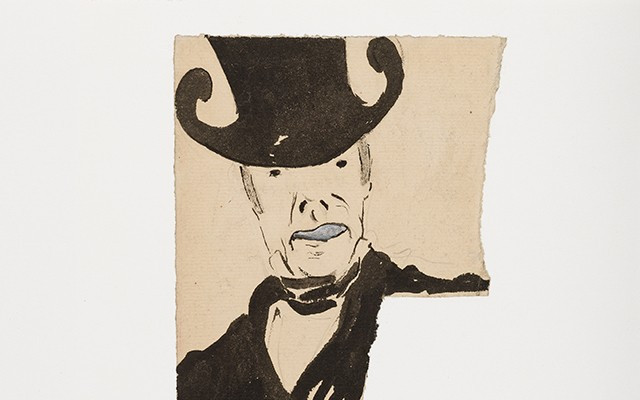
The actor Ernest Coquelin cadet in the role of Léridon, 1890
Trace of graphite, Indian ink wash and watercolor on paper, studio stamp lower left.
26.50 x 12.10 cm
Provenance:
Private collection, France
Certificate of inclusion in the supplement to the catalogue raisonné of Edouard Vuillard's paintings and pastels established by the Vuillard Committee.
Edouard Vuillard, Intimacy on Display
Edouard Vuillard was born on November 11, 1868, in Cuiseaux, Saône-et-Loire. He came from a modest background; his mother was a corset maker. The family moved to Paris in 1877, and Vuillard began his schooling at the Lycée Condorcet, where Bergson and Mallarmé taught. There he met Maurice Denis, Lugné Poe, and Kerr-Xavier Roussel.
After a stint at the Académie Julian, he enrolled at the École des Beaux-Arts in 1887 and quickly became involved with a group of innovative painters—the Nabis—influenced by Paul Gauguin and Emile Bernard. The movement was formed in 1889 around Paul Ranson, Paul Sérusier, Maurice Denis, and Pierre Bonnard. Vuillard kept his distance, at least initially, from this “brotherhood” detached from all academic conventions.
In 1889, Vuillard exhibited for the first time at the Salon des Artistes Français. He moved into a small studio at 28 rue Pigalle with Pierre Bonnard and Maurice Denis. In 1891, he met Thadée Nathanson, who had become director of the Revue Blanche that same year and who devoted a major exhibition to him in his premises, a meeting place for intellectuals and artists. Thadée and his wife, Misia, introduced the painter to the Parisian avant-garde and opened the doors to a cultural microcosm that gave his work a new dimension. That same year, he exhibited at the Le Barc de Boutteville gallery in Saint Germain-en-Laye alongside the Nabis. These years also saw Edouard Vuillard's work come to fruition and bring him fame. He painted intimate interiors in rich settings adorned with wallpaper and played with the effects of different materials. Far from being anecdotal, these interior scenes also reflect a pronounced taste for theater and literature, in which the characters evolve to the rhythm of the story they are telling. The influence of the masters he encountered at the Louvre—Chardin and the 17th-century Dutch painters—faded to reveal the feverish energy of the Nabis and with it an explosion of color, emerging under the impetus of broad flat areas and distorted forms.
From 1900 onwards, the painter became close to fashionable galleries, notably Bernheim-Jeune, and began to work exclusively with the dealer Jos Hessel, Alexandre Bernheim's nephew. His wife, Lucy, became Vuillard's muse and lover for four years. He then entered the world of businessmen and politicians. His painting became calmer, even darker, regaining a greater softness, reviving his taste for naturalism and structured compositions. During this period, Vuillard painted an important series of portraits of high society and declared: “I don't paint portraits, I paint people in their homes.”
At the end of his life, he received commissions from the state and became a member of the Institut de France in 1937. His first major retrospective was held at the Musée des Arts Décoratifs in 1938.
Edouard Vuillard died on June 21, 1940, in La Baule, where he had taken refuge during the war.
Discover more works by this artist on the gallery's website: https://www.galeriepentcheff.fr/fr/peintre-edouard-vuillard#Oeuvres
Trace of graphite, Indian ink wash and watercolor on paper, studio stamp lower left.
26.50 x 12.10 cm
Provenance:
Private collection, France
Certificate of inclusion in the supplement to the catalogue raisonné of Edouard Vuillard's paintings and pastels established by the Vuillard Committee.
Edouard Vuillard, Intimacy on Display
Edouard Vuillard was born on November 11, 1868, in Cuiseaux, Saône-et-Loire. He came from a modest background; his mother was a corset maker. The family moved to Paris in 1877, and Vuillard began his schooling at the Lycée Condorcet, where Bergson and Mallarmé taught. There he met Maurice Denis, Lugné Poe, and Kerr-Xavier Roussel.
After a stint at the Académie Julian, he enrolled at the École des Beaux-Arts in 1887 and quickly became involved with a group of innovative painters—the Nabis—influenced by Paul Gauguin and Emile Bernard. The movement was formed in 1889 around Paul Ranson, Paul Sérusier, Maurice Denis, and Pierre Bonnard. Vuillard kept his distance, at least initially, from this “brotherhood” detached from all academic conventions.
In 1889, Vuillard exhibited for the first time at the Salon des Artistes Français. He moved into a small studio at 28 rue Pigalle with Pierre Bonnard and Maurice Denis. In 1891, he met Thadée Nathanson, who had become director of the Revue Blanche that same year and who devoted a major exhibition to him in his premises, a meeting place for intellectuals and artists. Thadée and his wife, Misia, introduced the painter to the Parisian avant-garde and opened the doors to a cultural microcosm that gave his work a new dimension. That same year, he exhibited at the Le Barc de Boutteville gallery in Saint Germain-en-Laye alongside the Nabis. These years also saw Edouard Vuillard's work come to fruition and bring him fame. He painted intimate interiors in rich settings adorned with wallpaper and played with the effects of different materials. Far from being anecdotal, these interior scenes also reflect a pronounced taste for theater and literature, in which the characters evolve to the rhythm of the story they are telling. The influence of the masters he encountered at the Louvre—Chardin and the 17th-century Dutch painters—faded to reveal the feverish energy of the Nabis and with it an explosion of color, emerging under the impetus of broad flat areas and distorted forms.
From 1900 onwards, the painter became close to fashionable galleries, notably Bernheim-Jeune, and began to work exclusively with the dealer Jos Hessel, Alexandre Bernheim's nephew. His wife, Lucy, became Vuillard's muse and lover for four years. He then entered the world of businessmen and politicians. His painting became calmer, even darker, regaining a greater softness, reviving his taste for naturalism and structured compositions. During this period, Vuillard painted an important series of portraits of high society and declared: “I don't paint portraits, I paint people in their homes.”
At the end of his life, he received commissions from the state and became a member of the Institut de France in 1937. His first major retrospective was held at the Musée des Arts Décoratifs in 1938.
Edouard Vuillard died on June 21, 1940, in La Baule, where he had taken refuge during the war.
Discover more works by this artist on the gallery's website: https://www.galeriepentcheff.fr/fr/peintre-edouard-vuillard#Oeuvres
12 000 €
Period: 19th century
Style: Modern Art
Condition: Good condition
Material: Paper
Reference (ID): 1593321
Availability: In stock
Print