THIS OBJECT WAS SOLD
David And Abigail, Jan Van Den Hoecke (1611-1651), Attributed

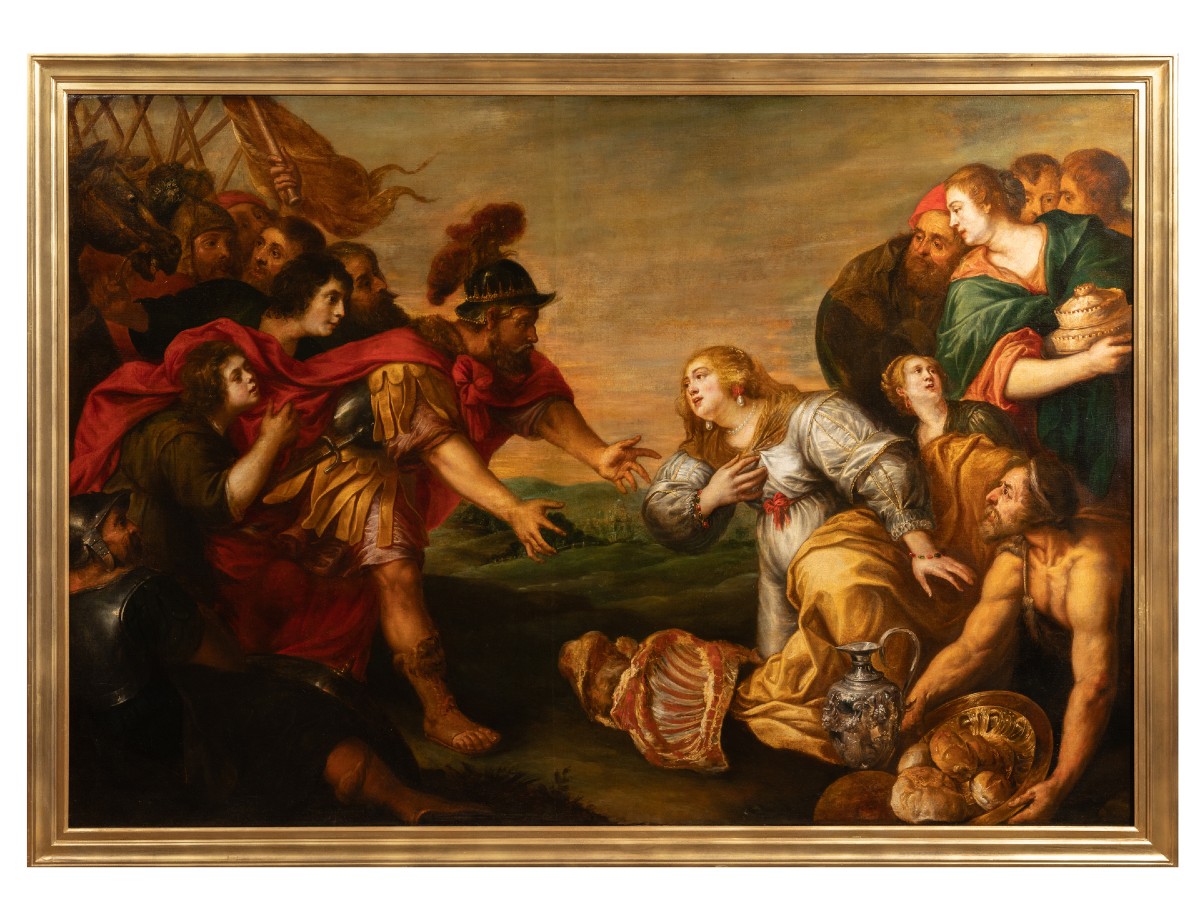
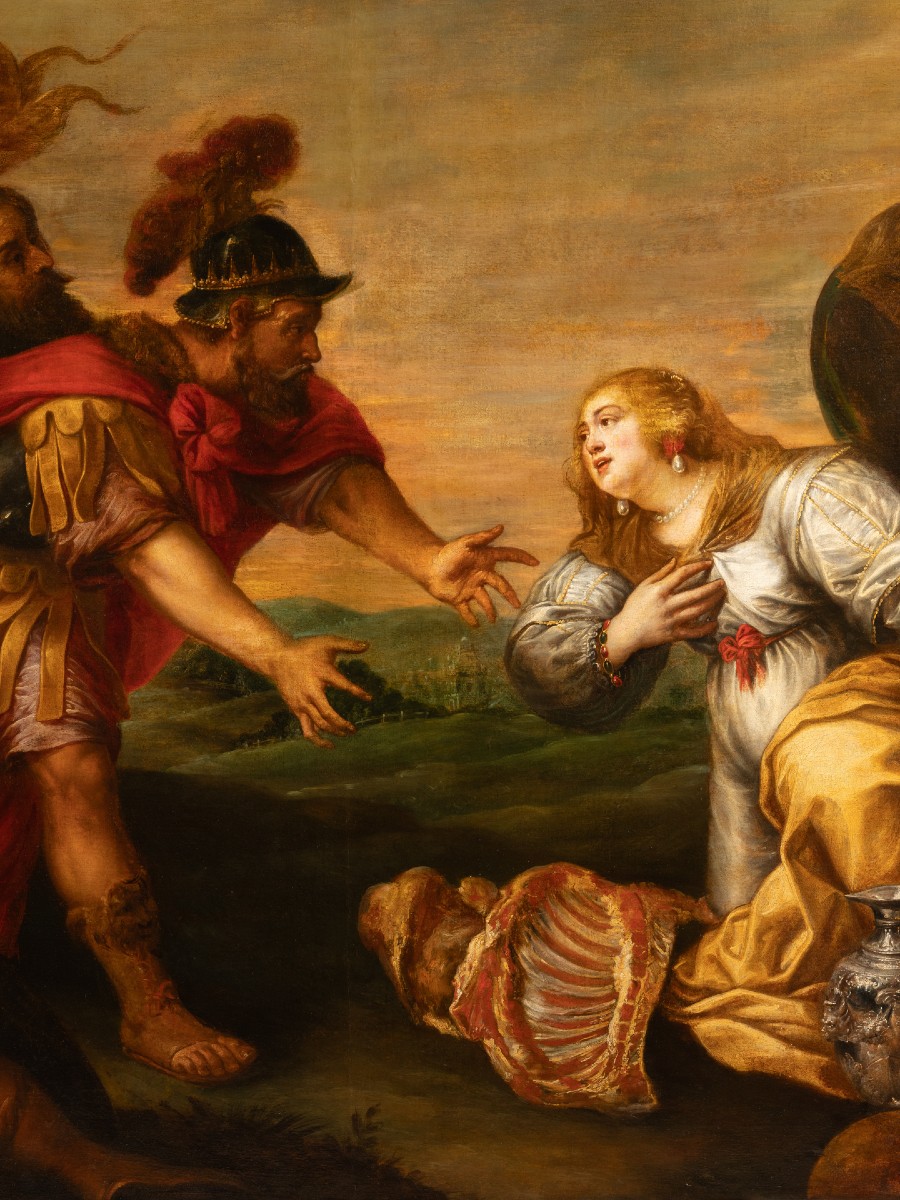


David, the third king of the Jewish people, was originally a shepherd who, through his courage, defeated the Phylistines in the 11th century BC by killing the giant Goliath. Abigail was the wife of a wealthy landowner named Nabal, who refused to supply King David's emissaries to feed his army on campaign. Faced with her husband's intransigence and David's anger, which threatened to fall upon them, Abigail decided to go and meet King David to give him the gifts. In the painting, we see David in war attire, a red cape on his shoulders, synonymous with power and glory, surrounded by a troop of soldiers rushing to raise Abigail, who had thrown herself at his feet with her arm placed over her heart. She is surrounded by her servants and some members of her family. At her feet, the offerings are placed on the ground: quarters of meat, wine in a silver jug and a golden dish filled with bread, behind stands a servant with a pie in her arms, synonymous with an offering to the Gods. Jan van den Hoecke, born in Antwerp, entered as an apprentice to the Flemish Baroque master Peter Paul Rubens (1577-1640), of whom he was one of the most talented collaborators, participating in numerous commissions, including that of the gallery of Maria de' Medici. After a stay in Italy, he opened a workshop in Antwerp and was entrusted with commissions for Ferdinand III at the court of Vienna. Related works by Jan van den Hoecke: The reconciliation between Esau and Jacob, Groeningemuseum Museum, Bruges. Hercules between vice and virtue, Uffizi Gallery, Florence. Dimensions without frame: 203 cm x 141 cm. Dimensions with frame: 215 cm x 154 cm.
Explore similar pieces and discover your ideal find:
Other Paintings