THIS OBJECT WAS SOLD
"hôtel De Ville" Chest In Walnut Wood And Wrought Iron Fittings. Castile, 17th Century.


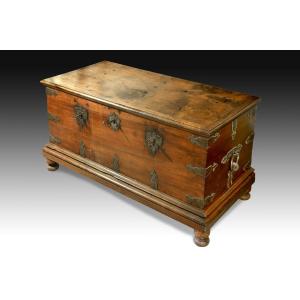


"Town Hall" chest in walnut wood and wrought iron fittings. Castile, 17th century.
Rectangular chest with a flat lid resting on four spherical feet and a prominent molding at the bottom, reinforced with corner pieces and featuring two handles with a central disc on the sides and, on the front, three bolts with a decorated lock shield highlighted on a fabric background, with their respective keys. The latter have a decorated rod and a ring with openwork circular elements. This type of chest is called "Town Hall" or "Council" due to its three locks, each closing with its own key. This furniture was used in all types of organizations, religious or civil, to store valuables, documents, or money, and each of the keys was entrusted to a person in charge, and all three must be combined to open the piece of furniture, thus avoiding any temptation. These were a very common element in the councils or town halls of cities and other towns, hence their name. Stylistically, they belong to the Baroque period due to the strength of the lower molding and the movement provided by the feet and the shapes of the different fittings. This typology was already used in the Gothic period and, given its success, it would remain common in the workshops of cabinetmakers and carpenters for many centuries. Sometimes they were made of iron and, in very rare cases, three keys were used to lock a silver chest (the one that contained the body of San Isidro, in Madrid). In many places, such as La Rioja, they served as municipal archives, in accordance with the laws inherited from a pragmatic of June 9, 1500, by which the Catholic Monarchs obliged the councils of their territories to build town halls, prisons, and have a chest of privileges and deeds. Although there were many of them at the time, few examples have survived because they fell into disuse and were replaced. Compare with the Council of Villafranca de la Marisma (Los Palacios y Villafranca, Seville), that of Valdipiélago (León), that of Matapozuelos (Valladolid), that of the Cabildo of Buenos Aires in Argentina (18th century, following earlier models), etc. -
Dimensions: 152x67.5x76 cm
Rectangular chest with a flat lid resting on four spherical feet and a prominent molding at the bottom, reinforced with corner pieces and featuring two handles with a central disc on the sides and, on the front, three bolts with a decorated lock shield highlighted on a fabric background, with their respective keys. The latter have a decorated rod and a ring with openwork circular elements. This type of chest is called "Town Hall" or "Council" due to its three locks, each closing with its own key. This furniture was used in all types of organizations, religious or civil, to store valuables, documents, or money, and each of the keys was entrusted to a person in charge, and all three must be combined to open the piece of furniture, thus avoiding any temptation. These were a very common element in the councils or town halls of cities and other towns, hence their name. Stylistically, they belong to the Baroque period due to the strength of the lower molding and the movement provided by the feet and the shapes of the different fittings. This typology was already used in the Gothic period and, given its success, it would remain common in the workshops of cabinetmakers and carpenters for many centuries. Sometimes they were made of iron and, in very rare cases, three keys were used to lock a silver chest (the one that contained the body of San Isidro, in Madrid). In many places, such as La Rioja, they served as municipal archives, in accordance with the laws inherited from a pragmatic of June 9, 1500, by which the Catholic Monarchs obliged the councils of their territories to build town halls, prisons, and have a chest of privileges and deeds. Although there were many of them at the time, few examples have survived because they fell into disuse and were replaced. Compare with the Council of Villafranca de la Marisma (Los Palacios y Villafranca, Seville), that of Valdipiélago (León), that of Matapozuelos (Valladolid), that of the Cabildo of Buenos Aires in Argentina (18th century, following earlier models), etc. -
Dimensions: 152x67.5x76 cm
Explore similar pieces and discover your ideal find:
Trunks, Chests