THIS OBJECT WAS SOLD
Louis XV Period Inkwell With Crowned C Meissen Porcelain And Gilt Bronze


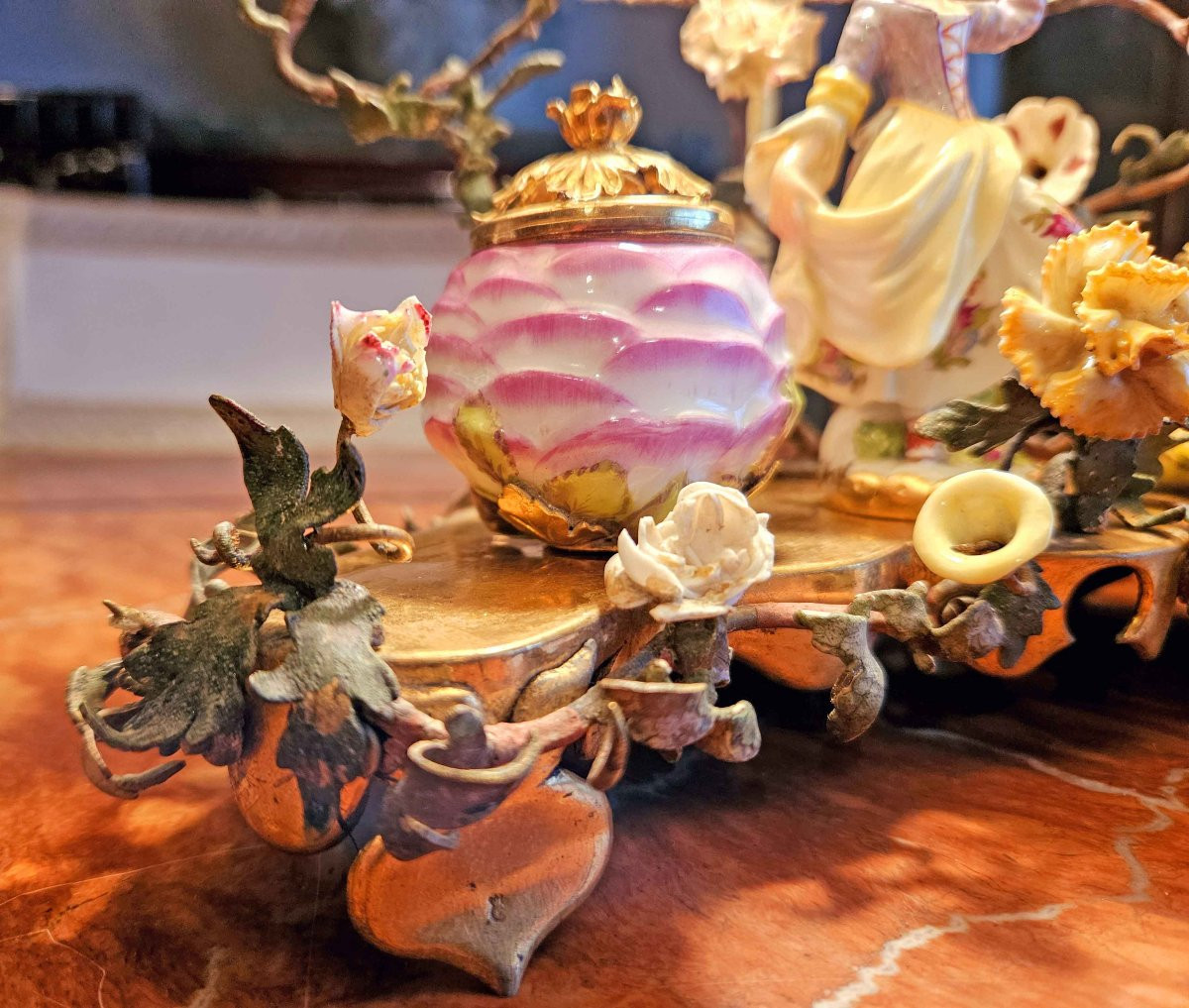


A writing desk or inkwell with a curved terrace marked with a crowned C, decorated with flowering branches in painted iron and Meissen porcelain. Louis XV period, circa 1745 - 1749 Good condition despite some missing parts, particularly to the flowers. Mounted as a lamp in the mid-20th century (possibility of removing the light arm fixed by 2 screws). The dimensions are given for the inkwell alone Total height with lampshade: 47 cm As a reminder: *An edict of 1745 required bronze makers to mark their works with a small distinctive letter, a C surmounted by a crown, thus subjecting them to the payment of a tax. This applied to both objects and furniture decorated with it. This mark, which measures only a few millimeters (from 2.5 to 5 depending on the size of the pieces), has long intrigued specialists. Is it the signature of the bronze-maker Caffieri, that of the founder Colson or even the stamp of the cabinetmaker Cressent? It was not until 1924 and Henri Nocq's thesis, Le Poinçon de Paris, that we learned that it was a mark sanctioning a tax paid on bronzes and coppers between 1745 and 1749. Like any tax, it was largely unpopular and there were many lawsuits opposing artisans to state agents. And yet the edict of February 1745 is formal: it applies to "all old and new works, of bronze, pure copper, cast iron, mixed copper, forged, ground, beaten, planed, engraved, gilded, silvered and colored, without any exception." Each craftsman must go to the mark office at the "cul-de-sac des Bourdonnais", in the Halles district, to have the hallmark stamped and pay the fee. A detail that is important: we are at the time of the War of the Austrian Succession and military needs are then pressing. In February 1749, the Peace of Aix-la-Chapelle is signed and some personalities then note the "abolition of small new taxes." But in the meantime, the hallmark must appear on all copper metal work executed or sold during these four years. The text also specifies that it concerns "all old or new work." It is therefore possible to find it on pieces prior to 1745. All that is required for this is for the object to be subjected to a new layer of gilding or for it to be put on the market during these four years. This is the case for certain pieces of furniture by André-Charles Boulle, from the Louis XIV period, but whose success continued. It is therefore possible to find it on a work prior to 1745 - even if this is rare - while it will be absent from a more recent bronze, unless it is a fake. Even if we limit ourselves to Louis XV bronzes, it is difficult to count them as the crowned C seems to have invaded furniture bronzes and decorative objects both in Paris and in the provinces during these four years. We know how many such objects were prized at the time and the success enjoyed by the bronze makers. The king found there a way to finance his campaigns, the artists a reward for their talent. And while questions remain about the different forms the hallmark took, its discovery remains a valuable reference for lovers of Louis XV bronzes.* French Gilded Bronzes of the 18th Century Pierre Verlet Picard Editeur - 1987
Explore similar pieces and discover your ideal find:
Inkwells, Desks Accessories