THIS OBJECT WAS SOLD
Incantatory Cup Near East, Mesopotamia 500 To 700 Ad


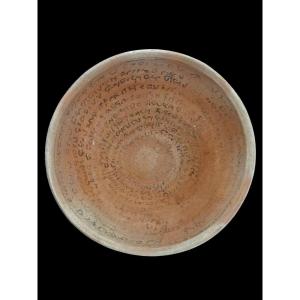


Incantatory cup, inscribed in the heart of the receptacle in Mandaean writing, (Mandaean Aramaic dialect), The text is here represented in a spiral from the bottom of the cup, the writings are in good condition and legible. Very good state of preservation. The Aramaic communities of Mesopotamia are the heirs of ancient beliefs dating back to Akkadian and even Sumerian texts, according to which demons were of an inexhaustible variety. The Mandaean, because of his dualistic faith, believes in evil spirits, whose harmful action he fears. Magic is therefore an essential aspect of his religious life. This practice, consisting of burying the cups thus inscribed in the four corners of the house, was widely disseminated among the various religious communities of Mesopotamia until the Muslim conquest and beyond. Its essential function was to protect the inhabitants of the house, to repel demons and evil spirits. Orange-beige terracotta with brown decoration (inscriptions) Near East, Mesopotamia 500 to 700 AD Dimensions: diameter 15.6 and height 7.9 cm Provenance: Michel Bouvier, Paris, (invoice dated July 26, 2007) Former collection Francois Letaillieur, Paris. "Francois Letaillieur is a collector passionate about writing, in all its forms, from cuneiform to calligraphy to hieroglyphics. This passion led him to focus on Lettrism, an avant-garde movement theorized in 1946 by Isidore Isou and Gabriel Pomerand, which focuses not on the meaning of words but on the poetry of sounds. A group of which François Letaillieur is today the greatest collector and connoisseur in the world." (Le Monde, Roxana Azimi, Published August 11, 2017). * Shipping costs on estimate.
Explore similar pieces and discover your ideal find:
Islamic Art