THIS OBJECT WAS SOLD
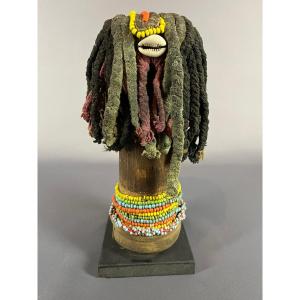
South Sotho Doll "nguana Modula", South Africa


Rare Sotho Zulu Doll This doll is part of a stylistically mysterious group called "enigma dolls" a mix of Sotho and Zulu styles. As explained in the article in "evocation of the child, fertility figures of the southern african region" (johannesburg art gallery ibsn0798138300) of which this model is the cover they write that the beading patterns are more zulu (matebele) but the shape is more sotho the V face would be explained by a missionary: F Porte on a mission to bosutholand in 1880 (cf F Porte "the reminiscences of a missionary from basutholand 1881-1895. Lesotho collection, anthropological studies The social center) he indicates that the faces of the young girls were disfigured by V tattoos. he indicates that they drew a line from one ear to the other passing halfway between the lip and the chin. After puberty a line was added which passed under the jaw line. So the double line represents southern Sotho scarification and should be identified as such the problem is that the dolls are more Zulu in their decoration there are several possibilities: Zulu soldiers fled after expeditions where they lost the battle and fled to the Sotho region to avoid death. This would explain why they maintained their traditions allowing Zulu women to bead Sotho dolls. Another possibility is that some Sotho groups lived in Zulu country like the Tlokwe living there and marrying Zulu women who created Zulu-Sotho dolls ex French collection
Explore similar pieces and discover your ideal find:
Tribal Art