THIS OBJECT WAS SOLD
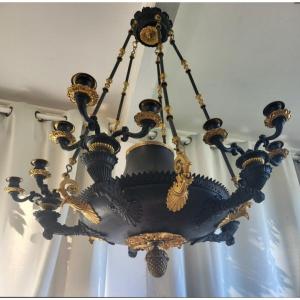
Bronze Neo-pompeian Chandelier By Hermann Hohn With A Sculpture By Otto Schmidt-hofer
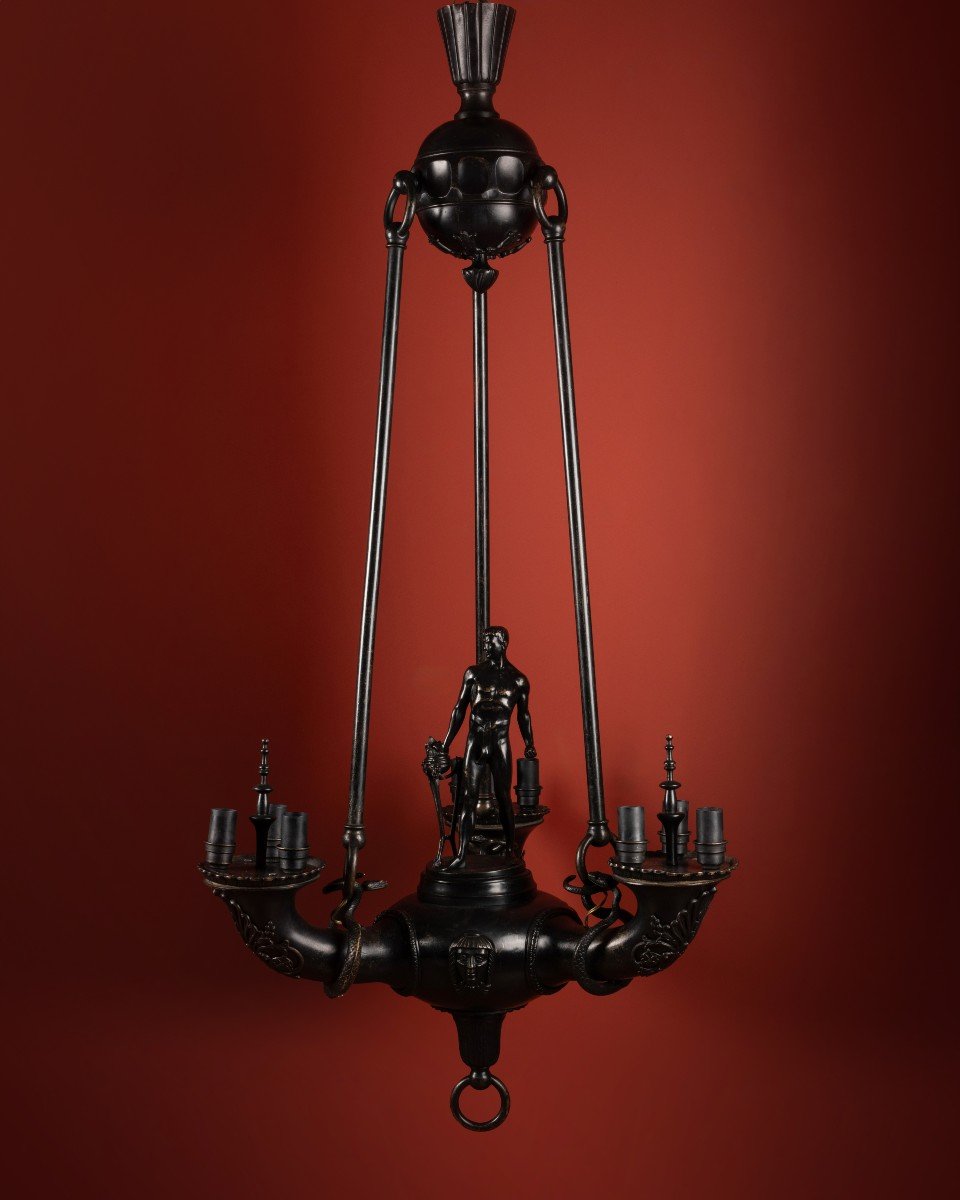




Bronze Neo-Pompeian Chandelier by Hermann Hohn with a sculpture by Otto Schmidt-Hofer.
Dark patina bronze.
Germany.
ca. 1911.
h. 45,3 in. ; l. 20,8 in.
Dark patina, Neo-Pompeian bronze chandelier for twelve candles, inspired by the many ancient Roman oil lamps unearthed in Italy throughout the second half of the 18th century.
The chandelier, prepared for electrification, is crowned by a bronze sculpture signed by the German sculptor Otto Schmidt-Hofer (1873-1925). The bronze sculpture features Caius Mucius Scaevola, an early Roman hero who, in 507 BC, as the Romans were besieged by the Etruscans, decided to infiltrate their campement armed with a dagger hidden under his clothes, in order to execute Porsenna, king of the Etruscans. Upon entering the camp, Caius Mucius was unable to distinguish the king from one of his ministers, as both wore luxurious clothing. Caius Mucius feared asking which of the two was Porsenna, lest it be discovered as a foreigner and denounced. Caius threw himself at one of them and stabbed him. He did not kill the king, but the minister. Brought before a tribunal, after making a bold and threatening speech that would become famous, Porsenna condemned Caius Mucius to death by fire, lest he would reveal what the Romans were plotting against him : it is then that Caius Mucius decided to put himself his right hand to the fire, looking straight at Porsenna, and saying : Here, so that you may judge how little the body means to those who are looking forward only to the highest glory.
It is this precise moment that the sculptor depicted, perhaps the most famous in the second book of Livy's Roman History. Porsenna, both terrified and admiring the fortitude of the Romans, forgives Caius Mucius, sets him free and considers making peace with the Romans. Caius Mucius, having returned to Rome, earns the cognomen, i.e. the nickname, of Scaevola, from scaevus (left), he who had boldly and patriotically lost his right hand in Etruscan fire.
The style of Schmidt-Hofer's Scaevola is that of a transitional period between the German classical revival of Adolf von Hildebrand and the quasi Art Deco style of Antoine Bourdelle, Aristide Maillol and the likes.
While the Scaevola sculpture bears Schmidt-Hofer's signature on its base, the chandelier is most likely the creation of Hermann Hohn, the German bronze-maker who designed several Neo-Pompeian chandeliers in the late 19th century. In order to make his chandeliers even more luxurious, Hermann Hohn commissioned several sculptors to crown them with different sculptures, thus bringing the German tradition of the figure chandelier into fashion.
Sources
Henry René d'Allemagne, Histoire du luminaire depuis l'époque romaine jusqu'au XIXe siècle, vol. I, Paris, 1891.
Kurt Jarmuth, Lichter Leuchten im Abendland, Brunswick, 1967.
Dark patina bronze.
Germany.
ca. 1911.
h. 45,3 in. ; l. 20,8 in.
Dark patina, Neo-Pompeian bronze chandelier for twelve candles, inspired by the many ancient Roman oil lamps unearthed in Italy throughout the second half of the 18th century.
The chandelier, prepared for electrification, is crowned by a bronze sculpture signed by the German sculptor Otto Schmidt-Hofer (1873-1925). The bronze sculpture features Caius Mucius Scaevola, an early Roman hero who, in 507 BC, as the Romans were besieged by the Etruscans, decided to infiltrate their campement armed with a dagger hidden under his clothes, in order to execute Porsenna, king of the Etruscans. Upon entering the camp, Caius Mucius was unable to distinguish the king from one of his ministers, as both wore luxurious clothing. Caius Mucius feared asking which of the two was Porsenna, lest it be discovered as a foreigner and denounced. Caius threw himself at one of them and stabbed him. He did not kill the king, but the minister. Brought before a tribunal, after making a bold and threatening speech that would become famous, Porsenna condemned Caius Mucius to death by fire, lest he would reveal what the Romans were plotting against him : it is then that Caius Mucius decided to put himself his right hand to the fire, looking straight at Porsenna, and saying : Here, so that you may judge how little the body means to those who are looking forward only to the highest glory.
It is this precise moment that the sculptor depicted, perhaps the most famous in the second book of Livy's Roman History. Porsenna, both terrified and admiring the fortitude of the Romans, forgives Caius Mucius, sets him free and considers making peace with the Romans. Caius Mucius, having returned to Rome, earns the cognomen, i.e. the nickname, of Scaevola, from scaevus (left), he who had boldly and patriotically lost his right hand in Etruscan fire.
The style of Schmidt-Hofer's Scaevola is that of a transitional period between the German classical revival of Adolf von Hildebrand and the quasi Art Deco style of Antoine Bourdelle, Aristide Maillol and the likes.
While the Scaevola sculpture bears Schmidt-Hofer's signature on its base, the chandelier is most likely the creation of Hermann Hohn, the German bronze-maker who designed several Neo-Pompeian chandeliers in the late 19th century. In order to make his chandeliers even more luxurious, Hermann Hohn commissioned several sculptors to crown them with different sculptures, thus bringing the German tradition of the figure chandelier into fashion.
Sources
Henry René d'Allemagne, Histoire du luminaire depuis l'époque romaine jusqu'au XIXe siècle, vol. I, Paris, 1891.
Kurt Jarmuth, Lichter Leuchten im Abendland, Brunswick, 1967.
Explore similar pieces and discover your ideal find:
Chandeliers, Pendants