THIS OBJECT WAS SOLD
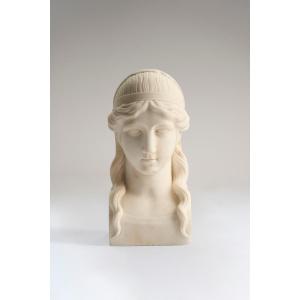
Porphyry Bust


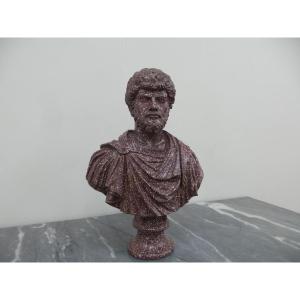


Rare porphyry bust representing Lucius Verus. Period 19th century Lucius Aurelius Verus, born in Rome on December 15, 130 under the name of Lucius Ceionius Commodus, adopted in 138 by Antoninus the Pious under the name of Lucius Aelius Aurelius Commodus, is Roman co-emperor with Marcus Aurelius from March 8, 161 to January 169, date of his death at Altinum in Veneto. He then bears the name and nicknames of Imperator Caesar Lucius Aurelius Verus Augustus Armeniacus Parthicus Maximus Medicus. He is the son of Lucius Ceionius Commodus whom Emperor Hadrian adopted in 136 under the name Lucius Aelius Caesar. His father was in poor health, known for leading a frivolous life, and died shortly before the emperor. In 138, Hadrian imposed on his new heir Antoninus the Pious to adopt the young Ceionius Commodus at the same time as Marcus Aurelius. In 161, on the death of Antoninus Pius, he became co-Roman emperor with Marcus Aurelius. Not devoid of qualities, in 162 he supervised a campaign against the Parthians. But more interested in a life of lust and debauchery, he left the reality of military operations to his legates Marcus Statius Priscus, who regained control of the kingdom of Armenia in 163, and especially to Avidius Cassius, who advanced into Mesopotamia and captured Seleucia of the Tigris, which he sacked, and Ctesiphon, the Parthian capital, in the year 165. The successes of his generals made it possible to extend the border of the Empire to the east of the Euphrates, to Doura Europos. He marries Lucilla, the daughter of Marcus Aurelius. Returning to Rome between 166 and 168, he continued to lead a life of luxury while nevertheless carrying out official tasks with a certain efficiency. Returning to the front, this time on the Danube to face the Marcomanni in particular, he fell ill and died on the return journey from Aquileia to Rome of apoplexy, prematurely worn out by his excesses, of the plague, or more probably from smallpox, in January 169, leaving the Empire to Marcus Aurelius alone. Despite differences between them, Marcus Aurelius accompanies the body to Rome, offers games to honor his memory and the Senate decides on his deification: he becomes Divus Verus.
Explore similar pieces and discover your ideal find:
Marble & Stone Sculptures