

The blue-and-white ceramics that swept across Europe from the sixteenth to the eighteenth century could be seen as symbols of the cultural and technological cross-fertilization inherent in the arts. Chinese blue-and-white porcelain inspired new tastes and styles, while stimulating the development of more local alternatives throughout Europe in the form of tin-glazed earthenware.
In this article, we explore the origins of Delftware and the influences that reached the Dutch Republic from abroad. These influences proved fundamental to the emergence of ceramics that remain renowned worldwide, more than three centuries after their beginnings.
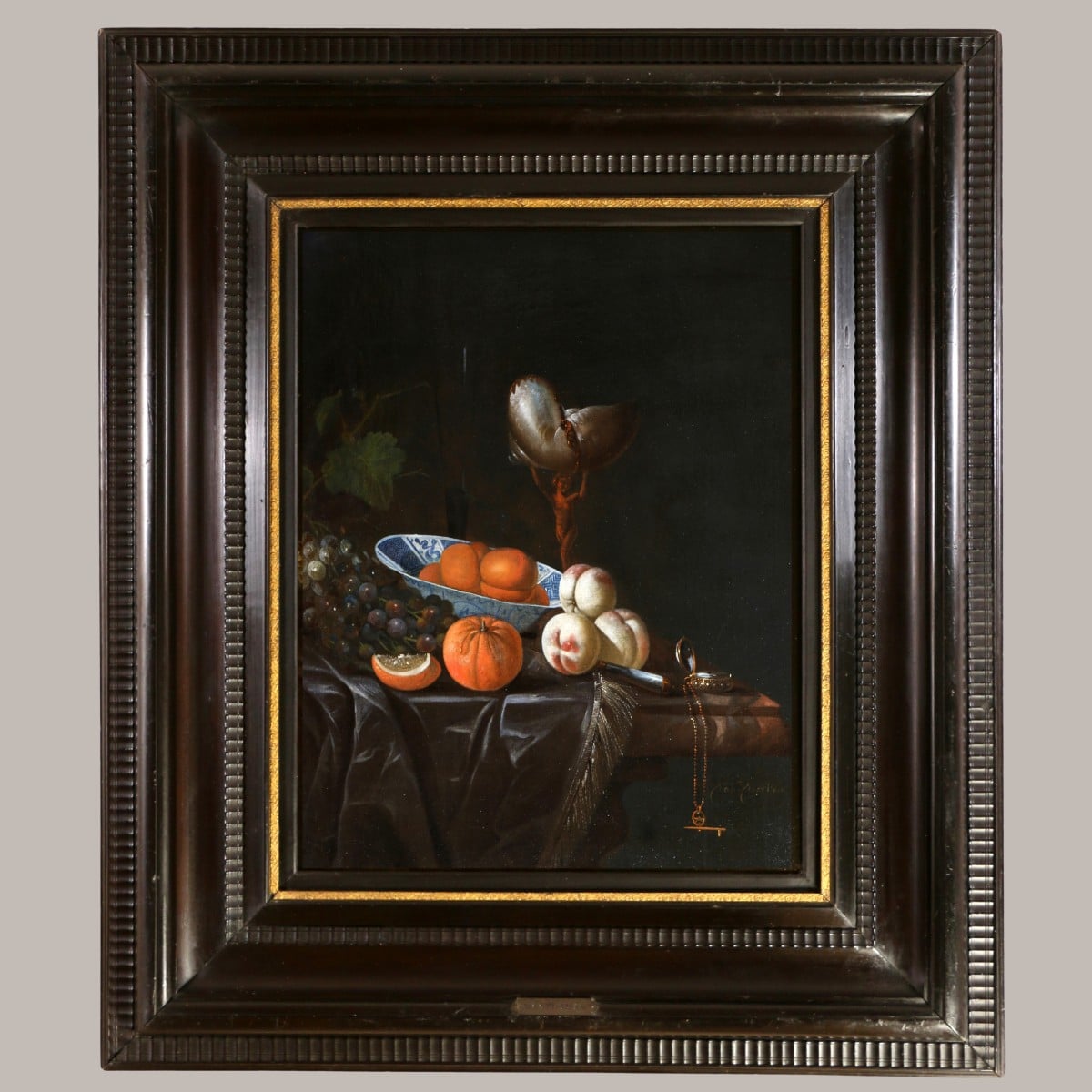
17th-century still life painting by Huybert Van Westhoven (1642-1712). A Kraak porcelain bowl among other expensive goods. © Galerie PhC
In the painting above, a still life evokes the luxury of the Dutch Golden Age, with a piece of Kraak porcelain displayed among other precious objects. Kraak was undoubtedly the most emblematic Chinese export porcelain to reach Europe before Delftware emerged. Yet, to understand the origins of Delftware, we must also consider the various types of porcelain imported through the beginning of the Qing dynasty and identify the major Chinese motifs and forms that captivated the West before being reinterpreted by Delft potters.
Chinese Porcelain Imports: A First Phase Dominated by the Portuguese
The Portuguese were the first Europeans to organize regular imports of Chinese porcelain, expanding this trade from the early 1530s. Lisbon’s Santos Palace (now the French embassy in Portugal) offers a spectacular testimony to the fascination it inspired: its Porcelain Room contains more than 260 Chinese dishes and plates, mostly sixteenth- and early-seventeenth-century blue-and-white wares, displayed across a gilded pyramidal ceiling.
Much of the porcelain reaching Europe came from the kilns of Jingdezhen and was made for export, tailored to foreign tastes. Europeans particularly admired the contrast between its luminous cobalt decoration and its fine, lightweight body: a milky white material, subtly tinged with green beneath a remarkably smooth and brilliant glaze.
First Orders and European Tastes
From around 1514, during the reign of the Ming emperor Zhengde (1506–1521), the Portuguese became the first Europeans to commission porcelain from Jingdezhen. Made for Manuel I and noble families, these rare blue-and-white vessels combine Chinese forms and motifs with Portuguese coats of arms, Christian emblems and the king’s armillary sphere. Ewers and dishes in the Medeiros e Almeida collection offer some of the earliest surviving evidence of this artistic exchange.
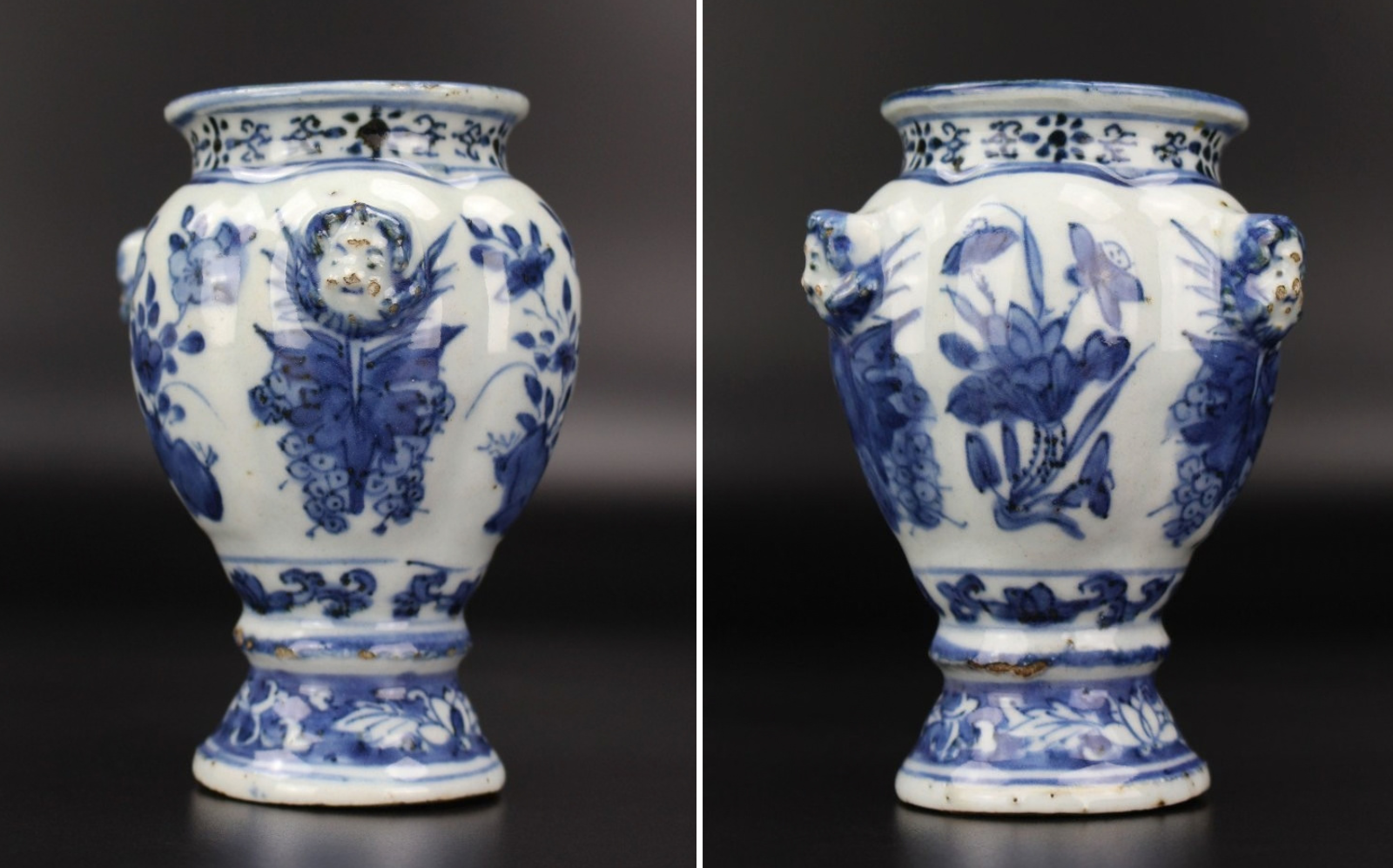
The pairing of angels with grape motifs further suggests a Eucharistic theme, likely for the Portuguese Jesuit market. This Chinese blue-and-white jar was probably made circa 1610-1630. © Menken Works of Art
Such adaptations continued as other European nations entered the trade, with vessels tailored to European uses, often following silverware models, and decoration incorporating Western imagery. The vase illustrated here, circa 1610–1630, probably made for Portuguese Jesuits, combines relief cherub heads and grapevines with Chinese floral and lotus motifs. It exemplifies the cultural hybridization of export porcelain, shaped by European demand and Chinese craftsmanship.
A Rich Decorative Repertoire: Zhengde, Jiajing, and Longqing
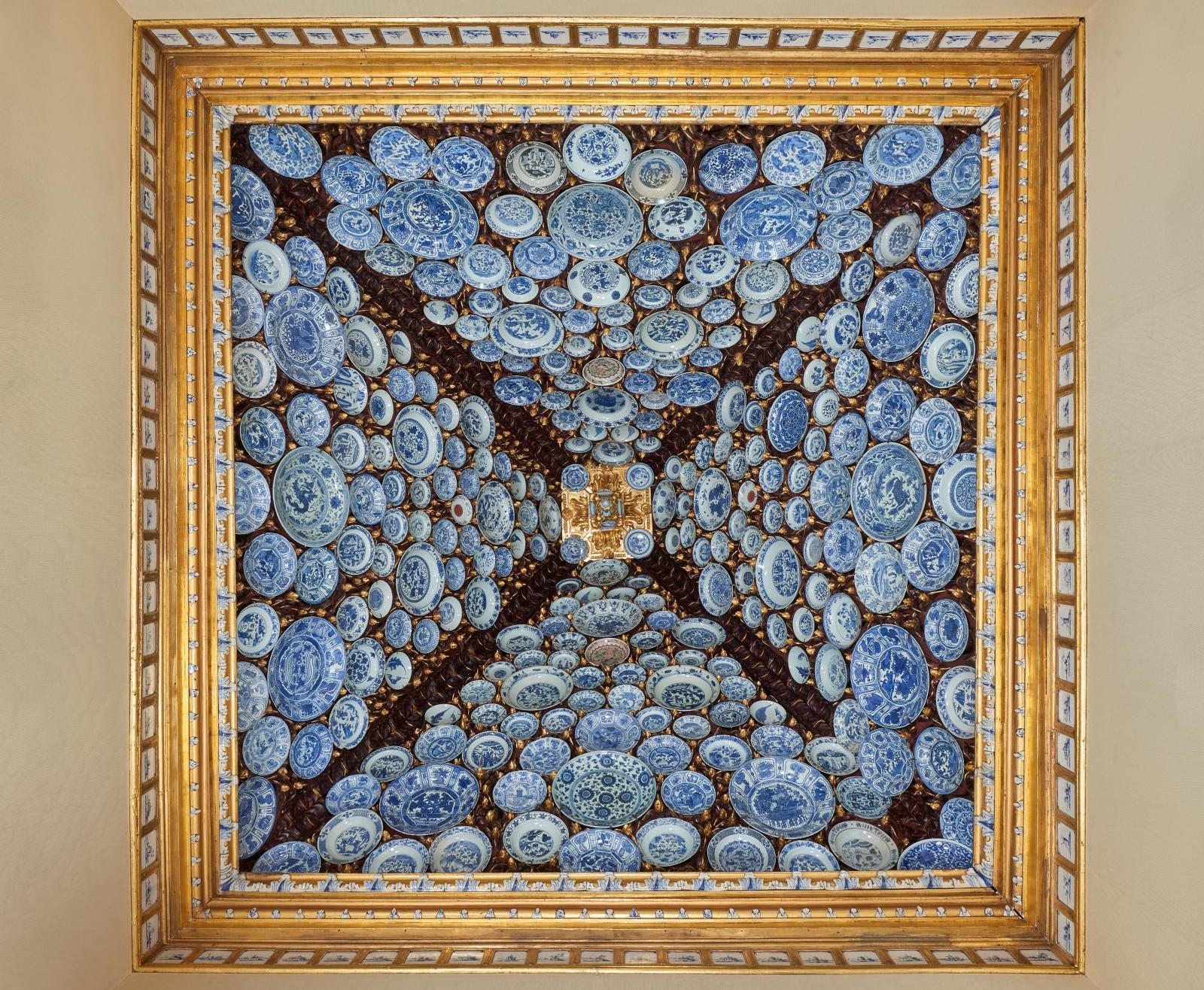
Produced at Jingdezhen during the late Ming dynasty, chiefly from the Wanli reign (1573–1620) to that of Chongzhen (1628–1644), Kraak porcelain dominated Chinese exports until around 1635. Its name probably derives from the Portuguese carraca, the merchant ships that first carried it to Europe, but it became more closely associated with the Dutch as trade expanded dramatically under their auspices.
Kraak was not a single, unchanging style. Its light, highly vitrified body, thin edges, lobed rims and molded divisions distinguish it from earlier export porcelain. Its brilliant glaze often flakes at the rim, producing a “moth-eaten edge.” The cobalt decoration was organized around a central medallion and radial compartments covering the well and rim.

17th-century Kraak porcelain bowl with a diameter of 35.4 cm. Central medallion with two birds among peonies. Radial panels with chrysanthemums, peaches, lozenge with ribbon. © Galerie Drake
In the earliest Kraak designs, the radial panels are contiguous and separated only by single or double lines. Traditional subjects—deer, birds, insects and landscapes—remain prominent in the central medallion, while the surrounding compartments contain finely painted flowers, fruit and auspicious emblems. Narrow bands were gradually inserted between the broader panels, establishing the alternating rhythm that became one of the most recognizable features of Kraak porcelain.
As the formula developed, the divisions became more elaborate. Geometric designs increasingly surrounded the central medallion and filled the narrow bands, while the broader panels were sometimes enclosed within lobed cartouches. Auspicious and symbolic objects, initially confined to the border, began to appear as principal subjects alongside women in gardens, flower baskets, birds and landscapes. Quality varied considerably: the finest dishes have precise drawing and brilliant, subtly modulated blues, whereas mass production encouraged hurried execution, grayish cobalt and increasingly careless secondary decoration.
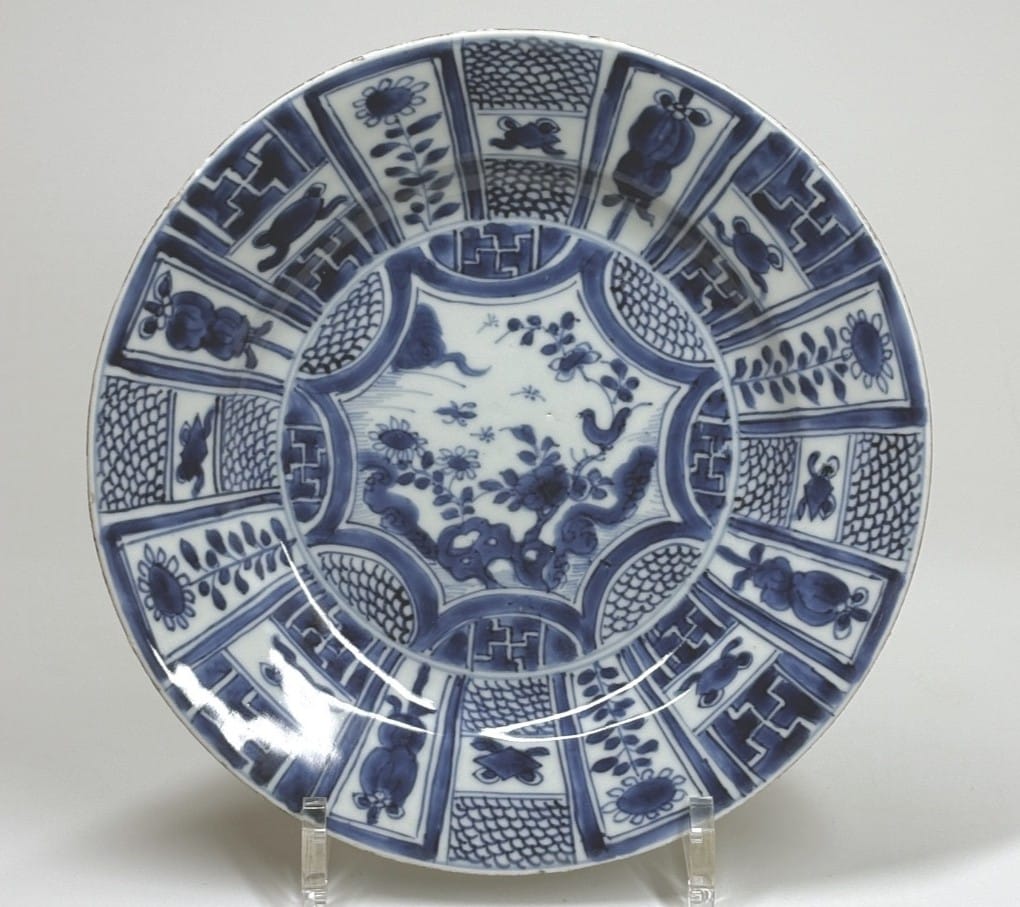
Prominent geometric patterns on this 17th-century Kraak porcelain plate (circa 1660). The center is emphasized by its star shape. © Bils Céramiques
In later examples, the radial compartments evolved into fruit-shaped medallions, particularly peaches. These were arranged around an increasingly angular central field that eventually assumed a star-like form. Larger dishes generally retained more complex geometric borders and finer painting, while smaller examples were often simpler and more rapidly executed. Abundantly represented in northern European collections and shipwreck cargoes, this adaptable system of a central image framed by radiating compartments became one of the principal models imitated by European potters.
Transitional Porcelain
Following the death of the Wanli Emperor in 1620, China entered a prolonged period of rebellion and dynastic conflict. As imperial patronage declined, skilled potters and painters increasingly worked for private kilns at Jingdezhen, serving domestic and foreign clients. This greater freedom encouraged the new forms and decoration now known as Transitional porcelain.
Rigid Kraak-style panels gave way to continuous landscapes and narrative scenes, sometimes inspired by illustrations in Chinese books. Scholars, horsemen, and attendants appeared among rocks, fences, terraces, and pavilions, surrounded by grasses, ferns, palms, and elongated flowering plants. Some romance scenes as well.
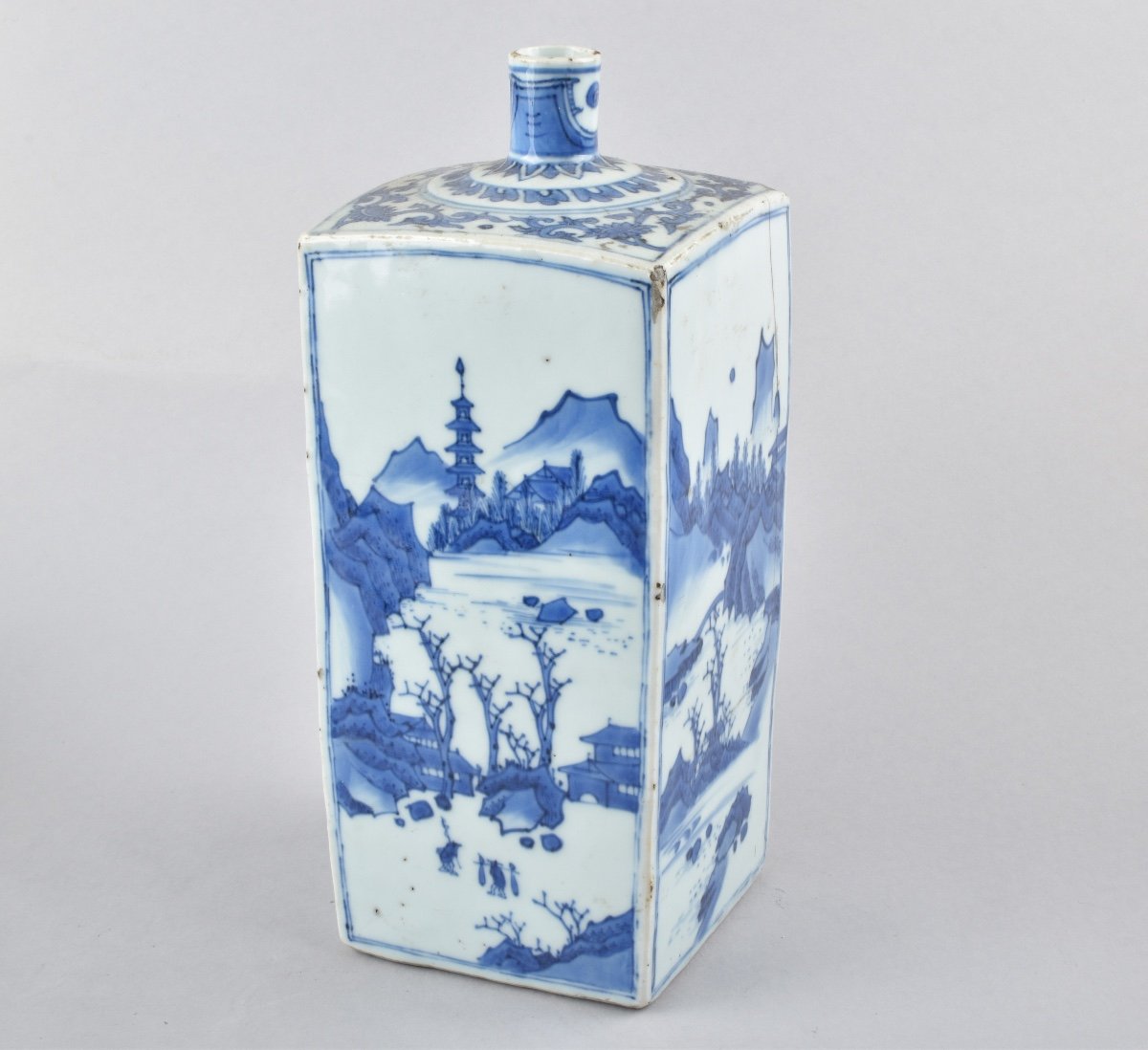
A Chinese blue-and-white porcelain bottle vase decorated with landscapes. From the Transitional period, circa 1630-1640. © Galerie Porcelaine des Compagnie des Indes
The Manchu conquest established the Qing dynasty in 1644, although resistance continued for decades. Warfare disrupted Jingdezhen and its supply routes, bringing regular VOC imports of Chinese porcelain almost to a halt from the late 1640s. Trade recovered only around 1680.
The Dutch Reaction to the Ming Dynasty Collapse
Find Another Source of Porcelain: Japan
When civil war disrupted Chinese porcelain exports, the VOC turned to Japan. Following the invasions of Korea in the 1590s, Korean potters had settled in Kyushu, where suitable porcelain stone was discovered near Arita. Their expertise laid the foundations of Japanese porcelain production. Meanwhile, the Portuguese were expelled from Japan in 1639, and the Dutch trading post was transferred to Dejima in 1641.
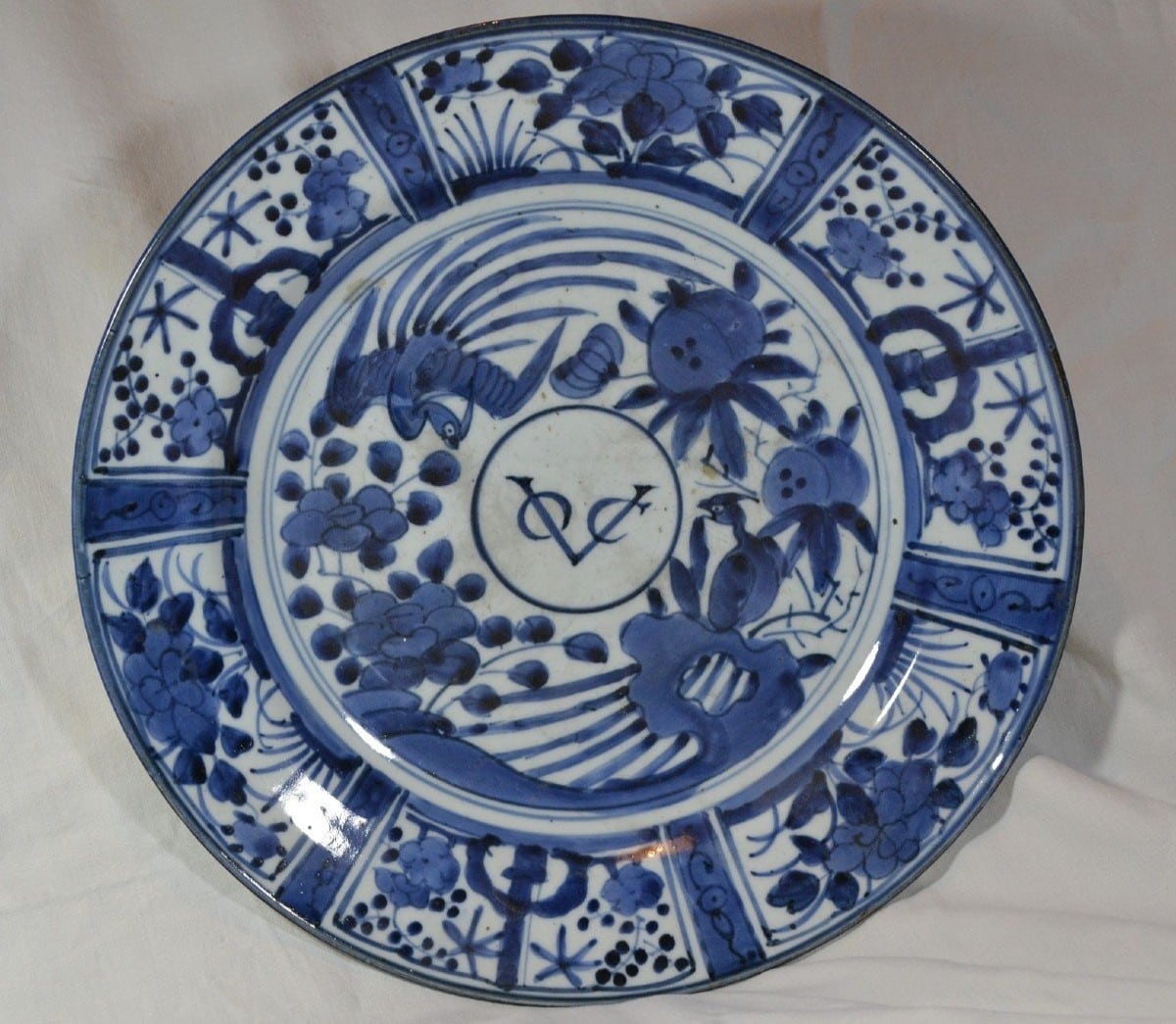
Late 17th-century Arita porcelain charger inspired by Chinese Kraak porcelain. Such dishes with the VOC mark were for high-ranking staff of the Dutch Vereenigde Oostindische Compagnie. © Conservatoire Sakura
From the 1650s, the VOC exported Arita porcelain in increasing quantities. Early wares imitated Chinese Kraak and Transitional designs, generally with softer blue and freer brushwork, before distinctively Japanese polychrome styles such as Kakiemon and Imari emerged. For more, see our article on The Ceramics of Hizen Province. When Chinese exports resumed in the 1680s, cheaper Jingdezhen porcelain again offered fierce competition.
Producing New Ceramics with Italian Technology: Delftware
European demand for porcelain far exceeded imports, yet its manufacture remained a mystery. Even the Medici workshop’s experimental soft-paste porcelain, developed in Florence around 1575, was costly and short-lived. If Europeans could not reproduce porcelain’s fine white body, however, they could imitate its appearance.
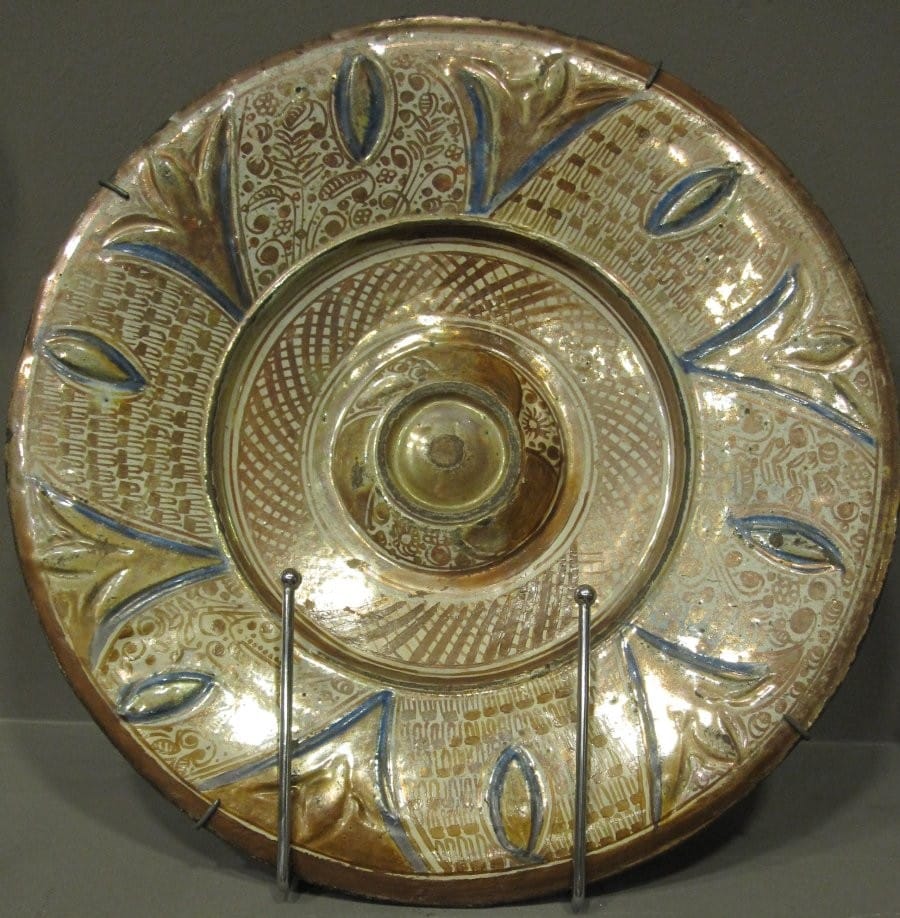
This 16th-century Hispano-Moresque lustreware dish features a raised central boss. The broad rim is decorated with foliage highlighted in blue against a background strewn with alternating solfas and tiny flowers. © Martin Villena Librero & Anticuario
The solution was maiolica: earthenware coated with an opaque white tin glaze, upon which colourful decoration could be painted. Developed in the Islamic world and transmitted to Italy through Hispano-Moresque pottery, the technique travelled north with Italian craftsmen.
Around 1508, Guido di Savino—later known as Guido Andries—settled in Antwerp and established an influential workshop. Antwerp subsequently became a centre from which this expertise spread to the Northern Netherlands, England, and Germany, laying the technological foundations for Delftware.

Polychrome majolica floor tiles of the type found at Herkenrode Abbey, made in Guido Andries’s Den Salm workshop, c. 1530–1540. © Mazereeuw Antiquair
Delftware: The Basics
The original aim of the pottery produced in Delft—in the province of Holland, within the young Dutch Republic—was to create the illusion of Chinese porcelain. The name of the first workshop, established by Herman Pietersz in 1598, perfectly illustrates this ambition: De Porceleyne Schotel (The Porcelain Dish).
Delftware reached its golden age in the late seventeenth century, particularly around 1680, although the period may be defined more broadly as extending from about 1640 to 1740. Delftware began as a blue-and-white ceramic tradition, and the vast majority of pieces remained so. Some, however, were left entirely white and became known as Delft Wits. From around 1670, green, yellow and brick red were added to the decorative palette.
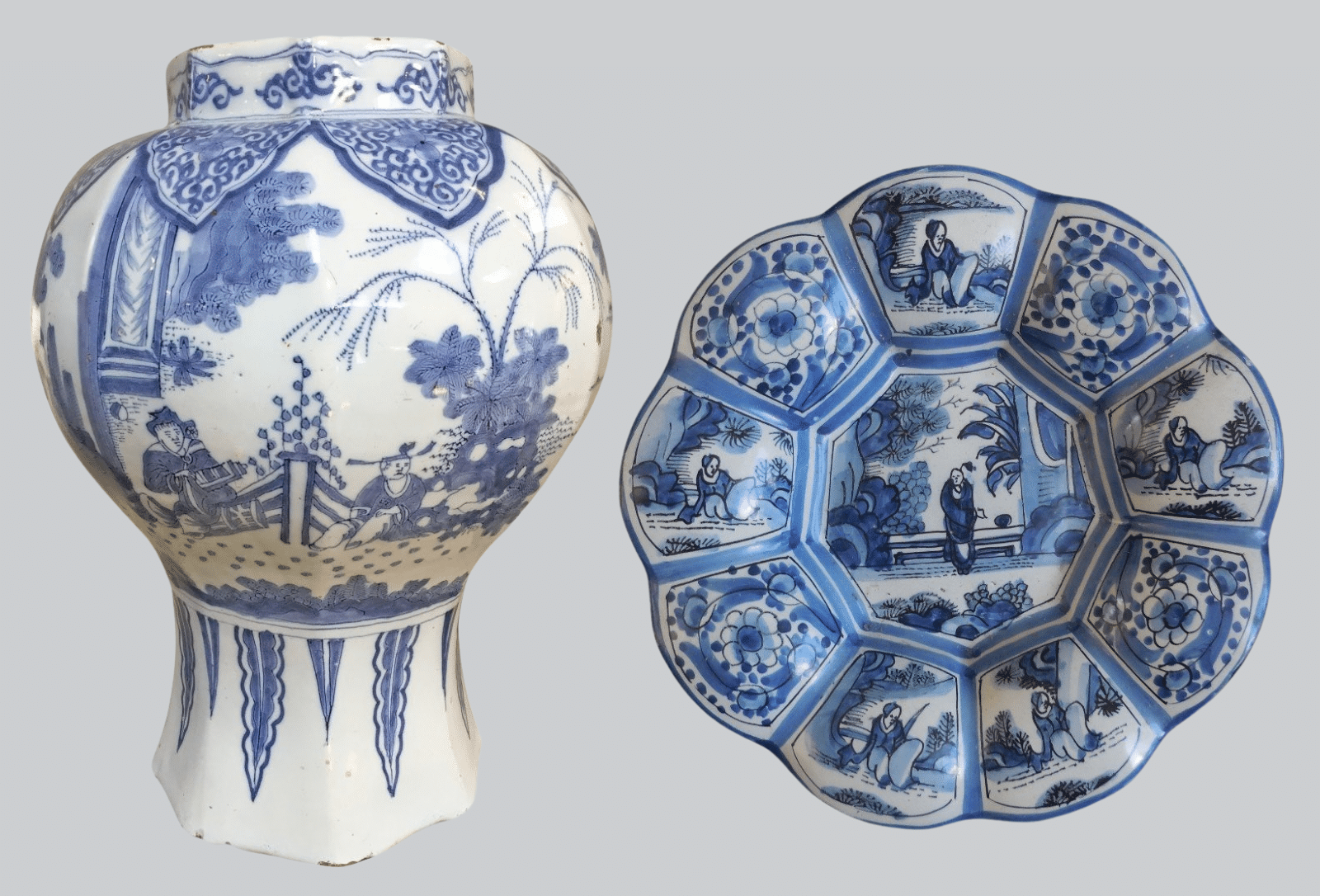
Two examples of Delft chinoiserie ceramics from the 17th century: a baluster vase (© Mazereeuw Antiquair) and a plate (© Galerie L’Héritage) that illustrate the range of blue tones and brushwork.
Technically, Delftware owed its fame to a thin, finely made earthenware body covered with an opaque white tin glaze. On finer pieces, an additional transparent lead glaze, known as kwaart, was applied before a second firing to enhance the brilliance and imitate porcelain’s glossy finish.
Cobalt-blue decoration, painted onto the unfired glaze, further enhanced this porcelain-like effect. Rather than using a single flat blue, Delft painters combined dark outlines—the trek—with paler washes and intermediate tones to suggest volume, distance, and shadow. Early pieces often display soft lavender-blue hues, while deeper blues became more common towards the end of the 17th century.
What Delftware Borrowed From Chinese Porcelain
As noted earlier, the porcelain imported from China was adapted to European markets. Nevertheless, Chinese forms and motifs remained essential to its appeal. Delftware did more than imitate the physical appearance of porcelain: it also drew extensively on the Chinese iconographic repertoire, even though many pieces remained firmly rooted in Western decorative traditions.
Our purpose here is not to explore the broader history of chinoiserie, which is far richer than the simple copying of Chinese designs. But we draw on the porcelain styles discussed above to identify the main decorative elements that caught European eyes and were adopted by Delft potters.
Motifs That Instantly Evoke China
Europeans adopted not only Chinese motifs but also their arrangement into medallions, radiating panels, reserves or continuous scenes.
Ruyi and Lingzhi
Among the most recurring ornaments was the ruyi head, derived from the curved end of a ceremonial sceptre whose name evokes the fulfilment of wishes. Its shape was closely associated with the lingzhi, the sacred fungus believed to confer longevity or immortality. Both motifs frequently appear amid stylized clouds, sometimes becoming almost indistinguishable from them. Detached from their original meaning, their sinuous outlines became a familiar element of chinoiserie decoration.
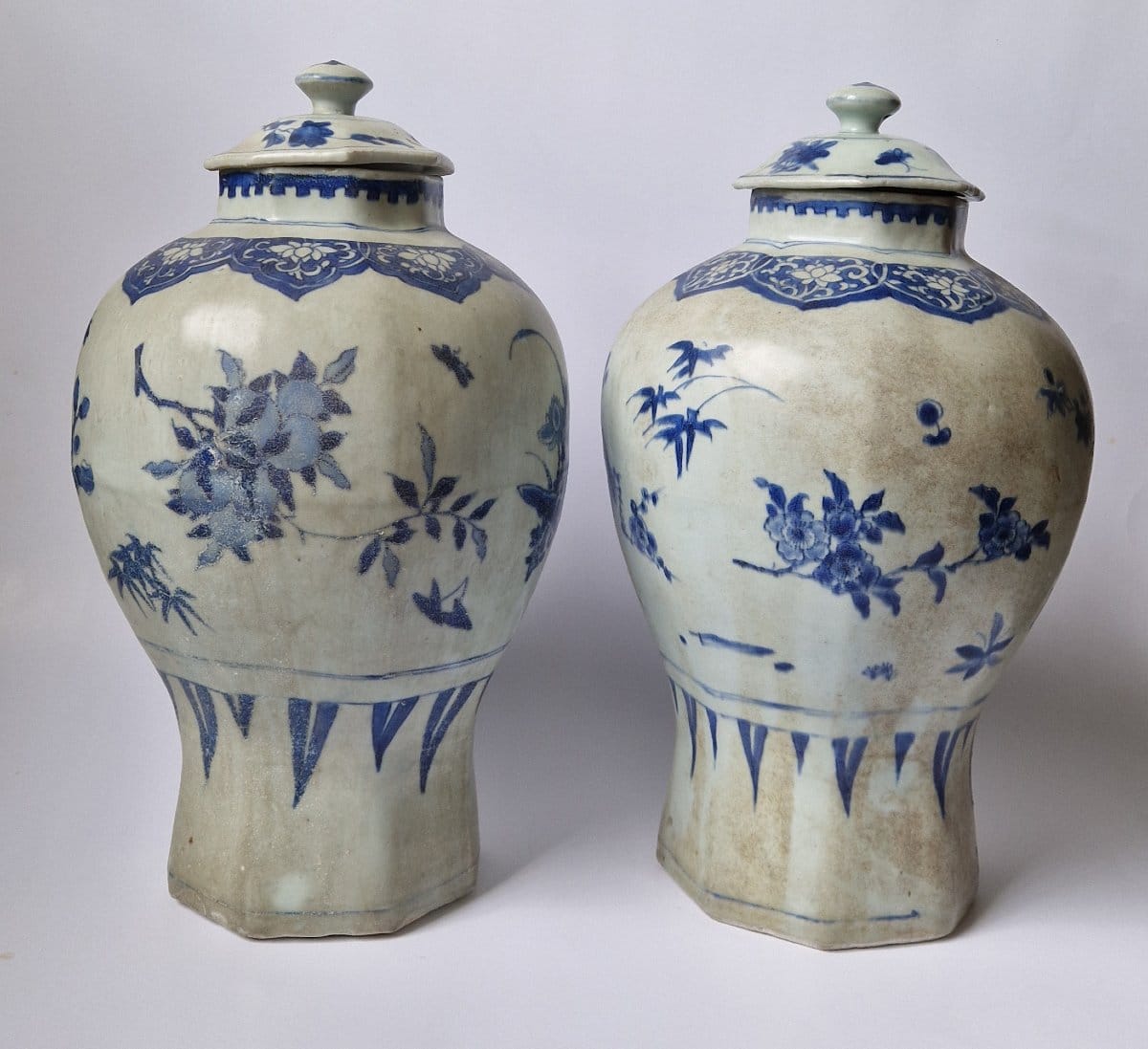
Note the two types of borders on this Transitional-style porcelain: a band of ruyi heads around the top of the neck and, below, a border of pendant banana leaves framing the principal decoration. This pair of blue-and-white covered jars is from the Hatcher cargo found in 1983. The shipwreck happened around 1643-1646 near the waters of Batavia. © Red Rose Fine Art
Symbols and Objects
The “Hundred Antiques” (bogu) brought together ancient bronzes, vases, books, scrolls and scholars’ objects, reflecting the antiquarian culture epitomized by catalogues such as the Xuanhe Bogu Tulu. These arrangements could be combined with Buddhist and Daoist emblems, particularly the Eight Auspicious Symbols (bajixiang): the wheel, conch shell, parasol, victory banner, lotus, paired fish, treasure vase and endless knot. Such motifs appeared frequently on export porcelain, including Kraak wares.
They should not be confused with the Eight Precious Objects (babao), whose composition varied. On Ming porcelain, they commonly included the flaming pearl, double lozenge, stone chime, pair of rhinoceros horns, paired coins, gold or silver ingot, coral branch and ruyi sceptre.
Often tied with fluttering ribbons and separated by flowers or clouds, these objects appealed to Western decorators primarily for their ornamental qualities. Their symbolism was generally misunderstood, and Delftware chinoiseries consequently combined elements from bogu, bajixiang and babao with considerable freedom.
Landscapes and Nature
Chinese porcelain introduced European decorators to a distinctive landscape vocabulary: pagodas and pavilions, fantastic rocks, waterfalls, figures crossing bridges, and sampans or junks navigating rivers, lakes and coastal waters. Buildings in the foreground were often partly concealed behind rocks or clouds, creating successive layers of scenery. Flowers—including chrysanthemums, lotus, peonies and camellias—were equally prominent, whether arranged in gardens, vases or ornamental borders.
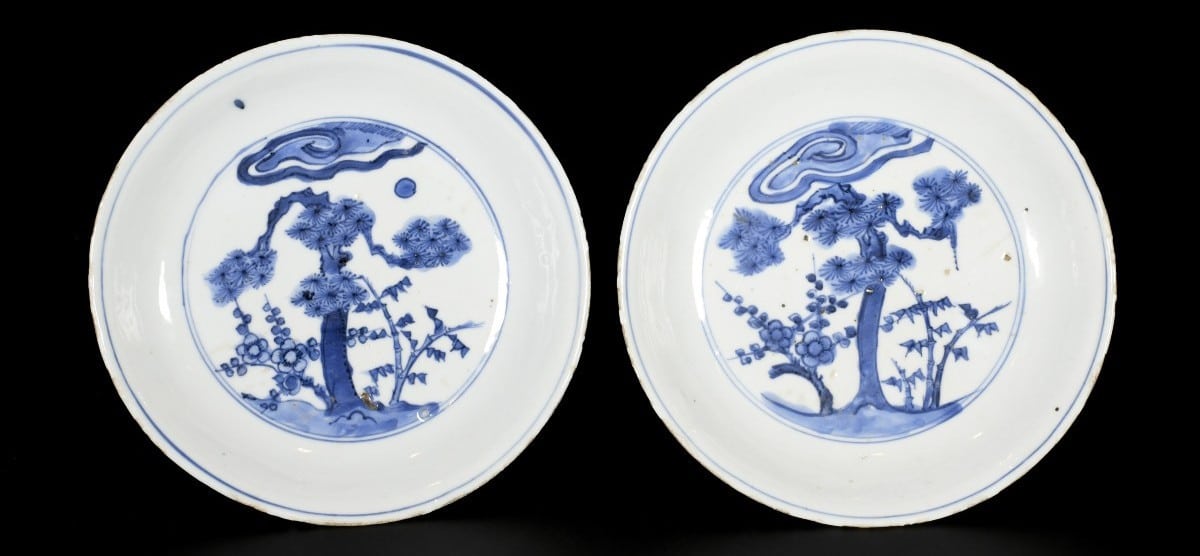
“Three Friends of Winter” on this pair of saucers from the Wanli period (1573-1620). © Galerie Drake
Certain plants carried particular symbolic importance. The “Three Friends of Winter”—pine, bamboo and flowering prunus—represented perseverance and resilience. The peach tree, especially when shown with a gnarled trunk, symbolized longevity, while its fruit was frequently combined with flowers and auspicious emblems. Banana plants, with their broad leaves, also became a favourite feature: their foliage could frame a scene or form a border and appeared unmistakably exotic to European eyes.
The animal world was equally rich. Deer, monkeys, hares, herons, cranes, ducks, fish, bats and tortoises appeared alongside imaginary creatures such as dragons, phoenixes, qilin and Buddhist guardian lions. Although each possessed specific associations—deer, for example, were linked to longevity and believed able to locate the sacred lingzhi—European painters generally retained their visual appeal while freely altering, combining or misunderstanding their meanings.
Distinctive Shapes
European potters repeatedly borrowed the distinctive profiles of Chinese porcelain: double-gourd hulu bottles, trumpet-shaped gu beakers, pear-shaped vase with a garlic mouth (known as suantouping), meiping vases, multi-faceted polygonal vases inspired by archaic ritual bronze vessels (stemming from fanghu or fangzun), ovoid jars and covered baluster vases.
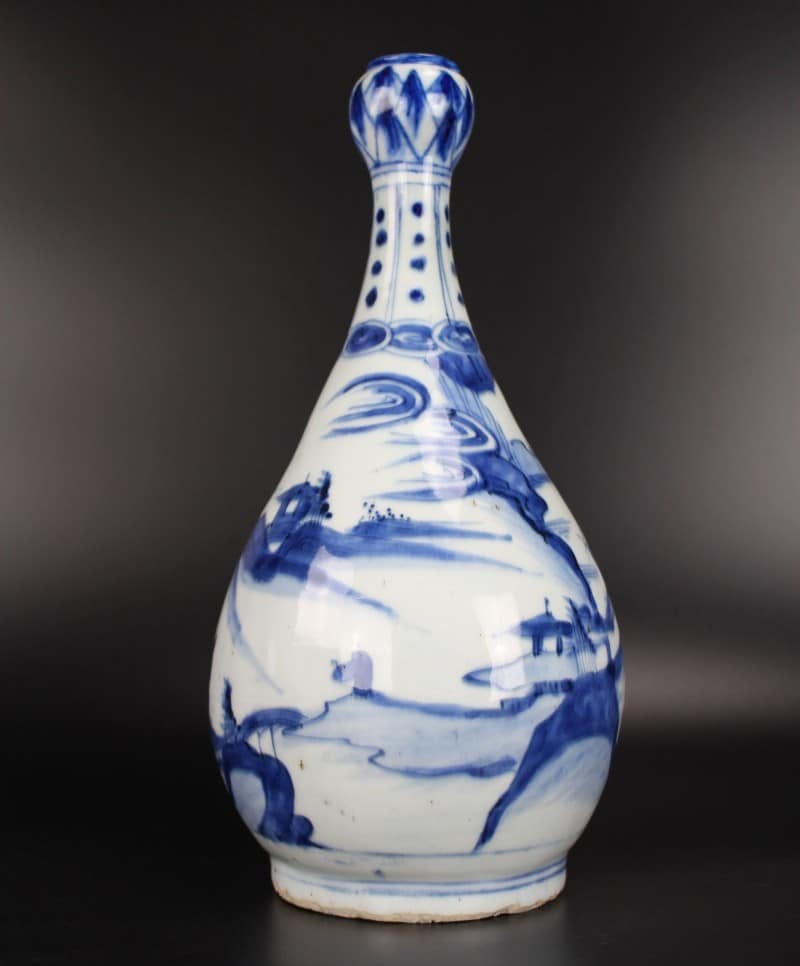
A Chinese pear-shaped porcelain vase with a garlic mouth from the Wanli period. © Menken Works of Art
In the Netherlands, three or five complementary vessels—usually alternating covered jars and beaker vases—were arranged symmetrically above cupboards and mantelpieces. Such a garniture was called a kaststel, or “cupboard set.”
Conclusion
In this article, we have briefly introduced delftware while focusing on the artistic and technical influences from abroad that shaped it, particularly the Chinese blue-and-white porcelain exported to Europe. Portugal initially dominated this trade before the Dutch Republic took the lead.
Chinese producers also showed considerable commercial acumen, tailoring their porcelain to the tastes of different markets. Outside the scope of this article are the wares they developed for Southeast Asia, such as Swatow, and for Japan, such as ko-sometsuke.
Kraak porcelain certainly played a major role in the European market. Yet we felt it was essential to examine other styles of Chinese blue-and-white porcelain up to the beginning of the Kangxi reign—a reign that roughly coincided with delftware’s period of full maturity. This broader perspective helps us identify the key shapes and motifs that Delft potters adopted in their chinoiserie wares.
####
We would like to give special credit to a resource that was instrumental in writing this article:
Lion-Goldschmidt Daisy. Les porcelaines chinoises du palais de Santos. In: Arts asiatiques, tome 39, 1984. pp. 5-72.
####