
An extraordinary chapter of technical and artistic experimentation with true pâte de verre unfolded in France from roughly 1885 until World War II, spanning the Art Nouveau and Art Deco eras. Few artists tried their hand at it, and fewer still are remembered today. The six featured in this article are those whose names have endured, each bringing his own imaginative world to the medium and, above all, a technical touch all his own.
Table of Contents
This creative awakening in pâte de verre also coincided—and by no means by chance—with the dazzling advances in glassmaking that accompanied Art Nouveau. These closely related art forms enriched one another. So closely related, in fact, that there is still widespread confusion about what pâte de verre actually is. So let’s address the elephant in the glass shop right away and get off on the right foot…
Pâte de Verre: What Is True Glass Paste?
The ambiguity stems from the widespread use of “pâte de verre” to describe Art Nouveau and Art Deco glassware that is technically something else. At PROANTIC, we too have adopted this familiar, broader “pâte de verre” category for our French-language pages (“cameo glass” on our English-language pages), even though it is not technically accurate. Gallé, Legras, Muller, and their contemporaries never produced true pâte de verre. The sole exception was Daum, through its collaboration with Amalric Walter, which lasted a little over a decade (see the section on Amalric Walter below).

Although commonly described in French as pâte de verre, this Gallé lamp is technically cameo glass. Designed around 1900, it features a seaweed motif acid-etched into multilayered glass. © The French Art
So what exactly is true pâte de verre? It is made from powdered glass (glass frit), mixed cold with a binding medium such as water, gum tragacanth, or even a decoction of quince seeds! The mixture is placed in a refractory mold and fired in a kiln. Practical and economical because it allowed broken glass to be reused, the process had been used since antiquity but had fallen into obscurity. Powdered crystal glass can also be used, theoretically yielding pâte de cristal, although the terms pâte de verre and pâte de cristal have been used somewhat loosely.

“Tropical Flowers” lamp in marbled purple, red and pink true pâte de verre, designed by Gabriel Argy-Rousseau in 1925. © BG ARTS
A range of variables leaves ample room for experimentation and creativity, producing different textures, from completely opaque to varying degrees of transparency. Artists can control where the colors appear. These colors come from varying amounts of metal oxides: silver, gold, platinum, iridium, and cobalt. At the turn of the 20th century, this was a modern form of alchemy.
Henry Cros, The Quest for Sculptures in Color
Henry Cros (1840-1907) began his career as a sculptor, making his debut at the Salon of 1861 with a bust of his brother Charles Cros, the inventor and poet. Creativity certainly ran in the Cros family. Henry, for his part, was fascinated by the idea of sculpture in color. Drawing inspiration from antiquity, he experimented with colored wax sculptures. Disappointed by their lack of durability, he continued his experiments, eventually turning to glass.
He is considered a pioneer in the revival of ancient glass paste techniques. To say that this knowledge had been completely lost may be something of an oversimplification: in the 18th century, artists such as James Tassie were already producing glass paste portraits in the manner of ancient cameos, and he was not alone. Whatever the precedents, Cros breathed new life into pâte de verre when he exhibited his first piece at the Salon of the Société des Artistes Français in 1883. His work attracted the attention of the Sèvres porcelain manufactory, which provided him with a workshop and kiln in 1891.

A glass paste medallion by Henry Cros. Profile of a woman inspired by ancient cameos. © Galerie Tourbillon
Cros approached glass paste as a sculptural medium, working primarily in low relief and also producing numerous medallions. Once removed from the mold, each piece was brushed but never polished, preserving its raw, opaque, matte surface. Pastel tones predominate, and his imagery recalls the work of Puvis de Chavannes. He also undertook large-scale compositions, including “The History of Water” (1894), “The History of Fire” (1900), and “The Apotheosis of Victor Hugo” (1905). Both Bourdelle and Rodin greatly admired his innovative approach to antiquity. As Antoine Bourdelle wrote to the artist’s son, Jean Cros:
How often Rodin told me: ‘Bourdelle, we all have a great obligation to Henry Cros. There seems to be far too little recognition of what a great artist he is.’
Albert Dammouse, The Exquisite Delicacy of His Enamel Pastes
In 1898, Albert Dammouse (1848-1926) first exhibited what he called his “pâtes d’émail,” or enamel pastes, at the Salon National des Beaux-Arts. By then, he had more than 20 years of experience. He had achieved considerable success in porcelain, designing models for Pouyat in Limoges and Haviland in Paris, as well as in art pottery, working in stoneware at Ernest Chaplet’s studio.
Unfortunately, little is known about how he developed his decorative glass paste pieces. He had maintained his own studio in Sèvres since 1871. His collaboration with his friend and fellow artist Ringel d’Illzach led to a glass-molding process in 1897. It is somewhat puzzling to imagine that Dammouse and Henry Cros, both working in Sèvres during the crucial years of their experiments with pâte de verre, might never have discussed their work. Yet, Cros appears to have passed his closely guarded techniques only to his son Jean.

Poppy flower bowl made by Albert Dammouse in 1905. The delicate borders and subtle pastel hues are captivating. © RMN-Grand Palais (Musée d’Orsay) / Hervé Lewandowski
Dammouse nevertheless pursued a different artistic path from Cros, remaining faithful to the decorative arts. He created exquisitely delicate bowls and vases adorned with stamped enamel decoration. Nature, particularly flowers, takes center stage — hardly surprising during the Art Nouveau period. His interplay of transparency and contrasting colors reaches its fullest expression in the flower-shaped bowls that marked the final years of his career, around 1910, their rims following the rounded or serrated contours of petals.
Georges Despret, a Franco-Belgian Industrialist With the Soul of an Artist
Georges Despret (1862-1952) followed a distinctive path in pâte de verre. He was, in a sense, born into glassmaking, coming from a long-established Belgian family of ironmasters and master glassmakers whose interests extended into France through the Jeumont plate-glass works. A successful engineer and businessman, he greatly expanded the family businesses.
He brought the same energy and creativity to glass paste. After experimenting throughout the 1890s, he came to prominence at the 1900 Paris World’s Fair. Apart from his masks, about 20 centimeters in size, which recalled wax reliefs, his approach to color differed considerably from that of his predecessors. His pieces resembled marbled stone, sometimes taking on an otherworldly quality depending on the colors he chose.

This leaping fish is a polychrome glass paste sculpture by Georges Despret made before 1906. 25.5 cm high. Similar models are found in several museums: Petit Palais in Paris, France, and the Chrysler Museum of Art in Virginia, USA. © Galerie Tourbillon
World War I severely damaged his production facilities in Jeumont, and his archives and some of his works were lost. As he focused his attention back on his factories and industrial production, this artistic chapter of his career fell into relative obscurity.
François Décorchemont, From Opacity to Transparency
With a sculptor for a father, François Décorchemont (1880-1971) had an early grounding in art. He began his career as a painter, exhibiting at the Salon des Artistes Français from 1898. His training at the École Nationale des Arts Décoratifs soon came to the fore, however: at that same Salon in 1903, he presented his first experiments in pâte de verre.
He worked independently, through trial and error, in his own studio — notably, not in Sèvres. Unusually, however, extensive archives document his methods. His earliest pieces were thin and fragile as eggshells, with stamped and pierced decoration and enamels held within the openings. The technique was related to Fernand Thesmar’s, while the style resembled Dammouse’s. As his palette expanded, Décorchemont could express his inspiration from nature more freely. He added seaweed to his repertoire of flowers and leaves, and as he gained greater control over relief decoration, he introduced insects and human figures and explored themes from antiquity.

Amber pâte de verre bowl by François Décorchemont. Created in the 1930s, the horn-like finish is exceptional. Diameter of 23 cm. © BG ARTS
In 1911, he entered a pivotal creative phase, moving toward a more sculptural approach. He adapted the lost-wax casting process traditionally used for bronze to glass, producing thicker, translucent walls. These works brought him much wider recognition. After 1921, he embraced a distinctly Art Deco style with simplified forms. Each piece had a dominant color, with other hues creating cloudlike or smoky effects that could suggest horn, depending on the palette. In 1933, he turned to stained glass — made with glass paste, of course! He shared some of his techniques with his grandsons, Etienne and Antoine Leperlier.
Amalric Walter, Conjuring Nature’s Magic in Pâte de Verre
Victor Amalric Walter (1870-1959) was born in Sèvres, where both his father and grandfather had worked as painters at the famous porcelain manufactory. He entered the Sèvres manufactory as a student at 15. His teacher Gabriel Lévy, known as Gabriel, collaborated with him on five pâte de verre designs exhibited in 1903 at the Paris fine arts and the Société des Artistes Français exhibitions. At the time, they called these works “pâtes d’émaux agglomérés,” or agglomerated enamel pastes.

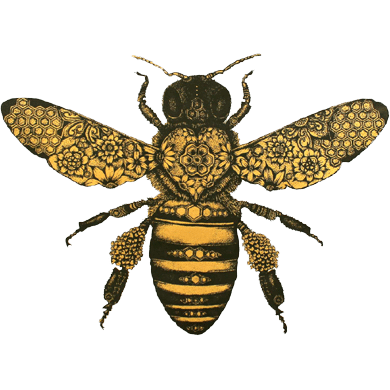
A bee tops this candy box in pâte de verre, ornated with berries and leaves. Double signature of Amalric Walter and Henri Bergé. © Splendeurs & Design
Antonin Daum, based in Nancy, at the heart of Lorraine’s glassmaking region, recognized the potential of their experiments. In late 1903, he offered them a contract to join Daum and sell him exclusive rights to their output. Lévy withdrew from the venture in late 1905. Working with Daum’s chief decorator, Henri Bergé, who supplied the models, Walter developed a successful range of glass paste pieces. Before World War I interrupted this creative period, around 100 designs were produced, bearing the signatures “Daum” or “Daum-Walter.”
After the war, Walter established his own workshop in Nancy and continued working with Bergé. These pieces were signed “Walter Nancy,” together with the name of Bergé or another modeler. Walter won numerous awards at salons and exhibitions. At its peak around 1925, the workshop employed about 10 workers. It closed in 1939, two years after Bergé’s death. Walter collaborated with more than 15 other artists, though Bergé was unquestionably his principal source of designs that expressed the poetry of nature.

Rooster in glass paste by Amalric Walter and Muller (double signature) in an outstanding ochre yellow color. © Galerie Arcanes
Nature is the undisputed star of Walter’s work, with animals taking center stage. He nevertheless produced some Tanagra-style figurines and female figures, a few rare masks and, later in his career, a handful of religious subjects. Functional objects predominated, including paperweights, trinket dishes and bowls. During the Daum years, his work also included stained-glass windows, opaque plaques, medallions and jewelry.
[Amalric Walter’s] use of color, by turns fiery and delicate, renders with a jeweler’s finesse the sprays of flowers, insects and little creatures with jade-like shells in which the École de Nancy has always delighted.
— Antonin Daum in 1926
Argy-Rousseau, Absolute Mastery of Pâte de Verre
Equally gifted in science and art, Joseph-Gabriel Rousseau (1885-1953) found in pâte de verre a medium that allowed him to bring all his talents together. He, too, was a graduate of the Sèvres manufactory, where he had become acquainted with Jean Cros, Henry Cros’ son.

Maidenhair fern (Capillaire) box in glass paste by Argy-Rousseau in 1914. A wonderful model early in Argy-Rousseau’s career. © BG ARTS
By the time he presented his first glass paste creations at the Salon des Artistes Français in 1914, however, he was already running his own Paris studio. The name Argy-Rousseau combined the first four letters of his wife’s surname, Argyriadès, with his own. In late 1921, he partnered with Moser Millot to establish Les Pâtes de Verre Argy-Rousseau.
Writing in 1928 for a magazine devoted to science and its applications in art and industry, Jacques Boyer described Argy-Rousseau’s colors: “His palette encompasses an infinite range of shades, from the palest to the most vibrant.” Argy-Rousseau had undeniably achieved a spectacular mastery of color, which he applied brilliantly to subjects drawn from nature. Ancient Egypt was another important source of inspiration, notably for his lively compositions featuring human figures.

Garden of the Hesperides glass paste vase by Argy-Rousseau in 1926. The subtlety of the colours and the vitality of the brushwork are breathtaking. © BG ARTS
His creations enjoyed enormous success. Vases, bowls and night lights made up much of his output, alongside a few pieces of jewelry. His company employed about 50 people in 1929, a year that marked a bleak turning point as the global economic crisis took hold. Two years later, the business had gone bankrupt.
Conclusion
All six masters of pâte de verre were tireless experimenters with the material, quite apart from the creativity they brought to their designs. The process lent itself to a particularly sculptural approach. Their finished works revealed a wealth of color and effects of depth, drawing on both transparency and opacity.
Sèvres, with its manufactory, school and independent studios, was a vital crucible for four of these artists: Cros, Dammouse, Walter and Argy-Rousseau. Meanwhile, Art Nouveau’s powerful wave of renewal in the decorative arts, particularly glass, helped give their creativity free rein.
True pâte de verre owes much of its distinction to this extraordinary pioneering spirit. Even today, relatively few artists seek to master it, despite a revival of interest since the 1980s encompassing decorative objects, sculpture and jewelry.
####
Although this article draws on a range of sources, its initial inspiration came from Édith Mannoni’s Les pâtes de verre : autour de Daum et Gallé (Paris: Ch. Massin, 1987).
####
You May Like
Henry Cros | Albert Dammouse | Georges Despret | François Décorchemont | Amalric Walter | Argy-Rousseau | Cameo Glass & Pâtes de Verre