

English landscape gardens became immensely fashionable in France during the second half of the eighteenth century. Artistic by nature, they were conceived as places that invited quiet contemplation and reverie.
Poetry, Painting, and Gardening, or the Science of Landscape, will forever by men of taste be deemed Three Sisters, or the Three New Graces who dress and adorn Nature.
— Horace Walpole (1717-1797)
Today, they remain a rich source of inspiration for creating poetic landscapes, where antiques lend a unique sense of depth, beauty, and timelessness. Amid islands of cool shade and lush greenery, imagination intertwines with the legacy of antiquity.

Belvedere Apollo bust in natural stone. Exposure to the elements has given it an expressive patina. © Ehrl Fine Art & Antiques
For this bucolic journey, let us begin at the English landscape garden of Bagatelle, commissioned in 1778 by the flamboyant Comte d’Artois—brother of King Louis XVI—from the Scottish botanist and landscape gardener Thomas Blaikie. From there, we will discover the essential decorative elements that continue to bring these picturesque gardens to life today. And since art lies at the heart of these gardens, we have illustrated our exploration with late 18th-century paintings of gardens.
Please note that, apart from exploring the spirit of these gardens as they developed in France under the influence of British garden design, this article does not focus on landscape design or the selection of plant species, but rather on the purely decorative and artistic aspects of English landscape gardens.
Breaking the Code of the English Garden at Bagatelle
We invite you to stroll through Bagatelle, one of the first landscape gardens created in France. The two lively gouaches on paper by Louis Bélanger (1756–1816), featured as the article banner and presented below, offer a privileged glimpse of the garden as it appeared at the time of its creation.
Louis Bélanger was, in fact, the brother of François-Joseph Bélanger, the architect to the Comte d’Artois. François-Joseph Bélanger thus oversaw the creation of the Bagatelle pleasure pavilion—nicknamed the “Folie d’Artois”—in 1777, as well as the development of the park’s decorative features, in collaboration with the Scottish gardener Thomas Blaikie, who was responsible for its vegetation.
Since this article focuses on the decorative and fine arts, we would first like to highlight in these gouaches the structures and artistic creations that follow two main themes: garden buildings, or “follies” (fabriques in French), and memorials. They reflect a universalist vision, for this type of garden was born of philosophical and political ideas.
Follies
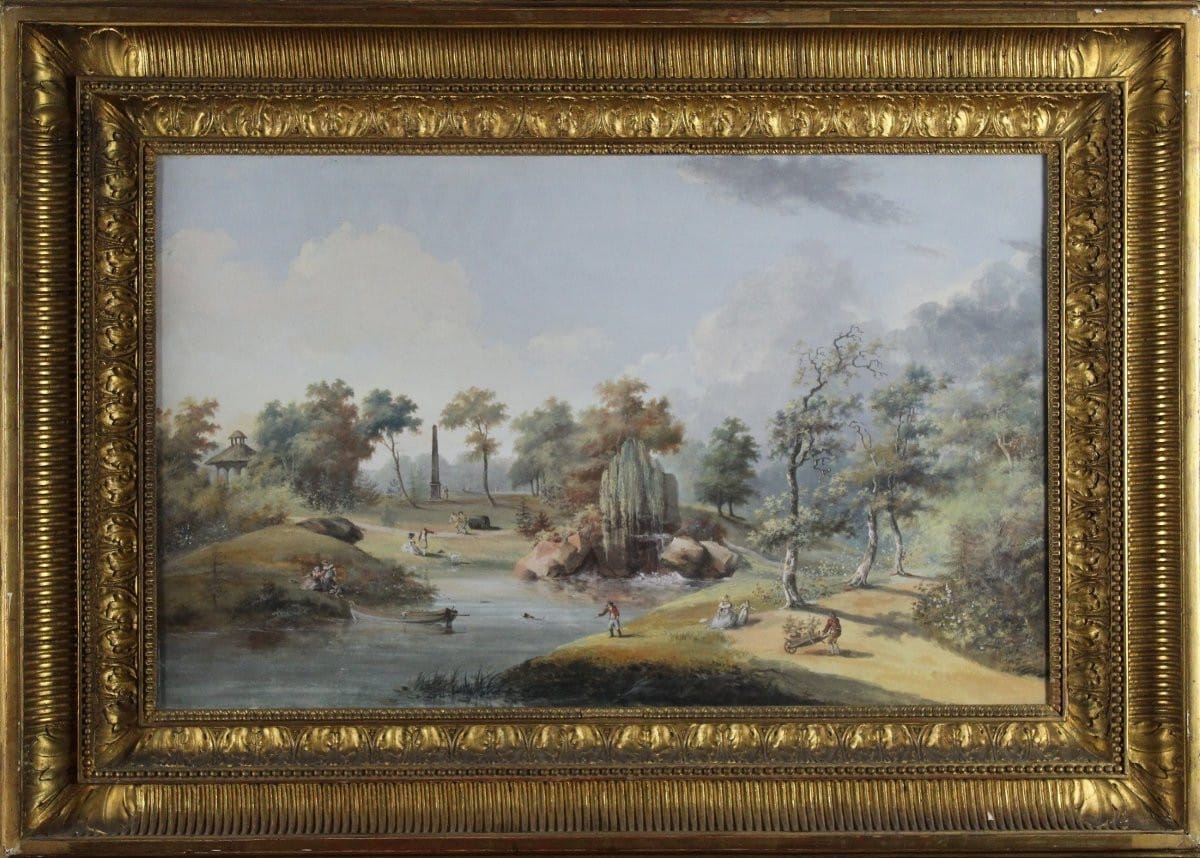
Gouache on paper by Louis Bélanger. Depicting a primitive hut, obelisk in the landscape garden of Bagatelle. © Pierre Brost
The primitive hut, or hermitage, is one of the follies represented here. It reflects the principles of Jean-Jacques Rousseau, who advocated a return to nature, believing that man was good in his pre-civilized state. Rousseau’s philosophy had a profound influence on the development of these gardens. He spent the final years of his life in the English-style park of Ermenonville, the first landscape garden developed in continental Europe, between 1766 and 1775. The Marquis de Girardin, who had invited him there, had him buried on the Isle of Poplars.
Perhaps the most common type of folly in an English landscape garden is the round, columned temple (a type of rotunda), such as those visible in the paintings presented in the next sections of this article. Antiquity was, after all, the predominant reference in this type of garden. Yet, in the desire to bring the world into the garden, there were also numerous Chinese pavilions and pagodas (explaining why the English landscape garden is also known as the Anglo-Chinese garden), mosques and representations of the Eastern world, expressing a spatial universality while revealing a taste for the exotic.
Memorials
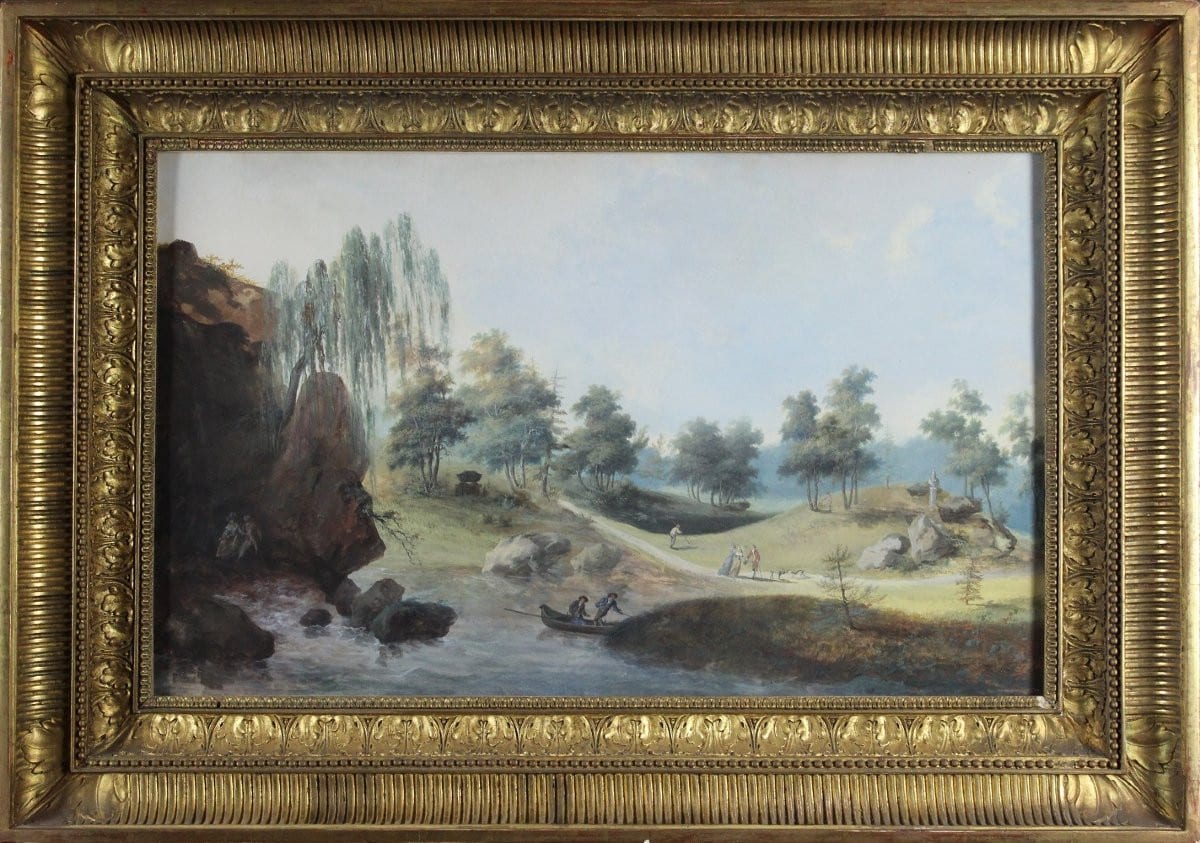
Grotto, tomb, and bust on pedestal in the landscape garden of Bagatelle. Second gouache on paper by Louis Bélanger. © Pierre Brost
In this other gouache, we see a cenotaph in the form of a tomb, belonging to the category of memorials. Mausoleums, sarcophagi and funerary urns are other manifestations of these places of memory, intended to inspire in the visitor a “gentle melancholy”. Homages to great men and great ideas offer another way of approaching universality and the ideals that give meaning to our lives. At the same time, they remind us of our own mortality, which is unquestionably universal. Likewise, monuments in ruins, evoking the passage of time, are so many imposing memento mori.
A Park Conceived as a Painting
It is no coincidence that Hubert Robert (1733-1808)—the leading French artist to champion the development of irregular gardens in France—was first a landscape painter renowned for his depictions of ruins before becoming a designer of the king’s gardens. Six of his paintings were installed in the bathing room of Bagatelle.
The various artistic features are carefully scattered throughout a park of subtly varied contours, with carefully selected plant species designed to lead visitors into a state of melancholy. Winding paths guide them through a succession of scenes: across the land, underground into grottoes, and alongside the water. The park as a whole becomes a place of dialogue with nature and with our inner selves, where man can also express his artistic and scientific techne.
As we now turn to the tangible artistic elements that shape an English landscape garden, let us keep in mind this quotation, which encapsulates its spirit and was written by the creator of the park at Ermenonville:
It is therefore neither as an architect nor as a gardener, but as a poet and a painter, that landscapes must be composed, so as to engage both the eye and the mind.
— Marquis de Girardin, De la composition des paysages, 1777
The Living Waters of Fountains
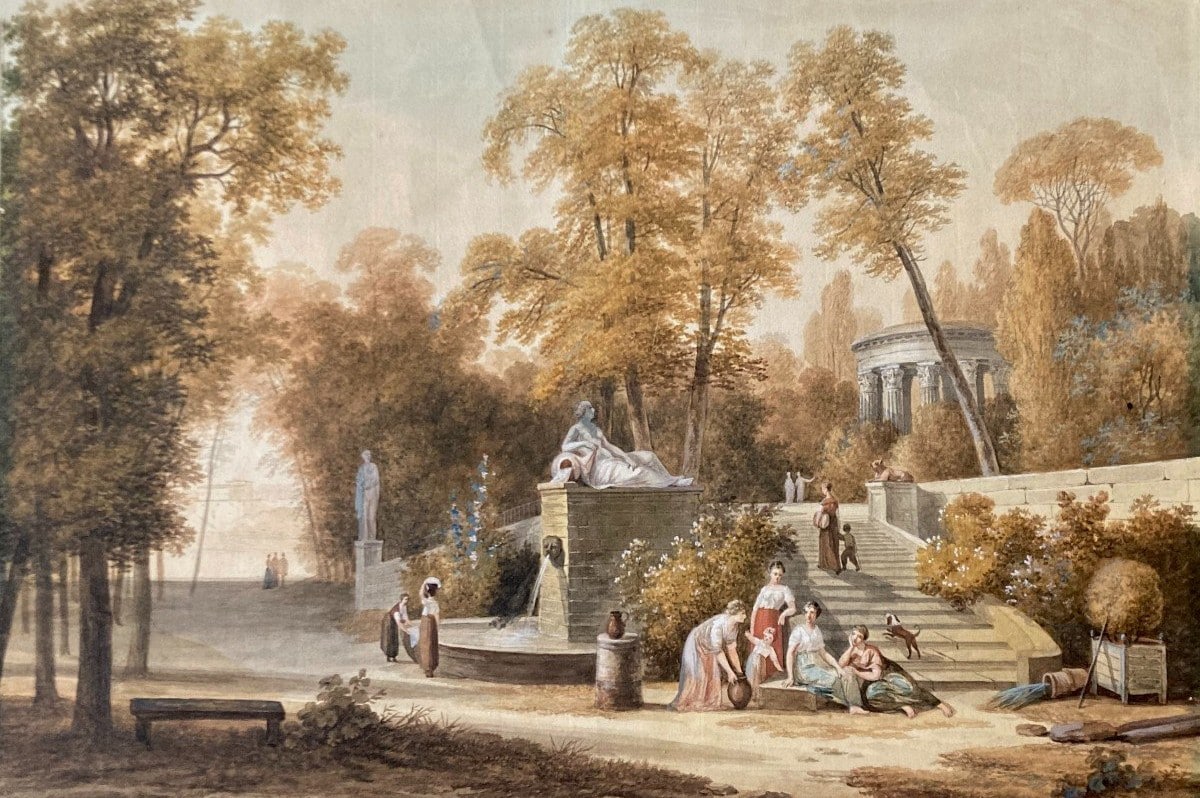
In this 18th-century gouache by Louis Gadbois (1770-1826), among the typical elements of a landscape garden, the water fountain displays a mascaron spout and a large water column supporting a statue. © Galerie Mazarini
Few of us have the space to recreate the rivers, lakes, cascades, grottoes, and bridges that animated eighteenth-century English landscape gardens. Fortunately, fountains are a far more practical alternative, available in a wide variety of forms and with basins that can be scaled to suit almost any setting. This is also an opportunity to note that Hubert Robert depicted fountains in three of his six paintings at Bagatelle.
In the Neoclassical style, ornament is restrained and clean, and geometric lines prevail. Depending on their size and placement—whether freestanding, set against a wall, or designed for a corner—basins are typically rectangular or gently rounded.
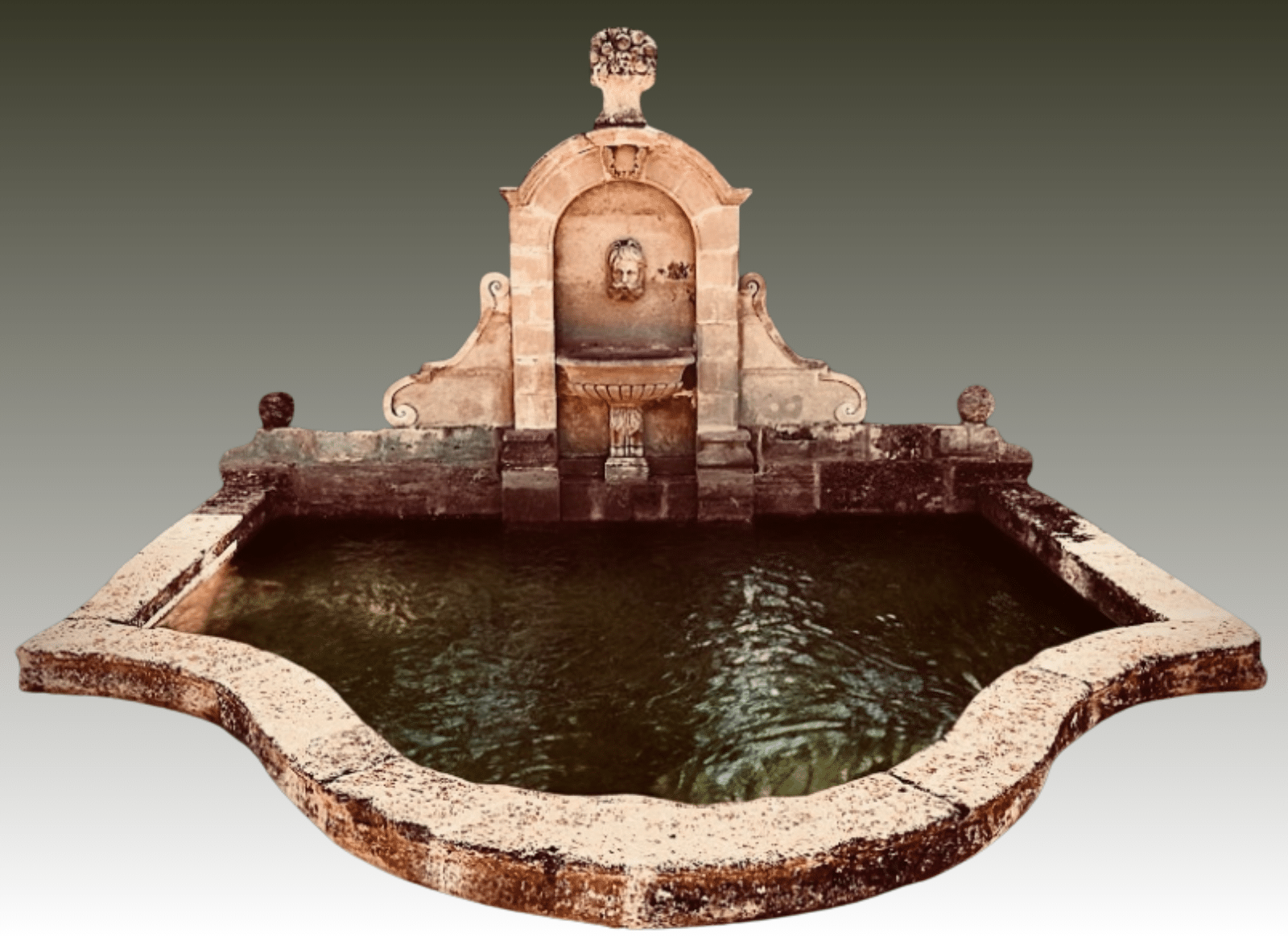
A monumental 18th-century Provençal garden fountain in stone. © Zunino Antiques
This monumental eighteenth-century Provençal fountain, with its impressive 6 × 6 metre basin, is a superb example of the genre. Its decorative vocabulary is entirely characteristic of the reign of Louis XVI: the gadrooned bowl, the acanthus leaves adorning the projecting console, and the fruit basket crowning the niche. Stone finials topping the ends of the side walls soften the composition’s otherwise rectilinear lines.
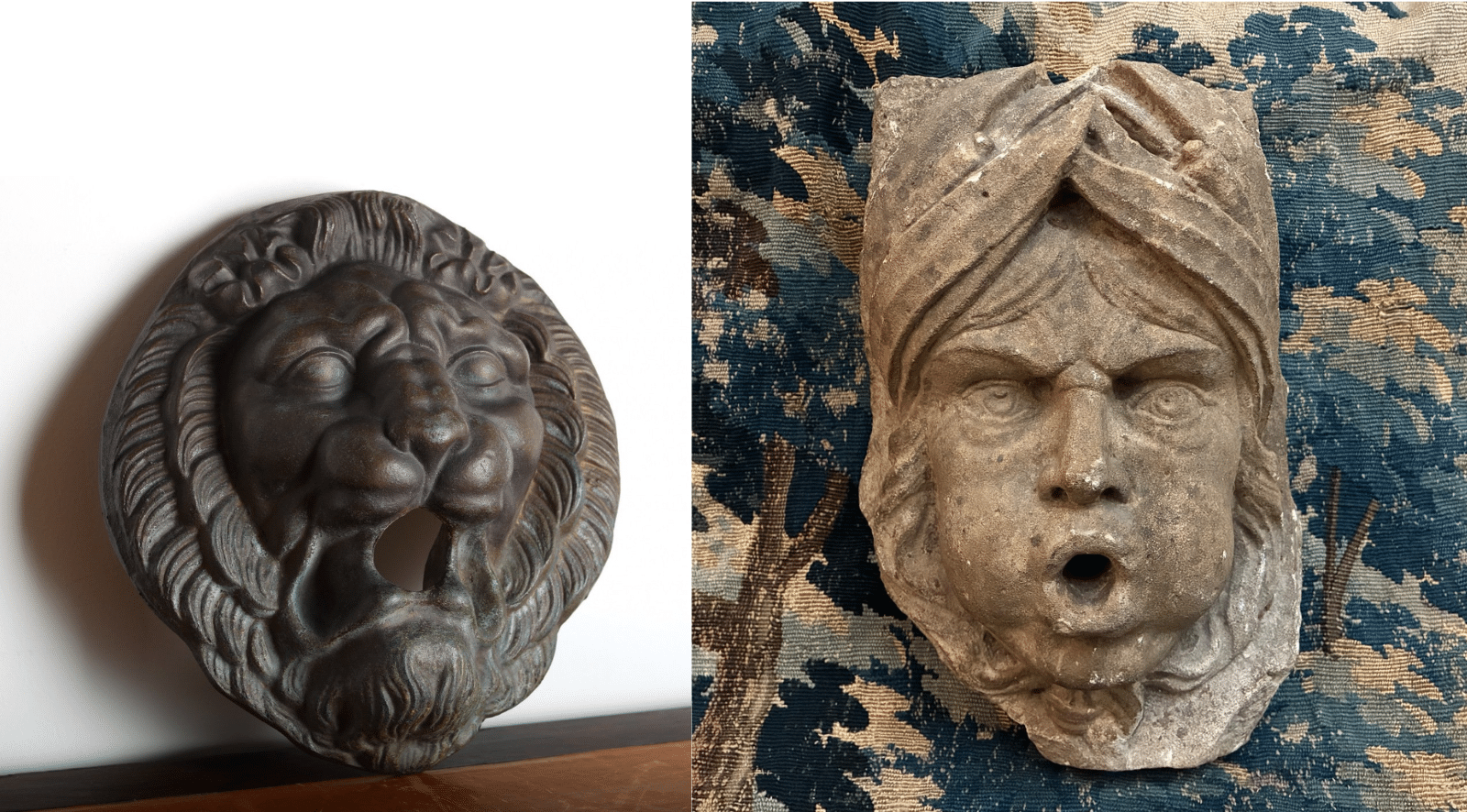
Two antique fountain spout mascarons. Left: 19th-century cast-iron lion head (© Metropolis Art 1900). Right: 18th-century limestone aquatic god (© Galerie Delavigne).
Two features, in particular, give water gardens much of their charm: a strong vertical element rising above the horizontal plane of the water—its reflection doubling the effect—and richly sculpted fountain spouts in the form of mascarons. Antique fountain masks (also known as fountainheads or gargoyle spouts) can easily be incorporated into a contemporary fountain, lending it instant character. They often depict deities associated with the aquatic world, although lion-head mascarons are equally traditional.
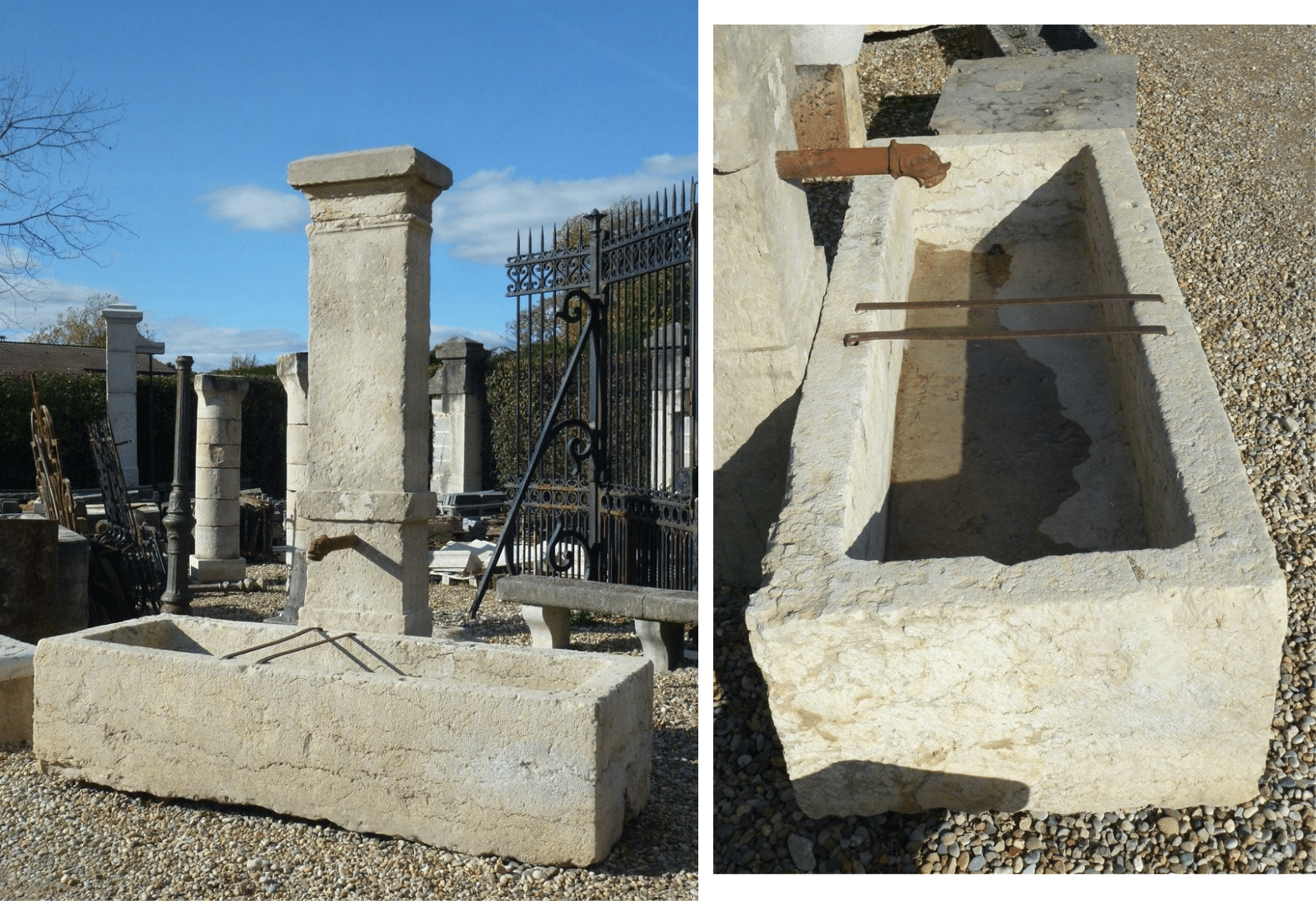
19th-century French fountain in hard stone from Villebois with a 224-cm long basin. © Claude Augustin
Even relatively recent public fountains can be successfully repurposed for the garden. A simple rectangular basin, unambiguously inspired by a watering trough, acquires a new elegance when paired with a tall water column capable of supporting an urn or other decorative ornament, transforming a utilitarian structure into a striking garden feature.
Columns and Obelisks: Linking Earth to Heaven
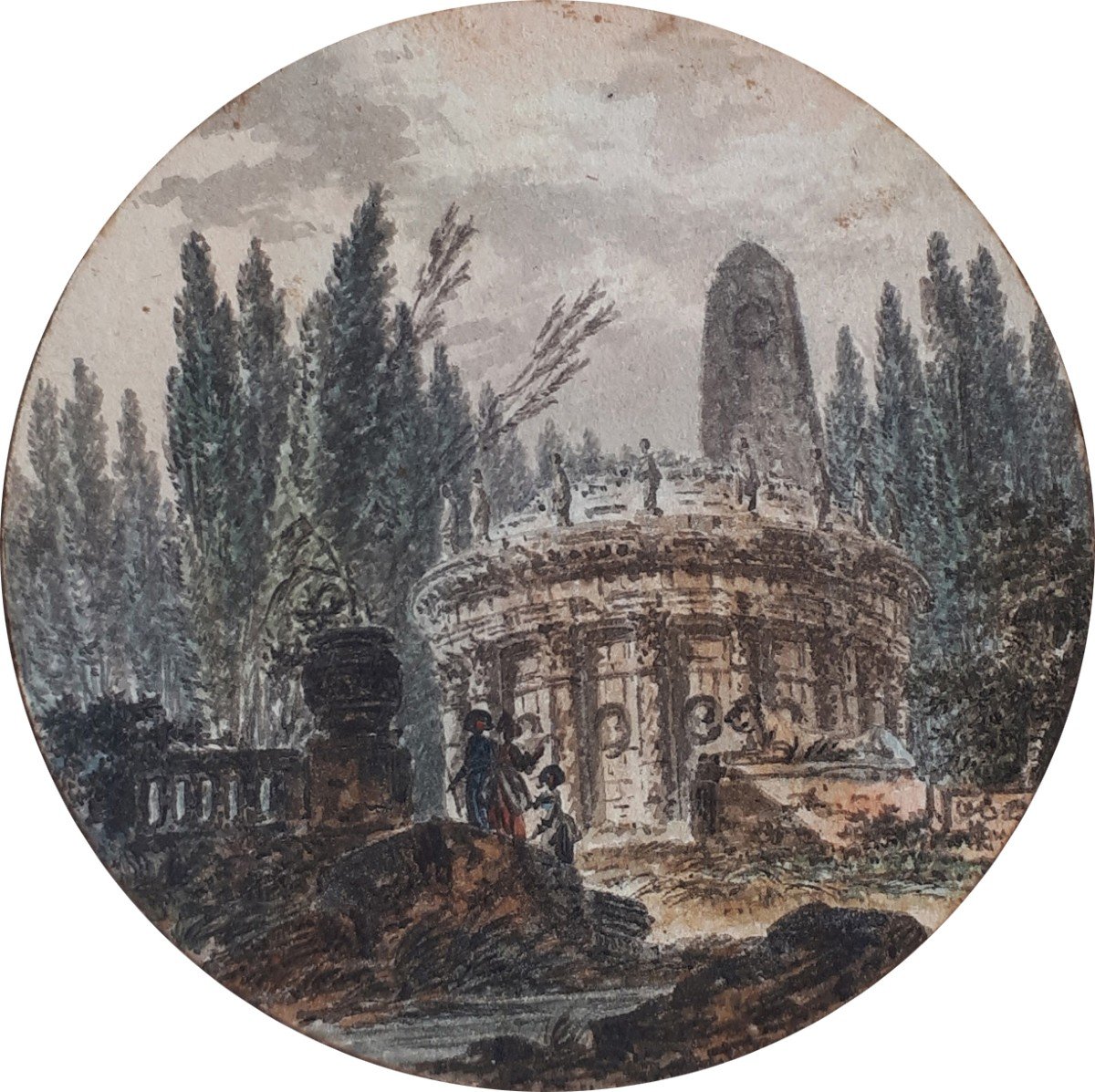
Ideal temple corner of an English landscape garden. Ink and watercolor by Alexandre Vernet (1763-after 1789), student of Hubert Robert and Pierre-Antoine Demachy. © Galerie Mazarini
The temple and site depicted above bear a striking resemblance to the Temple of Philosophy at Ermenonville, for which one of Alexandre Vernet’s teachers, Hubert Robert, was himself an artistic adviser. The temple at Ermenonville, however, was deliberately left unfinished, as a metaphor for the incomplete state of our knowledge. Nor does it stand beside a monumental obelisk such as the one Vernet placed behind this alluring circular temple.
The first thing to retain from these two architectural elements, the column and the obelisk, is their verticality. Of course, their connection with Antiquity—whether Roman, Greek or Egyptian—is also important. But in an English landscape garden with a strong philosophical dimension, columns and obelisks also carry a significant spiritual charge.
Columns
Columns can be of any architectural order. Although those associated with Antiquity may seem the most natural choice here, the essential thing is to place in the garden what is dear to our hearts, consistent with a personal quest for meaning. Nor should we forget that Gothic elements were sometimes incorporated into certain follies and ruins, as at the Désert de Retz. In England, the Gothic style—embraced early on by Horace Walpole at Strawberry Hill House in 1749—symbolized the Anglo-Saxon origins of the English nation, a rebuke to the absolute monarchy that had subsequently taken hold, and an ode to freedom.
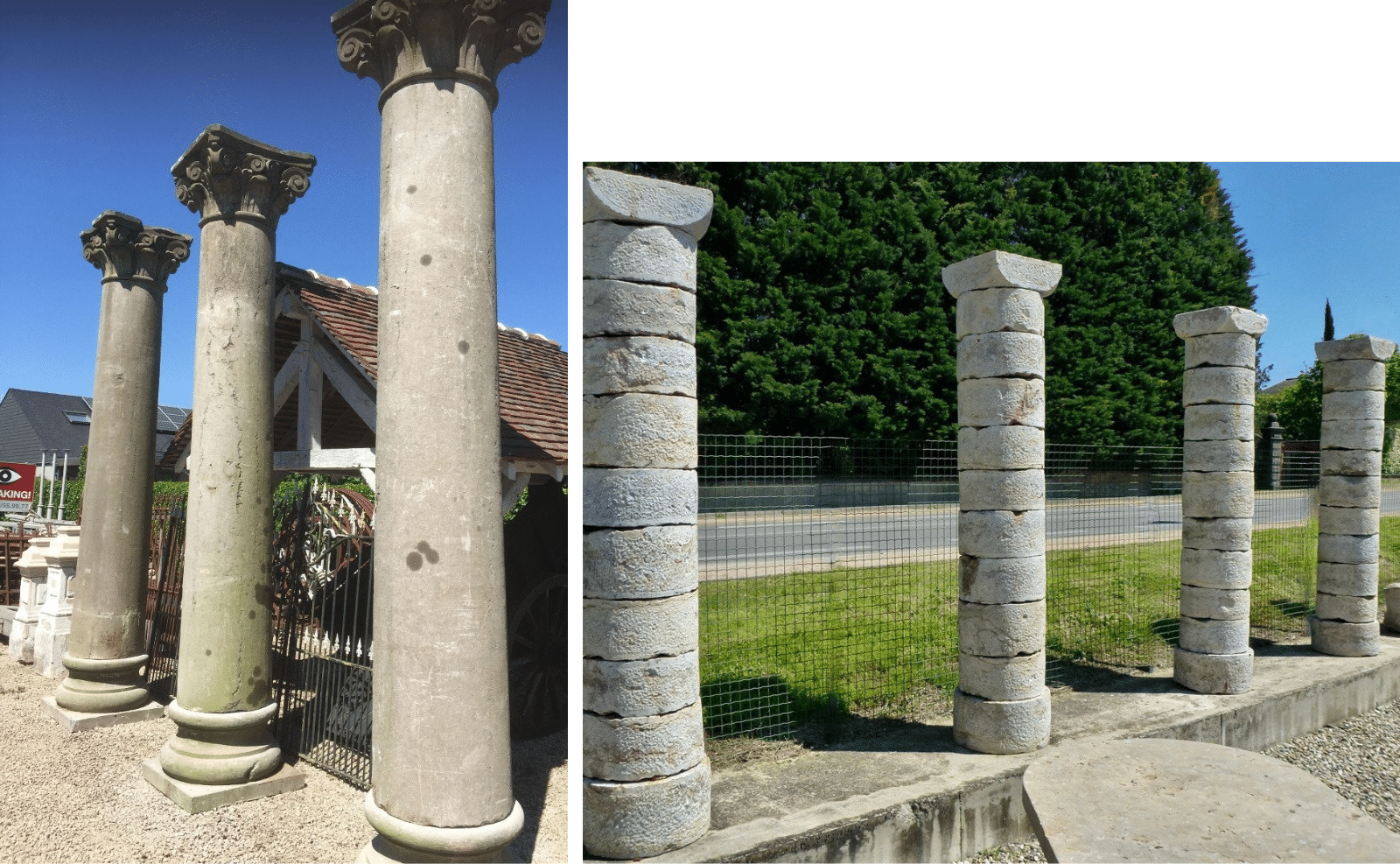
Left: Set of three 18th-century Belgian blue stone columns (© Anresto Decor). Right: Set of four 17th-century drum columns (© Claude Augustin).
The Temple of Philosophy at Ermenonville is dedicated to the pursuit of knowledge, with the Virgilian verse Rerum cognoscere causas—“to know the causes of things”—inscribed above the entrance. Each of its six columns bears the name of a famous man associated with a particular notion or value. We draw attention to this because giving meaning to different parts of one’s garden can certainly bring an additional pleasure to its contemplation. The associations of ideas are part of the poetic game of the English landscape garden.
Combining tradition and modernity, columns can also be used for practical purposes. They can, for instance, support an arbour. The vegetation forming its canopy will only enhance the romantic character of this space. Here is another idea: a fallen column can serve as a bench while echoing the theme of ancient ruins. Or if you get drum columns (as those in The Bathing Pool by Hubert Robert, one of the paintings originally in the Bagatelle pavilion), you can adjust the height and use a few drums as seats.
Obelisks and Pyramids
Obelisks are far rarer on the market today. Naturally, they evoke ancient Egypt. And let us not forget that, at the end of the 18th century, Rome’s thirteen obelisks were among the wonders that Grand Tour travellers could admire in the Italian capital, along with the Pyramid of Cestius.

Left: 18th-century obelisk in St-Maximin stone (© Debart). Right: Pair of 20th-century pyramidal pillar caps, 83 cm high (© Thierry May).
For the ancient Egyptians, the obelisk—which is related to the pyramid, incidentally, since an obelisk is crowned with a pyramidion—represented the solar deity Ra, symbolizing connection to the divine, and stood guard at the entrance to temples. The pyramid, as a funerary monument, enabled the deceased to ascend towards the heavens.
Smaller pyramids can also adorn pillars, most commonly those forming part of a gateway, but also certain pillars or pedestals approximately one metre high, which can be used to mark or frame the entrance to a new space.
Sculptures in a Landscape Garden
The English garden is nature transformed into art, but the hand of man must remain invisible despite its omnipresence. The sculptures it contains are the clearest reminder that art is in command. The style is deliberately restrained, the purity of the lines reflecting the purity of the ideas. There is nothing here of Rococo exuberance.
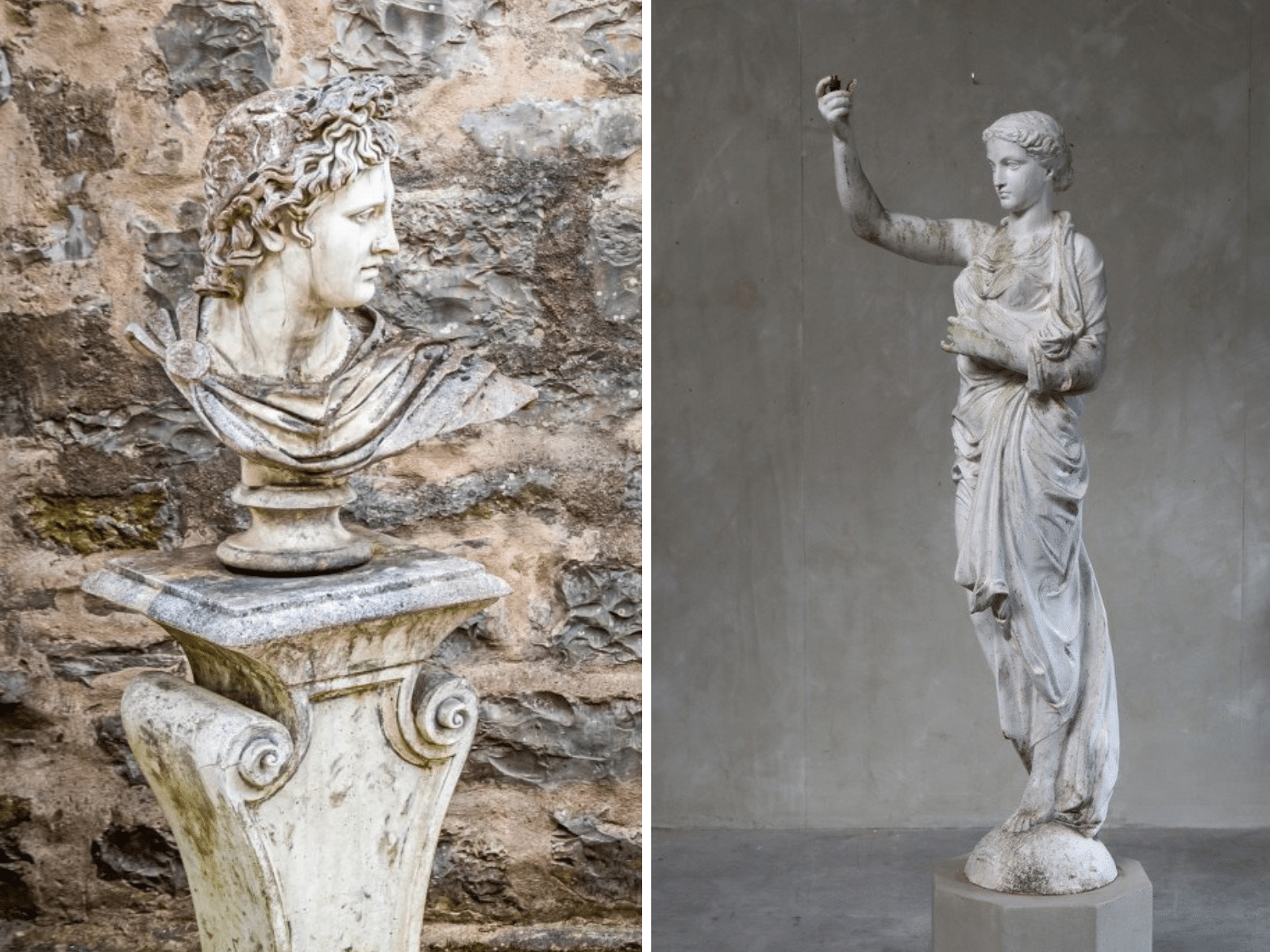
Left: Bust of Belvedere Apollo, 66 cm high (© Ehrl Fine Art & Antiques). Right: Statue of an antique-fashion draped woman holding a torch, 143 cm high (© De Groot Antiques).
Whether full-length statues or busts, these sculptures are steeped in the favoured themes of Antiquity and in the memory of great men, offering countless opportunities to embody virtues and values that still resonate with us. In your search, think gods and goddesses, nymphs, muses, allegories. Also, guardians can protect the house. Classic apotropaic figures would be sphinges or lions.

Neoclassical late 18th-century sphinge in Conflans stone. L 100 cm x H 75 cm x D 31 cm. © Questel Antiquités
It should be noted that garden sculptures, exposed to the harshness of the elements, have often suffered greatly, while many of the great gardens were renovated in a different style or at least partially dismantled long ago. As a result, examples dating from before the 19th century that remain in good condition are not easy to find. Yet admiration for Antiquity, more or less pronounced according to the period, has never entirely disappeared. Incomparable patina, which new pieces simply cannot offer, can be found in works from the 19th and 20th centuries. Alongside marble and natural stone, one may also find sculptures in terracotta, cast iron, or reconstituted stone.
Vases, Planters and Urns: Timeless Garden Ornaments
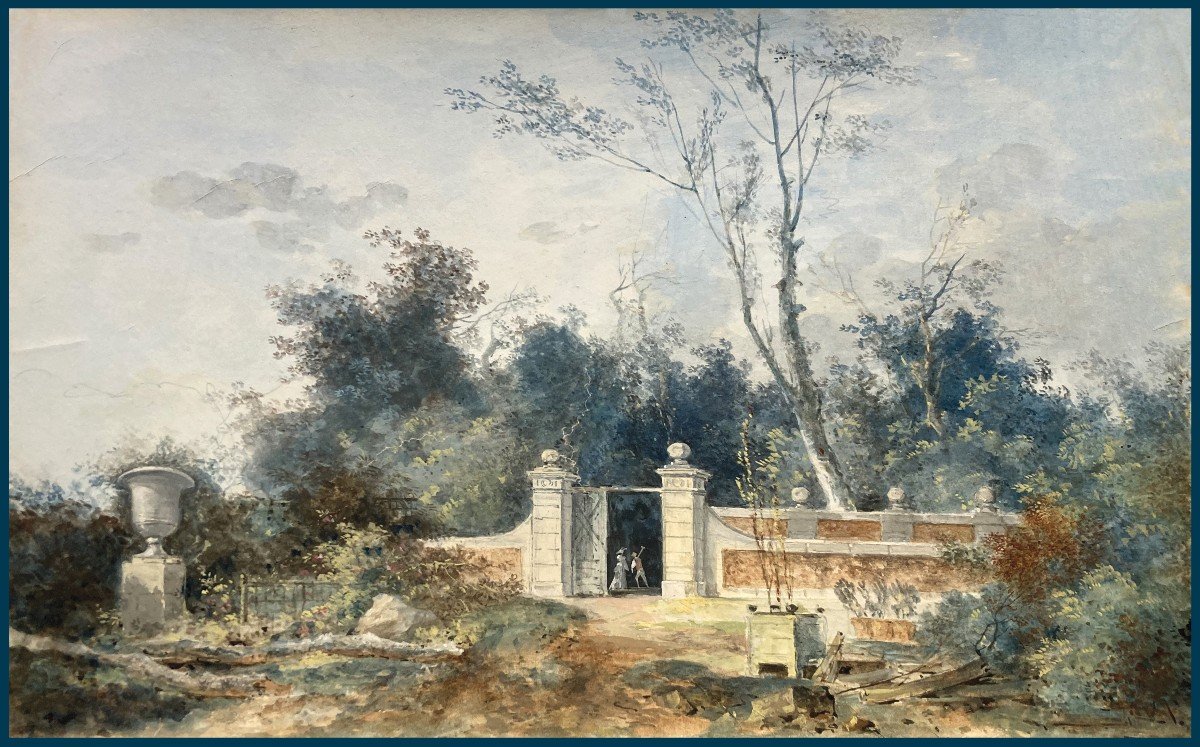
Entrance of an English-style park with vase and planter. Watercolor and gouache by Louis-Gabriel Moreau (1740-1806). © Galerie Mazarini
Here, we will look at ornaments that share an imposing scale, standing approximately one metre high. These vases, which could be planted, and these covered urns were used to embellish pathways or to mark the entrance to a different space, such as a terrace, a pool, or an arbour. They predated the English landscape garden but were naturally incorporated into it.
Vases and Planters
Vases and planters have stood the test of time, and their connection with Antiquity is particularly strong in forms such as the Borghese Vase and the Medici Vase—ancient models rediscovered or brought back into prominence during the Renaissance. Thus, although they occupied a prominent place in the 18th-century landscape garden, they had undeniably been in vogue long before.
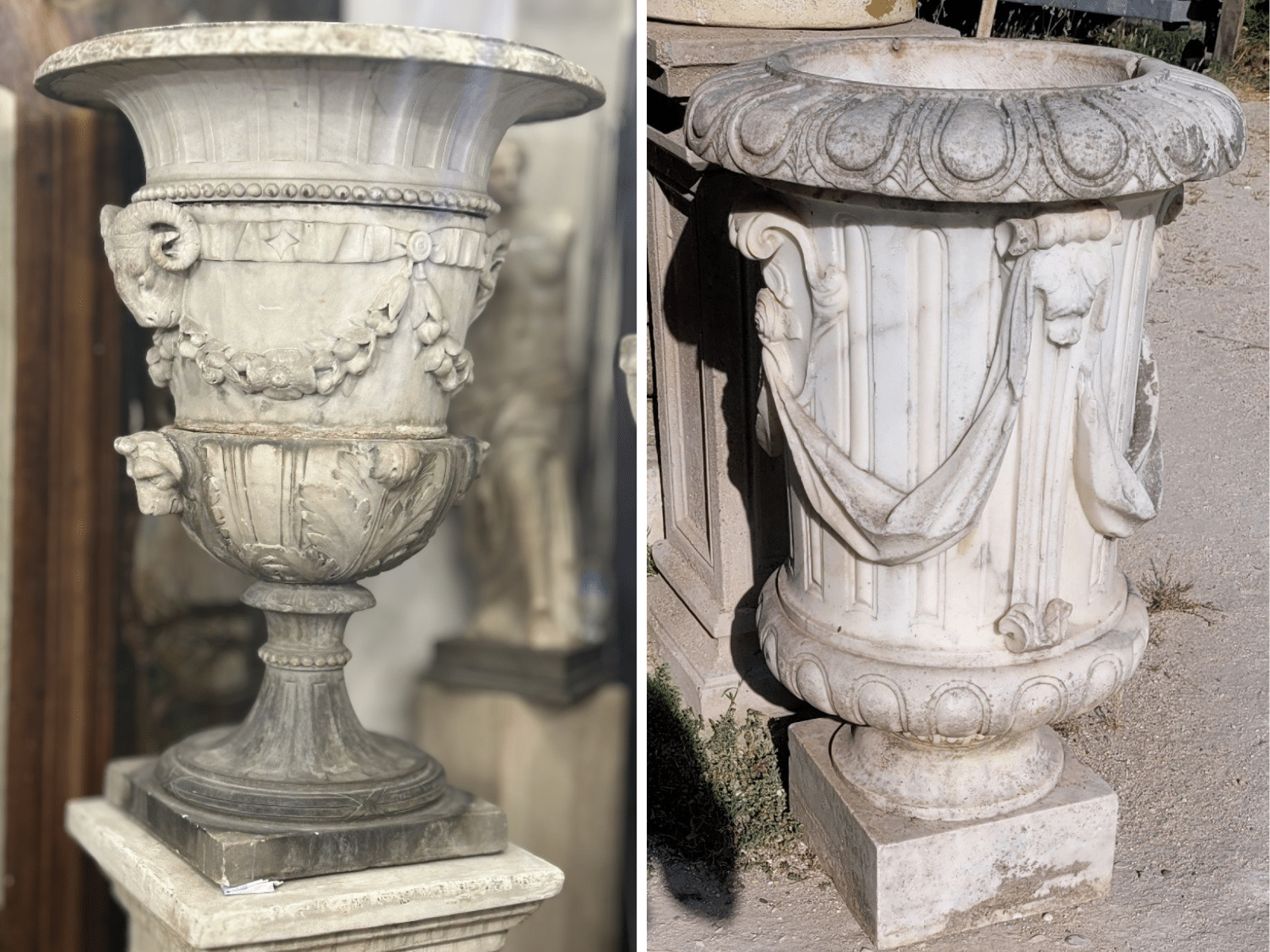
Two examples of classic 18th-century marble vases. Left: 105 cm high (© Antiquités Brion Laurent). Right: Originally fitted to host aquatic plants; 1 meter high (© Le Mas du Lac).
The defining feature of these vases, which came to embody the very essence of Classicism, is their bell-shaped krater form, generally raised on a fluted or gadrooned foot, often echoed around the rim. They may be fitted with handles or decorated with lion, ram or satyr masks. The ornamentation of the body varies: the original celebrated vases feature mythological friezes, while 18th-century examples are frequently adorned with fluting, acanthus leaves, garlands or drapery.
Beyond these vases—classics among classics—we may also be surprised by more unexpected forms, which are no less suited to the landscape garden. This marble planter, shown below, for instance, allows us to move beyond the traditional circular vase. Shaped like a tomb, it combines restraint with deeply carved mouldings and a few decorative scrolls.
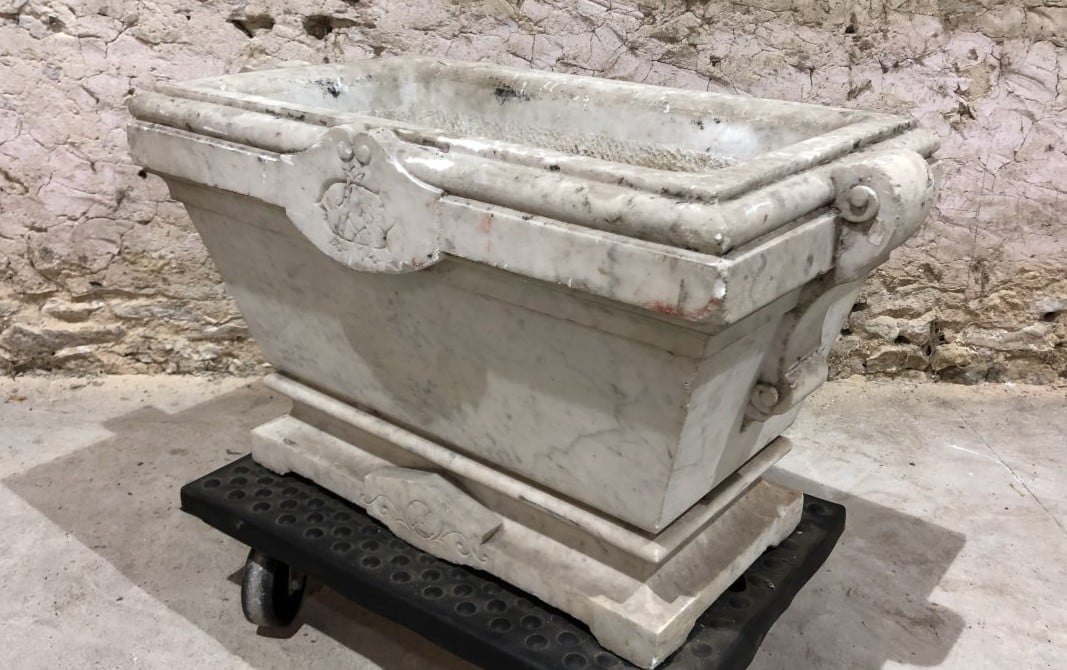
18th-century sculpted and monogrammed marble planter with a zinc-lined base. © Ribes Jean-Charles
Another great classic that also predates the English landscape garden is the orange-tree planter from the Palace of Versailles, the first model of which was designed by André Le Nôtre around 1670. Its simplicity, practicality, and elegance no doubt explain why it eventually moved beyond formal French gardens and orangeries, as illustrated above in the painting by Louis-Gabriel Moreau.
Urns
The funerary theme discussed earlier also appears here, concealed beneath the seemingly innocuous form of lidded urns. William Kent (1685–1748), the architect and designer who pioneered the English landscape garden, is said to have designed several lidded urns for the gardens of the celebrated poet Alexander Pope at Twickenham.
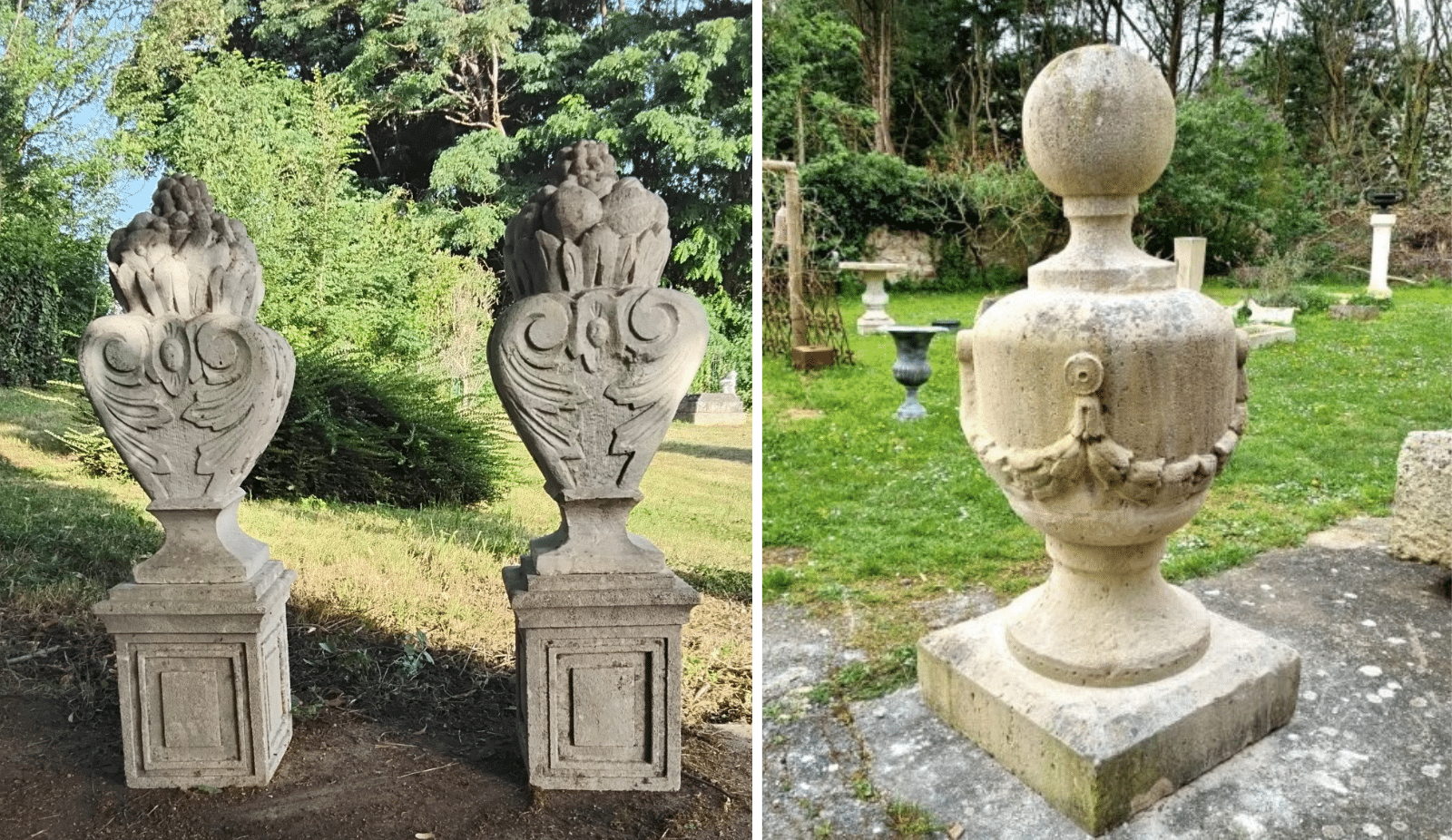
Antique 18th-century garden urns. Left: A pair of flamed urns in natural stone, 92 cm high. (© Pleuvry Christian). Right: A lidded urn in limestone (© Antiquités-Brocante de Chaignes).
These lidded urns are close relatives of pots à feu (flaming urns), which originally commemorated glorious military deeds and later became symbols of the eternal flame of remembrance. From the beginning of the French Renaissance, however, the flame was sometimes transformed into a flower, an artichoke, or a pine cone.
Conclusion: Inspiration Comes As We Walk
We hope this article has deepened your interest in—or love of—landscape gardens and inspired you to incorporate at least some of their defining features into your own garden.
One of the richest sources of inspiration may well be a visit to some of France’s finest surviving landscape gardens. We therefore invite you to discover:
- Parc de Bagatelle
- Parc Jean-Jacques Rousseau at Ermenonville
- Désert de Retz
- English Garden at the Trianon Estate, Versailles
Of these four gardens, Bagatelle has evolved considerably over time and is now particularly renowned for its rose garden, which was developed later. Nevertheless, its overall layout remains firmly rooted in the English landscape tradition. Ermenonville perhaps best illustrates the garden’s evolution towards a more Romantic sensibility. The Désert de Retz offers a remarkable variety of follies, while the charm of the English Garden at Versailles lies partly in the opportunity to walk in the footsteps of Marie-Antoinette.
We wish you many inspiring visits!