

Born in Brussels around 1689 and active in Paris from the early 1720s, Mathieu Criaerd belongs to the remarkable generation of Northern European craftsmen who helped define the French Rococo style under the reign of Louis XV. Although less celebrated today than contemporaries such as Bernard II Van Risen Burgh, Jean-François Oeben, or Jean-Henri Riesener, Mathieu Criaerd (1689-1776) was among the most prolific and refined ébénistes of mid-eighteenth-century Paris. His œuvre reflects both the evolution of French furniture design and the growing fascination with exotic materials, lacquer decoration, and sophisticated marquetry.
Criaerd came from a Flemish family of cabinetmakers. He was the son of Jean Criaerd, a bourgeois of Brussels, and the younger brother of the cabinetmaker Antoine Criaerd. Like many craftsmen from the Low Countries, he moved to Paris in search of greater opportunity in what had become the artistic and commercial capital of Europe. Installed on the rue Traversière-Saint-Antoine by 1723, he obtained his maîtrise in the guild of menuisiers-ébénistes on 29 July 1738. His marriage in 1721 to Jacqueline Godelart, daughter of the Faubourg Saint-Antoine cabinetmaker François Godelart, further integrated him into the Parisian furniture trade. Two of his sons, Antoine Mathieu and Sébastien Mathieu Criaerd, also entered the profession, perpetuating the family workshop.
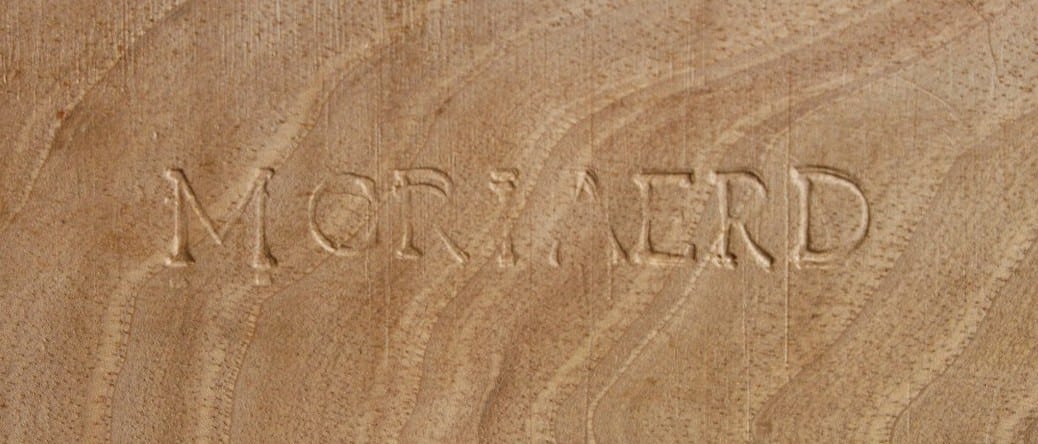
The maker’s stamp of Mathieu Criaerd “M CRIAERD” on the slant-front desk discussed below. © Galerie Gilles Linossier
Criaerd’s career unfolded at the heart of the Parisian luxury furniture industry. He worked for some of the most important marchands-merciers of the period, especially Thomas-Joachim Hébert, supplier to the Garde-Meuble royal. Through Hébert, Criaerd produced luxurious furniture destined for royal residences and elite patrons. After Hébert, he also collaborated with Gilles Joubert during the years 1755–1765. Sources further indicate that he worked for Jean-François Oeben until the latter’s death in 1763, revealing the degree to which Parisian cabinetmakers often operated through complex networks of workshops, merchants, and subcontractors.
Louis XV Lacquer Furniture: Chinese Taste and Vernis Martin
Among Criaerd’s most celebrated achievements are his lacquered commodes, which perfectly embody the French passion for chinoiserie during the reign of Louis XV. Their serpentine outline and uninterrupted drawers (drawers with concealed rails) are also typical of their time.
Prestigious Asia-Inspired Chest of Drawers
The enthusiasm for East Asian lacquer furniture intensified after 1737, when Bernard II Van Risen Burgh delivered to Queen Marie Leszczyńska at Fontainebleau what is considered the first French commode mounted with Japanese lacquer panels. Such creations represented a brilliant fusion of Asian materials with French furniture forms.
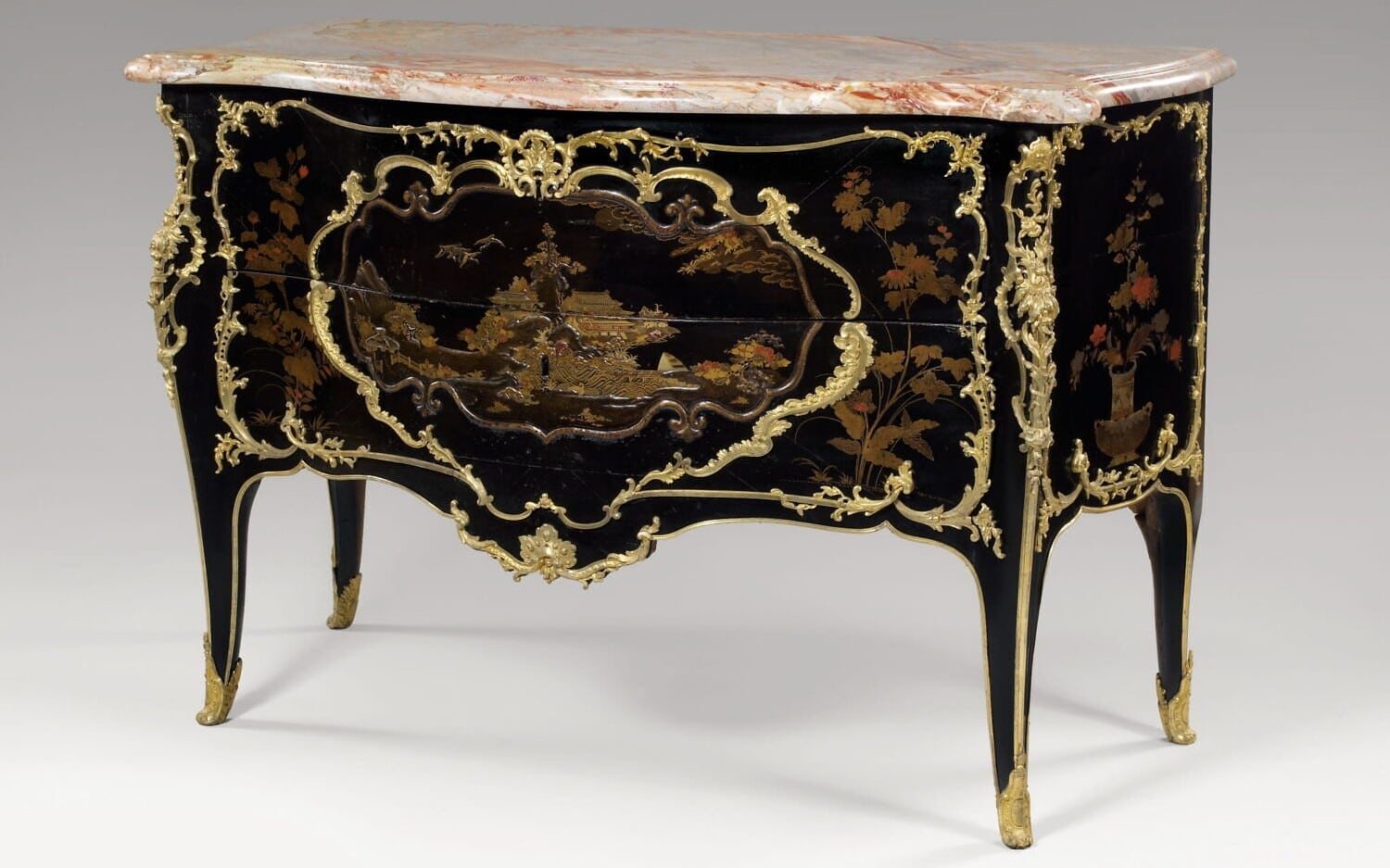
Three Japanese lacquer panels were used for this chest of drawers by Bernard II Van Risen Burgh, estampille BVRB. © 2008 Musée du Louvre, Dist. GrandPalaisRMN
Like other leading ébénistes of the period, Criaerd worked both with authentic imported lacquer and with European substitutes known as vernis Martin. Developed by the Martin brothers around 1728, vernis Martin imitated the appearance of Chinese and Japanese lacquer while offering a more affordable and adaptable solution. Criaerd proved especially gifted in incorporating these surfaces into the curvilinear forms of Rococo furniture.
His most famous lacquer furniture is undoubtedly the celebrated blue-and-white commode and matching corner cupboards preserved at the Musée du Louvre. Created around 1742–1743 for the “Chambre bleue” of Madame de Mailly at the Château de Choisy, these pieces are associated with the marchand-mercier Hébert and demonstrate the sophistication of French chinoiserie at its height.
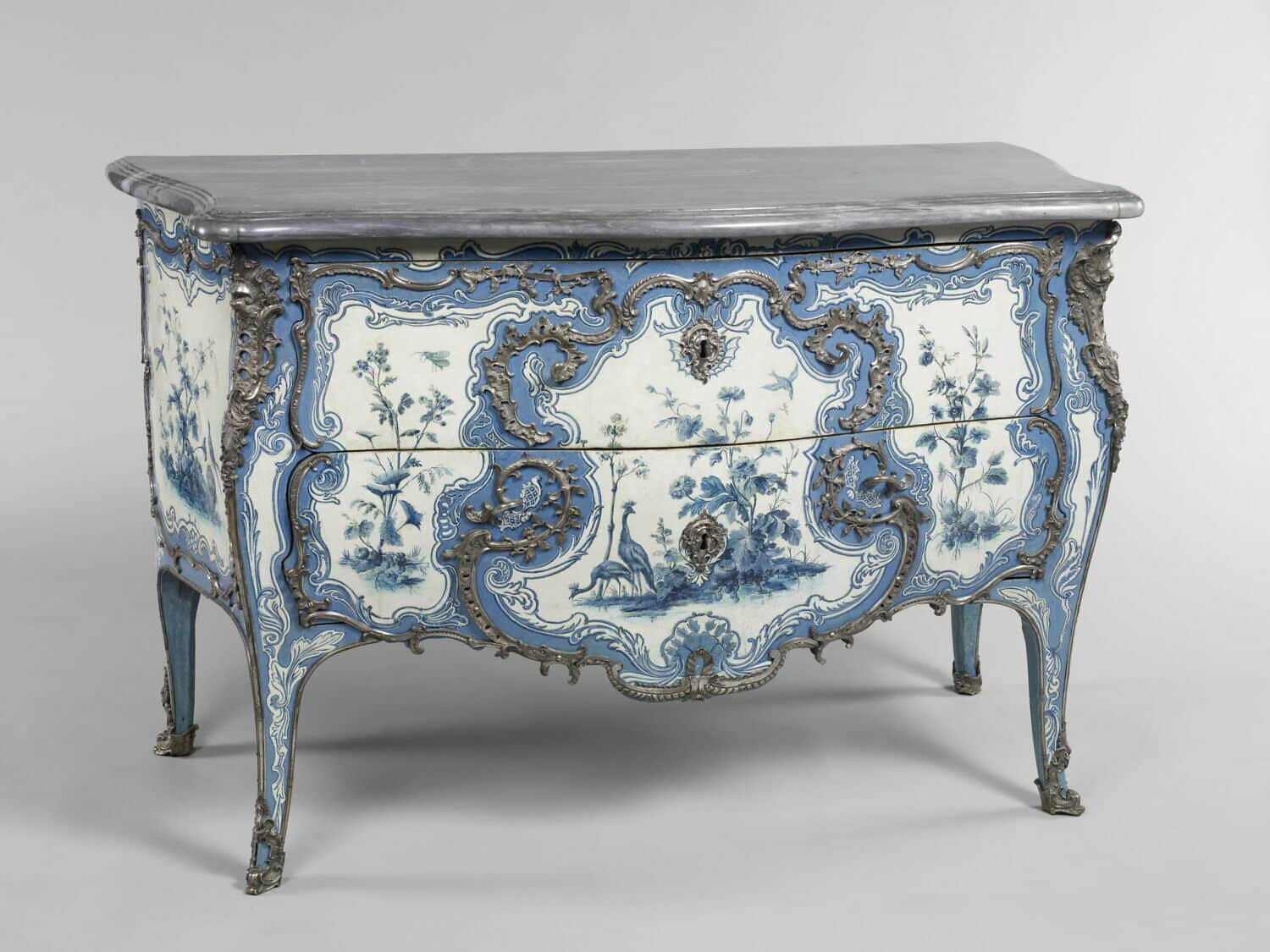
Probably the most famous chest of drawers by Mathieu Criaerd. In vernis Martin with a blue-and-white decor, silver bronze mounts, and a turquin-blue marble top. © 2012 Musée du Louvre, Dist. GrandPalaisRmn / Thierry Ollivier
Their painted decoration of birds, flowers, rocks, and fantastical Oriental motifs reflects the contemporary taste inspired by artists such as François Boucher, Alexis Peyrotte, or, most importantly, Christophe Huet. The delicate blue camaïeu decoration on a pale background evokes Indian textiles, or Chinese porcelain, and imaginary Eastern landscapes while remaining unmistakably French in composition and elegance.
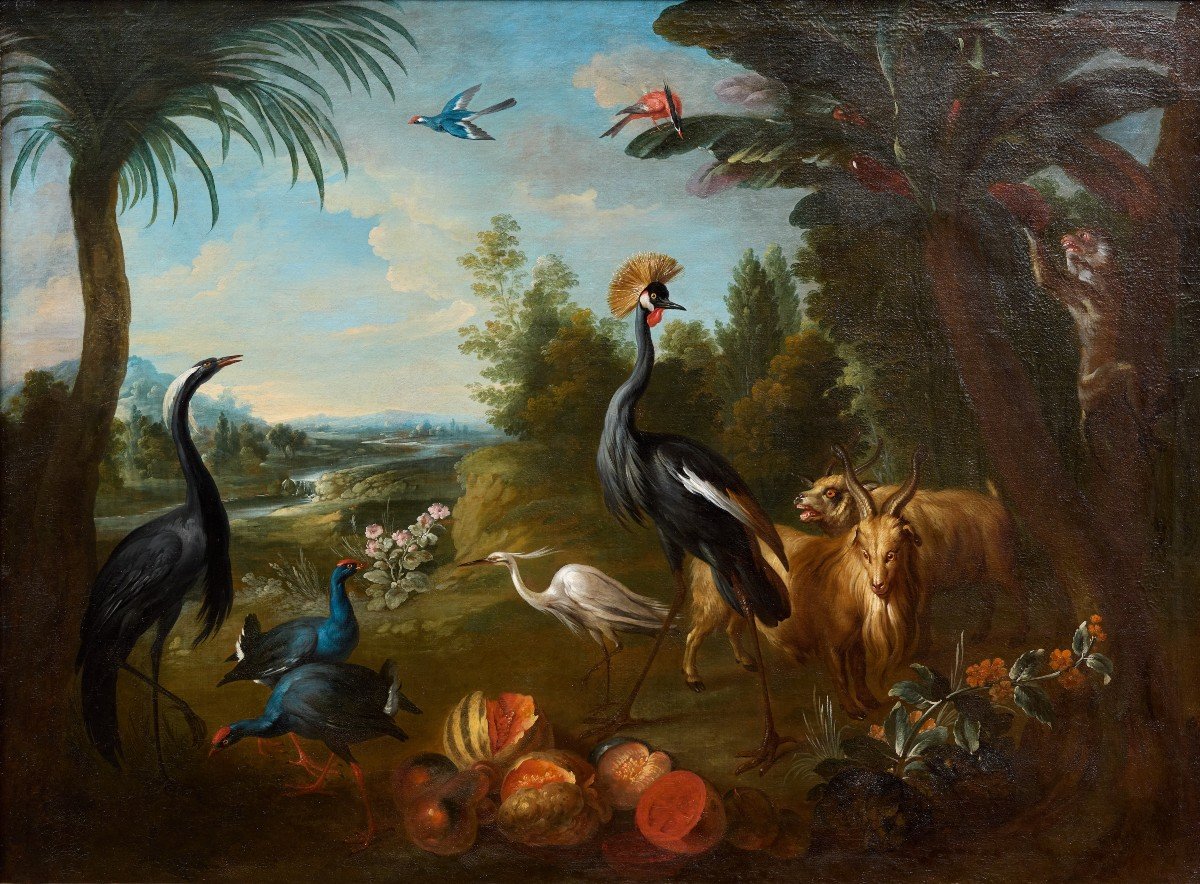
Crowned crane surrounded by an egret, a demoiselle crane, two goats, a monkey, and various other birds, amidst fruit and luxuriant vegetation, with a river flowing in the background. © Galerie Gilles Linossier
The resemblance between the postures of the crowned cranes on this chest of drawers and those depicted in the painting by Christophe Huet below is striking, despite the distinct treatment of the surrounding vegetation. Oil paintings of such imposing dimensions (here, H 119 × W 157 cm) were designed to be integrated into the boiseries of castles and grand residences, helping to evoke the exotic atmospheres that were highly fashionable in eighteenth-century interiors.
Mathieu Criaerd’s Black-Lacquer Commodes
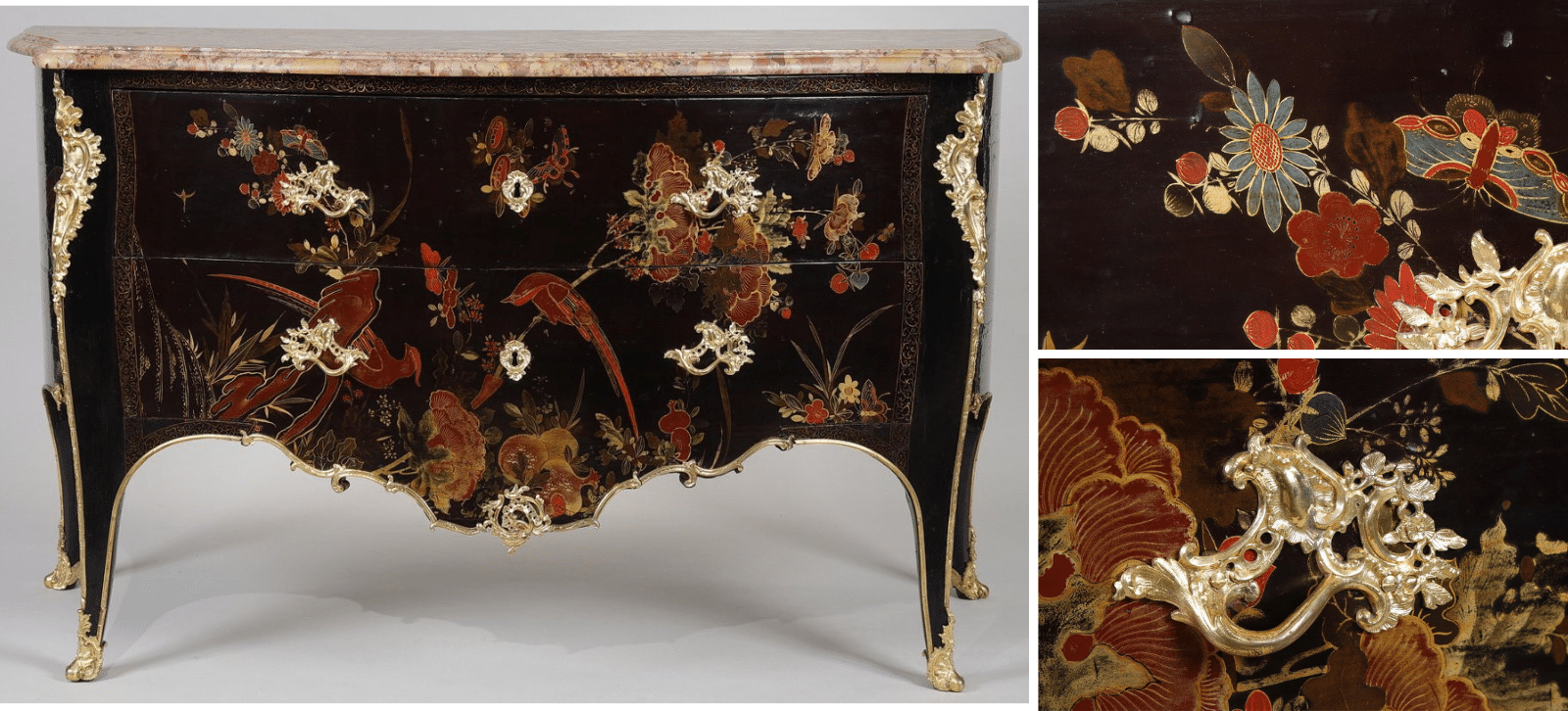
The quality of the polychrome lacquer and the bronze mounts and similarities with catalogued pieces made it possible to attribute this drawer chest to Mathieu Criaerd. © Galerie Gilles Linossier
Criaerd also produced furniture with black lacquer grounds richly decorated with polychrome flowers, phoenixes, butterflies, and foliage in the Chinese taste, inspired by East Asian lacquerware, that reflect the eighteenth-century fascination with distant lands and naturalistic ornament.
In the example above, the principal appeal of this elegant Louis XV commode lies in its sumptuous European lacquer decoration, executed in a vibrant polychrome palette, enriched with touches of blue, set against a deep black ground. An exotic landscape with a bridge framed by bamboo animates the sides. The front is adorned with long-tailed birds—creatures closely associated with China in the European imagination—perched among flowering peonies and luxuriant foliage. In Chinese culture, peonies symbolize prosperity and wealth and are commonly found on ceramics and decorative objects. Combined with a butterfly, they also represent a couple and express wishes for happiness and prosperity.
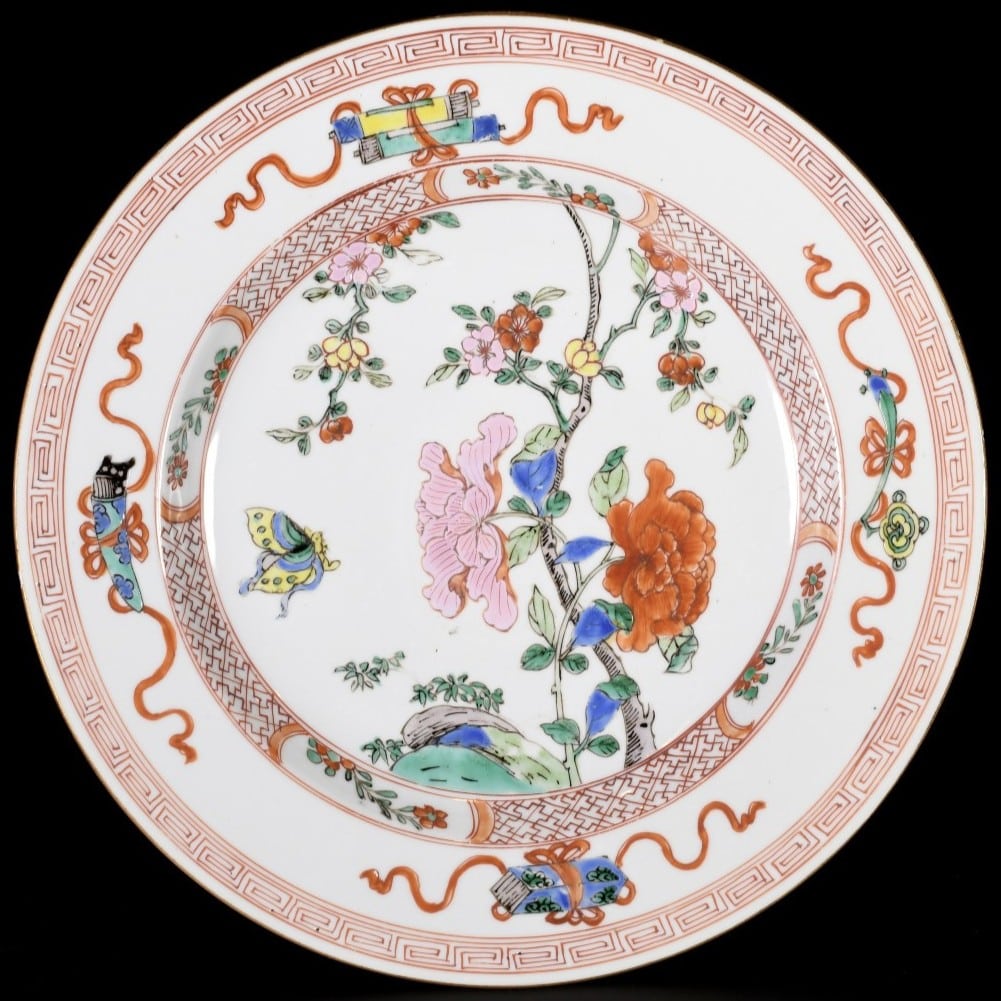
Peonies and a butterfly are included in the central decor of this Yongzheng period (1723-1735) porcelain plate with Famille Rose and Famille Verte enamels. © Galerie Drake
The lacquer panels are framed by finely chased and gilded bronze mounts of exceptional quality. Particularly noteworthy are the corner mounts, whose graceful contours elegantly delimit the lacquered surfaces and contribute to the architectural balance of the composition. The delicately modelled drawer handles, remarkable for their lightness, asymmetrical design, and refined chasing, introduce a subtle rocaille flourish, while the scrolling sabots complete the ensemble. The warm glow of the gilding provides a striking contrast with the deep black ground and brilliant polychromy of the lacquer.
The success of these lacquered commodes rested not only on their exotic appearance but also on the harmonious integration of French Rococo forms. Criaerd’s bronzes are consistently praised for their finely chased quality and animated rocaille design. Several sources suggest that these mounts may have derived from models provided by Hébert himself, underlining the collaborative nature of Parisian luxury production.
Mathieu Criaerd’s Veneers and Geometric Marquetry
Although Criaerd is especially remembered for lacquer furniture, his marquetry pieces reveal another essential dimension of his talent. His work in veneer and geometric inlay demonstrates an exceptional sensitivity to wood grain, colour contrasts, and surface pattern.
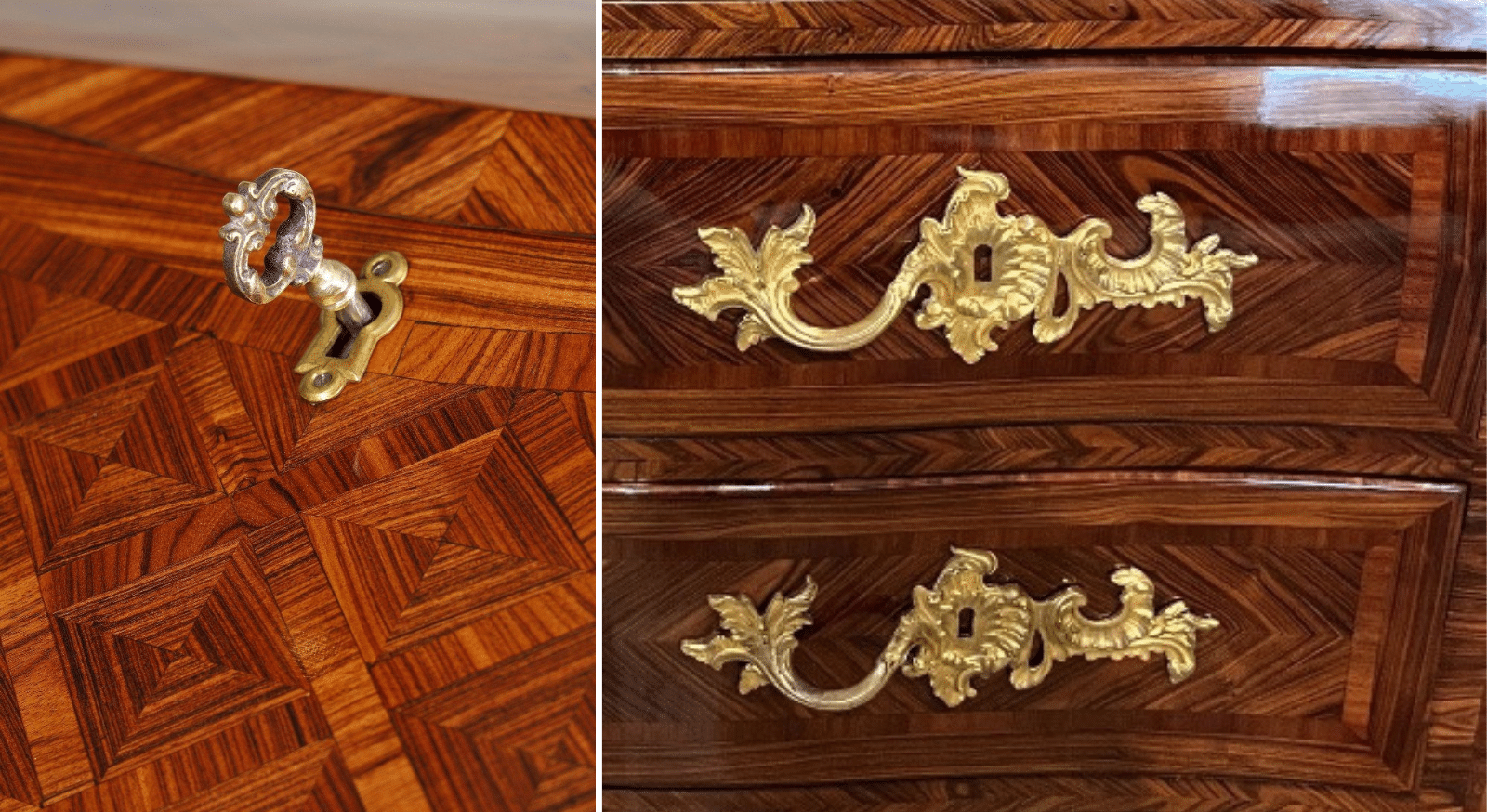
Details of the marquetry and veneer work in furniture discussed below. Left: © Galerie Gilles Linossier. Right: © Julien Cordier Antiquités.
Criaerd particularly favoured tulipwood, kingwood, satiné, and amaranth. He arranged these veneers into highly characteristic geometric compositions, notably trellis patterns and box-match veneers (lozenge or diamond motifs). These diamond-point marquetries became one of the signatures of his workshop. Rather than relying exclusively on floral marquetry, as many contemporaries did, Criaerd frequently explored abstract decorative rhythms created through contrasting veneers and directional grain.
Chests of Drawers in Veneer
His early commodes, often in the bombé form inherited from the Régence style, featured dark veneers of palisander and amaranth, highlighted by the warm brilliance of gilt-bronze mounts. As his style evolved into the full Louis XV manner, his furniture adopted more sinuous outlines and lighter, more varied veneers. Commodes with crossbanded trellis marquetry on all sides became especially characteristic of his production.
This bombé commode is characteristic of Mathieu Criaerd’s early work, its form still strongly rooted in the Régence style. The gilt-bronze escutcheons and drawer pulls, however, display the asymmetry associated with the Louis XV rocaille aesthetic. The drawer pulls are particularly elegant, their rings discreetly suspended from finely modelled acanthus-leaf stems. The kingwood veneer is arranged in Criaerd’s characteristic book-match diamond motif, highlighted by delicate satinwood stringing.
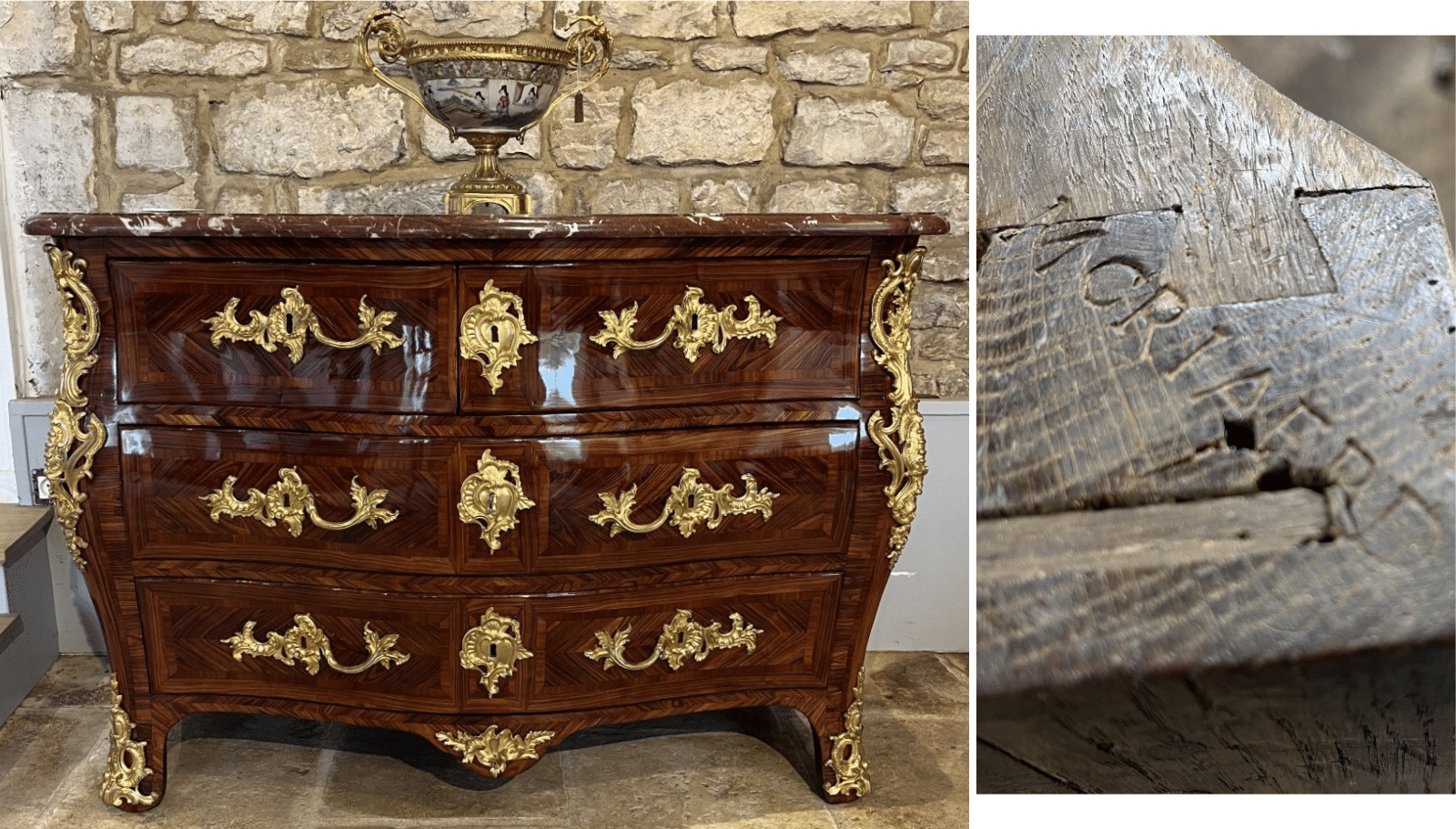
Bombé commode by Mathieu Criaerd with rococo bronze mounts. © Julien Cordier Antiquités
Another remarkable example is a large commode “à la Régence” (sold by Hôtel Drouot in June 2022) opening with two drawers and two side doors, decorated with diamond-point marquetry in satinwood and kingwood. The richness of its gilt-bronze ornamentation — with foliage, fruits, and strapwork mounts — recalls the decorative language of masters such as Charles Cressent and André-Charles Boulle’s successors. The absence of the crowned “C” tax mark on the bronzes allows the piece to be dated before 1745, placing it among Criaerd’s earliest documented works after obtaining his maîtrise.
Other Fashionable Furniture of the Louis XV Period
In addition to commodes, Criaerd also produced slant-front desks, dressing tables, gaming tables, and occasional furniture. These pieces were generally simpler in conception but retained the refined marquetry techniques and elegant proportions characteristic of his workshop. The reign of Louis XV saw the development of lighter, smaller furniture forms that were easier to move and better adapted to increasingly personalized interiors.
For instance, the slant-front desk is a form of furniture closely associated with the reign of Louis XV and represents a stylistic innovation largely confined to the years c. 1730–1760. Over time, its silhouette became progressively more refined as the drawer compartments diminished in size or disappeared altogether. The graceful cabriole legs further contributed to the form’s lightness and elegance.
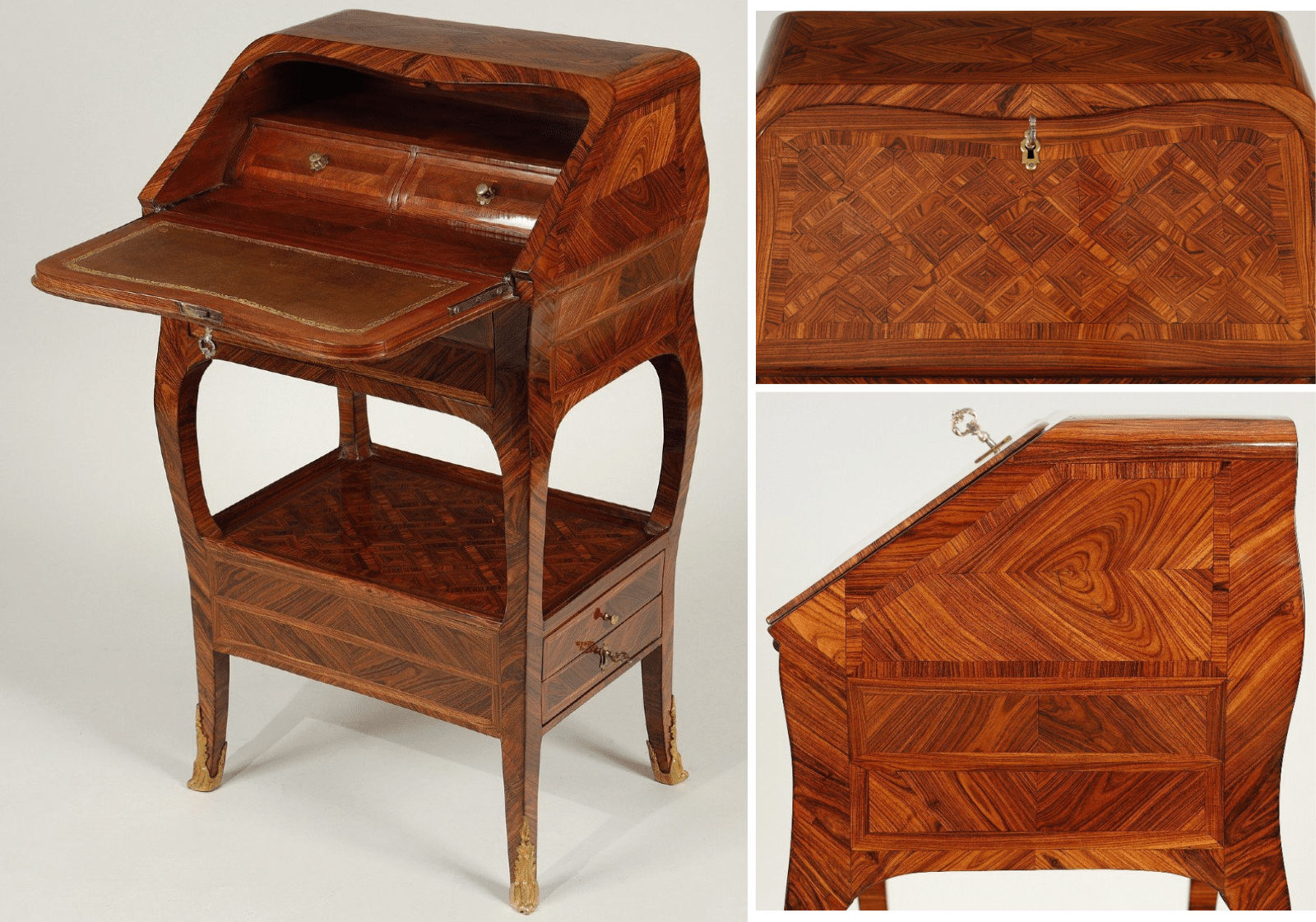
A distinctive small slant-front desk by Mathieu Criaerd in the same style as Pierre IV Migeon for the kingwood veneer. © Galerie Gilles Linossier
In the present example, however, the two-drawer under-tier cabinet makes the piece particularly distinctive. It demonstrates remarkable ingenuity in increasing storage capacity while preserving—and indeed emphasizing—the curvature of the legs. This small desk also offers a constant visual interplay between straight and curved lines, evident both in its geometric marquetry and in the contours of the carcass itself.
The kingwood veneer, combining diamond-patterned grain (occasionally arranged in lattice motifs) with book-matched veneers, is highly reminiscent of the work of Pierre IV Migeon. This resemblance is particularly interesting in light of the documented business relationship between Criaerd and Migeon, the latter acting both as cabinetmaker and marchand-ébéniste. Indeed, Criaerd appears among the craftsmen recorded in the Migeon workshop ledgers.
Conclusion: Mathieu Criaerd, At the Heart of Louis XV Furniture Production
Mathieu Criaerd occupies a distinctive place in the history of eighteenth-century French furniture. As a member of the community of craftsmen from the Low Countries who settled in Paris, he contributed significantly to the flourishing of the decorative arts under Louis XV. His furniture embodies the dialogue between tradition and innovation that characterizes the period: between Régence forms and Rococo exuberance, between geometric marquetry and exotic lacquer, and between artisanal craftsmanship and the commercial vision of the marchands-merciers.
Criaerd’s influence extended beyond his own workshop. Furniture by other makers, notably the vernis Martin commodes stamped by Charles Chevallier, has often been compared to his celebrated creations, particularly those preserved at the Louvre. The close ties between the Chevallier and Criaerd families are further illustrated by the career of Antoine Mathieu Criaerd, Mathieu’s eldest son, who became a master in 1747 and succeeded to Chevallier’s business after he died in 1771. His younger son, Sébastien Mathieu Criaerd, inherited his father’s workshop when Mathieu retired following the death of his wife in 1767, ensuring the continuation of the family enterprise.
While some of his contemporaries achieved greater posthumous fame, Criaerd’s finest works rival those of the leading Parisian ébénistes of the age. His lacquer commodes rank among the most accomplished expressions of French chinoiserie, while his marquetry furniture reveals a highly personal and refined decorative language. Through his collaborations with Hébert, Joubert, Oeben, and the Chevallier family, and through the legacy continued by his sons, Mathieu Criaerd secured an enduring place among the foremost cabinetmakers of Louis XV’s reign.
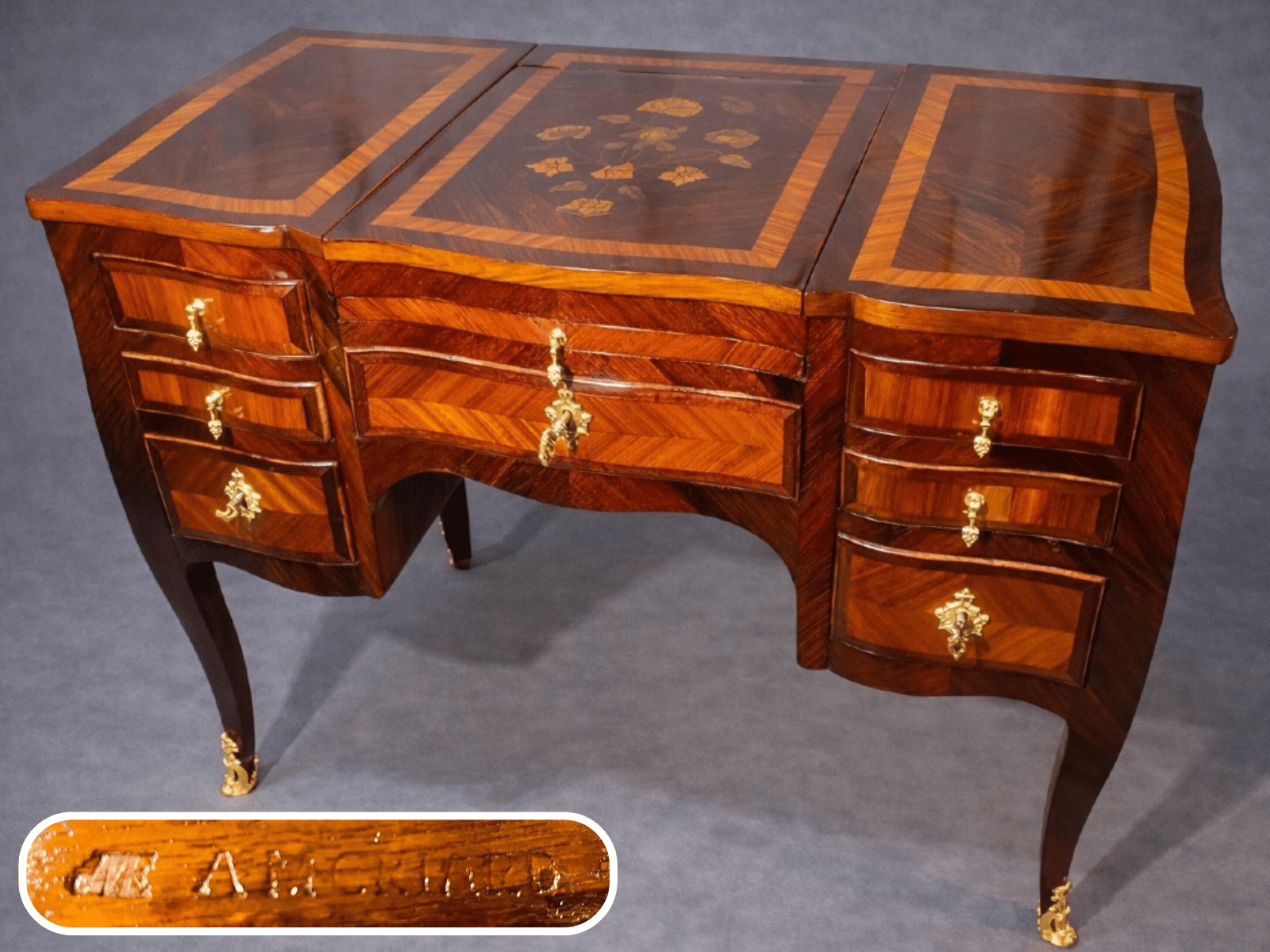
A dressing table by Antoine Mathieu Criaerd, stamped “AM CRIARD”, with the e of the surname omitted compared to the stamp used by his father, Mathieu Criaerd. Also bearing the “JME” guild mark (Jurande des Menuisiers-Ébénistes). © Galerie Leroy
You May Like
The Criaerd Family of Ébénistes | 18th-Century Chest of Drawers | 18th-Century Furniture | Louis XV Furniture