

The iconic motif of Longwy enamels is without doubt the “apple blossom” — so what better season than spring to talk about it? This floral pattern is heir to the not less famous Japanese “cherry blossom”, an explicit sign of the immense influence of Asian arts on the Longwy manufactory at the end of the 19th century.
We invite you to discover the process behind the development of Longwy’s legendary style within the French decorative arts, and to explore its origins and creative experiments more deeply, broadening the perspective on Longwy’s most notable collectibles.
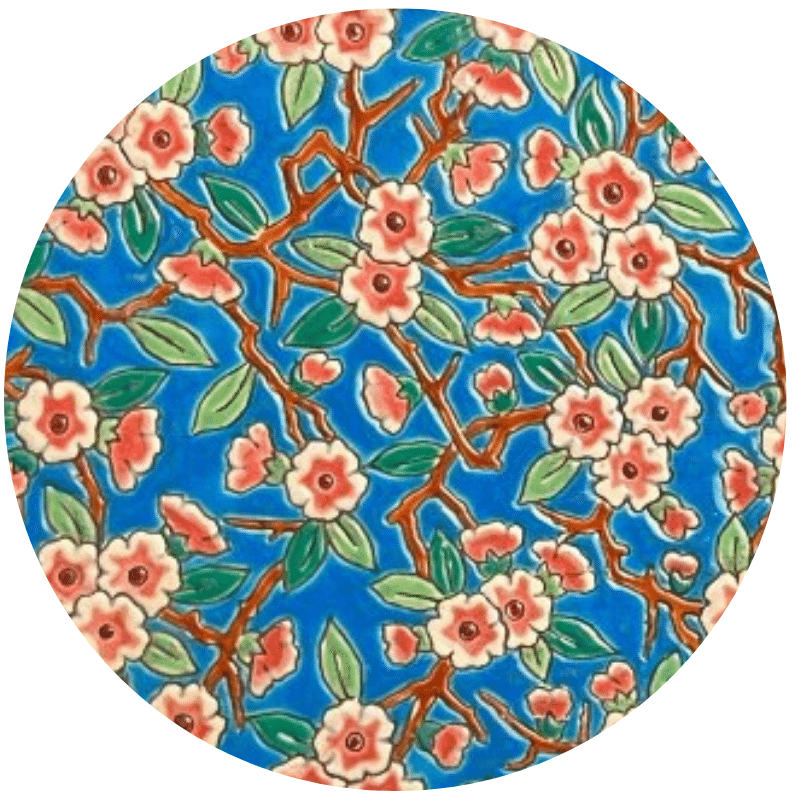
A variation of the famous D188 apple blossom pattern on a turquoise blue background, from the 1920s–30s. © Adequantik
Founded in 1798 in the town of Longwy in Lorraine, the manufacture has produced ceramics for more than two centuries, combining technical mastery with artistic innovation. Nowadays, despite economic challenges, the “Manufacture des Emaux de Longwy 1798” continues to inspire strong public support. A recent crowdfunding campaign raised over €1 million, demonstrating the popularity of Longwy’s famous pieces of decorative art even today.
Its cloisonné-style enamel on earthenware—characterized by raised outlines separating vividly colored enamel cells—has become the factory’s unmistakable signature and one of the most iconic decorative techniques in French ceramics.
The Golden Age of the 1870s: Birth of the Iconic Longwy Style
The roots of Longwy’s distinctive aesthetic lie in the late nineteenth century, even though—as we develop it below—the Art Deco period considerably expanded its popularity. Beginning in the 1870s, the manufacture entered what is often described as its golden age. During this period, Longwy developed the decorative technique that would become its visual signature.
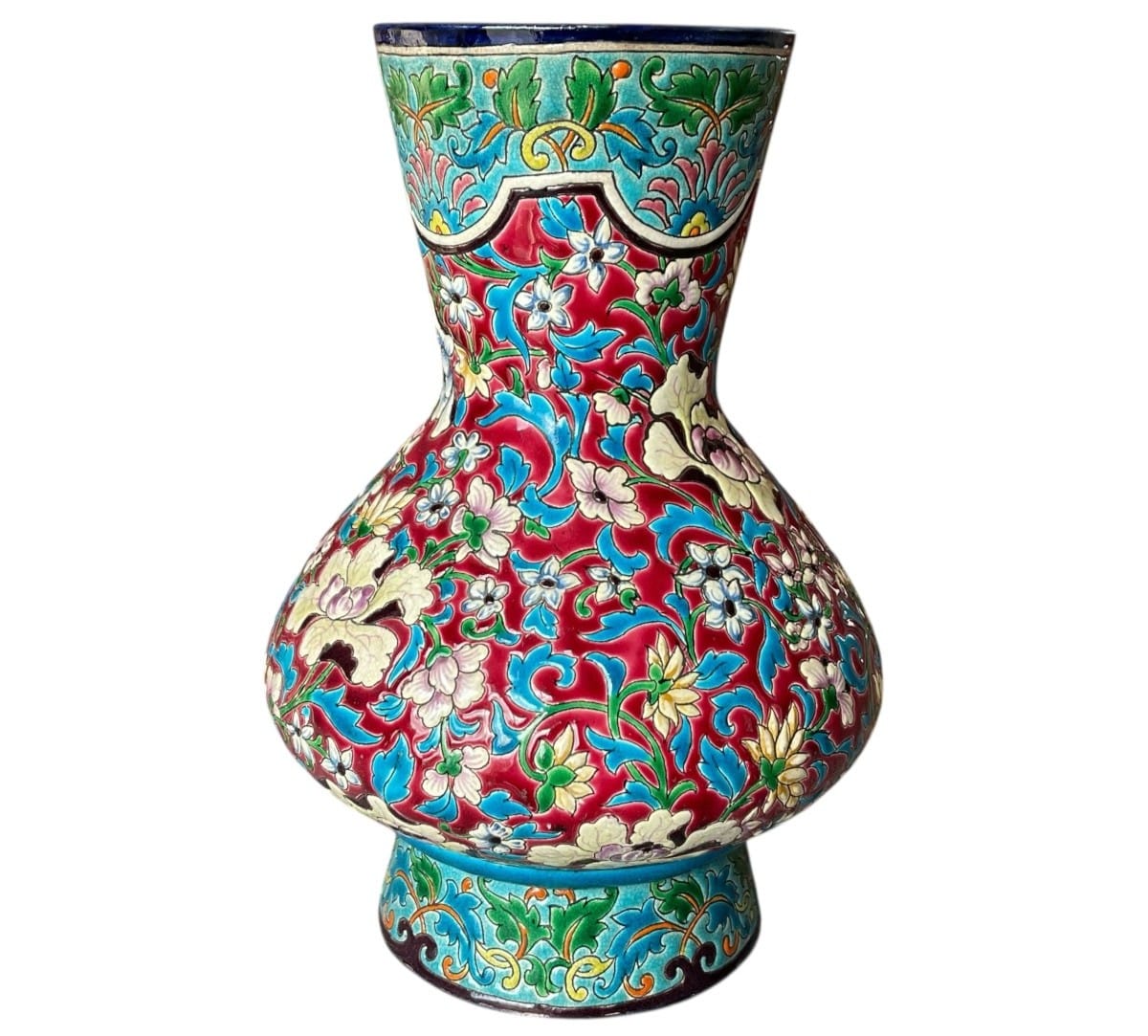
The influence of Chinese decorative arts is obvious in this Longwy baluster vase. The D792 pattern shows chrysanthemums or peonies in a lively color palette reminiscent of Chinese cloisonné enamels. © Michael Delaby Antiquités
A crucial turning point came after the Paris Universal Exhibition of 1867. The exhibition introduced European audiences to a vast array of Asian decorative arts, particularly from China and Japan. This encounter sparked a wave of fascination with oriental aesthetics, and Longwy was among the manufacturers eager to respond to this new demand.
In this Asian- and Oriental-inspired aesthetic, flowers dominate the signature style of Longwy. Birds, too, are a recurring motif in Longwy ceramics. These are garden birds, frolicking in the foliage as if glimpsed from a window—or egrets, herons, waders, and a wide variety of wild birds, most often depicted near a body of water.
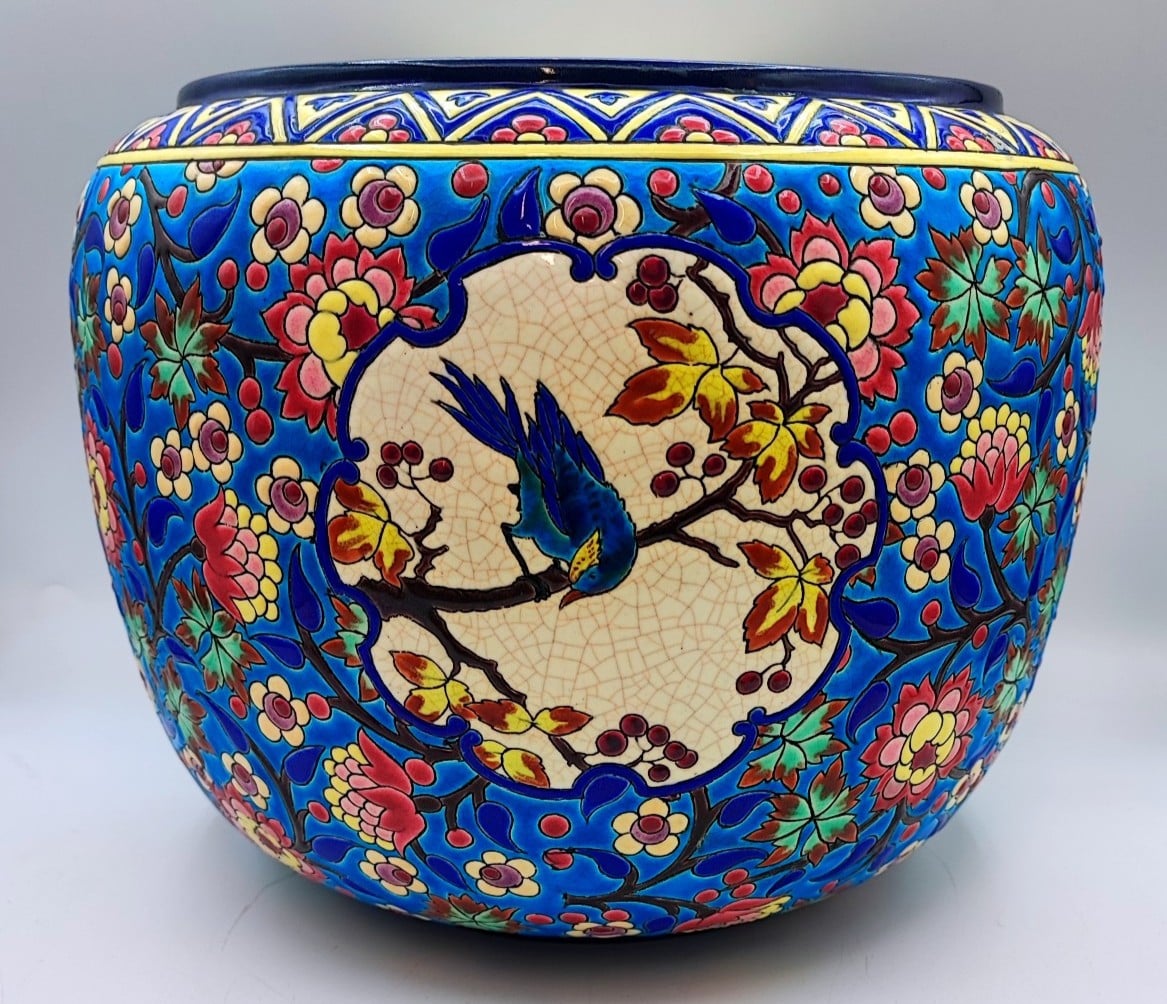
A striking 19th-century Longwy planter with a D5670 pattern and a blue jay. © Antiquaire Nancy
In 1873, the factory adopted a cloisonné-style enamel technique characterized by raised outlines—known as cernés—that separate colored enamel areas. This method was inspired in part by experiments by the ceramicist Eugène Collinot (1824-1889), who had patented a similar process earlier in the century. At Longwy, the technique was refined and adapted to earthenware, creating a distinctive visual language that quickly became the hallmark of the manufacture.
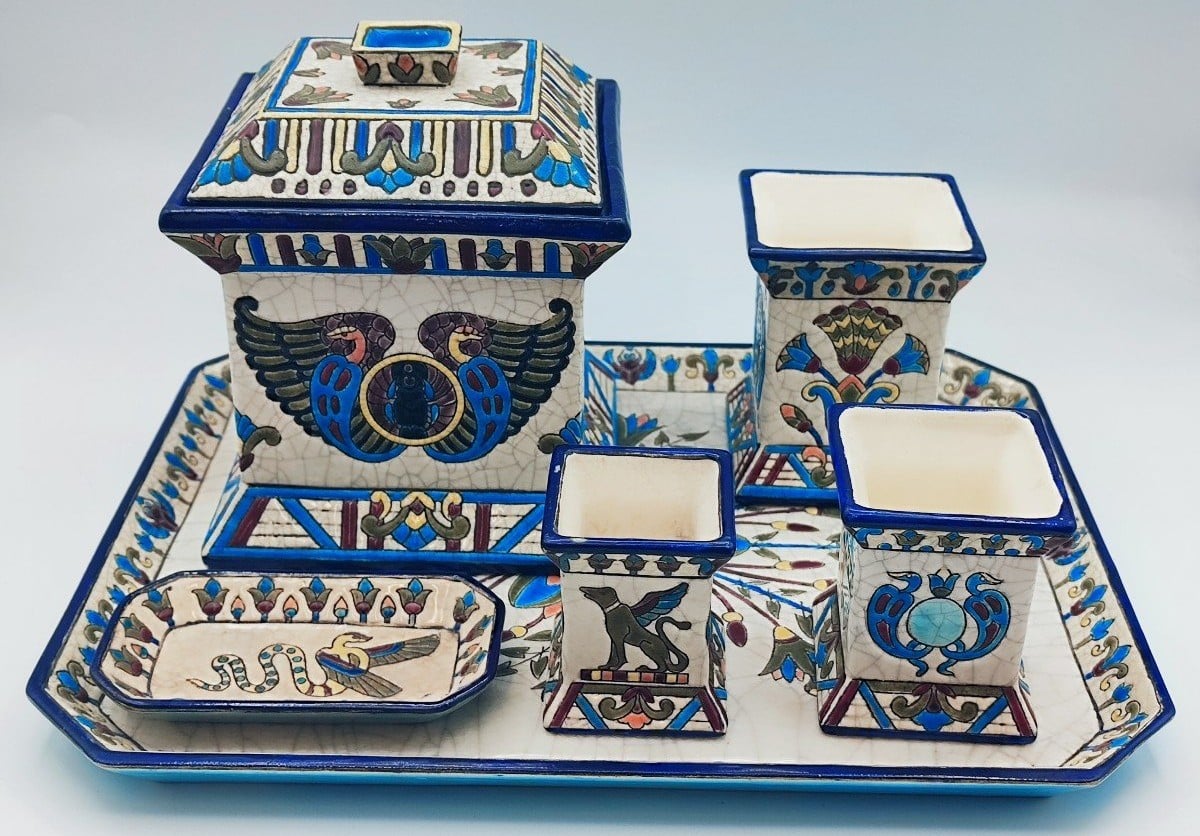
A complete six-piece set by Longwy made in the 19th century. The Egyptian motifs illustrate the Egyptomania that came in various waves during the 19th century. © Antiquaire Nancy
The new style was instantly recognizable. Brilliant cerulean blue backgrounds, black outlines, and richly colored motifs created a vivid decorative effect. The designs often drew inspiration from a wide range of cultures, including Iznik ceramics from the Ottoman Empire, Chinese and Japanese ornament, Persian motifs, and even ancient Egyptian imagery. Through these influences, Longwy created a decorative vocabulary that felt both cosmopolitan and original.
Among the most famous patterns developed during this period is the “apple blossom” motif registered under the décor number D188. Over time, it became one of the most recognizable and iconic decorations ever produced by the factory. While in the 19th century the D188 pattern appeared in several color variations, its best-known version today is undoubtedly the white-and-pink flowers set against a luminous blue background, widely popularized during the 1920s and 1930s.
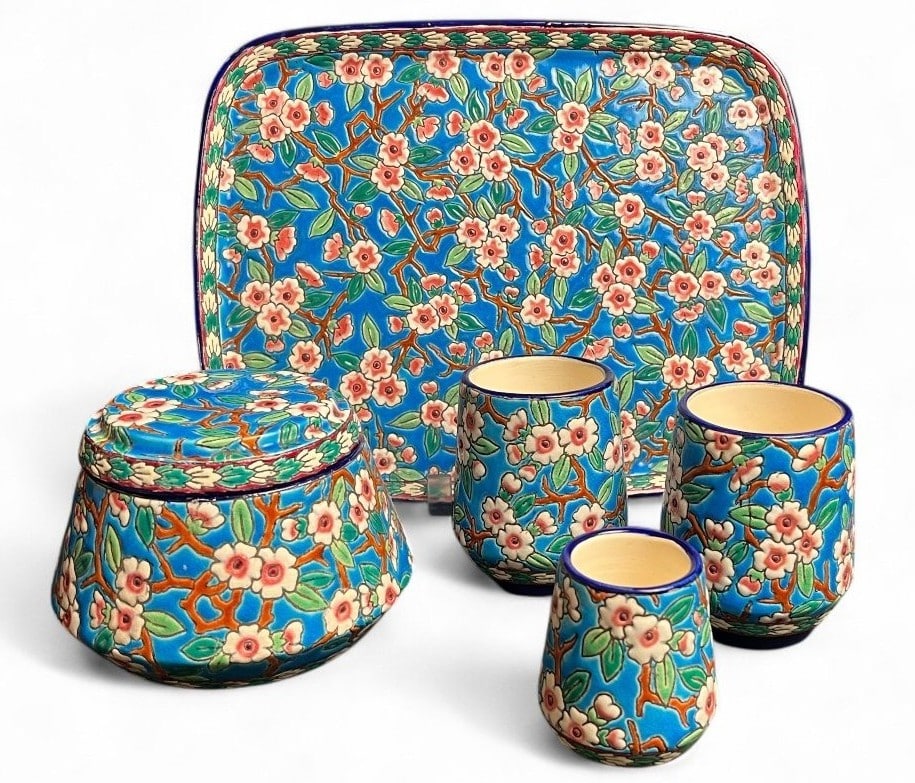
A five-piece Art Deco Longwy smoking set boasting the famous D188 “apple blossom”. © Adequantik
Art Deco and the Fame of Longwy
Among the many periods of Longwy production, the Art Deco era of the 1920s and 1930s stands out as particularly celebrated. During this time, the manufactory embraced modern design while maintaining its technical traditions. The result was a series of striking decorative pieces that combined geometric aesthetics with the brilliance of cloisonné enamel.
Two Defining Artistic Directors: The Chevallier Cousins
Perhaps the most iconic example is the celebrated “Boule Coloniale – Amazonie et jungle” vase. Created by Maurice Paul Chevallier, this remarkable piece embodies the dynamism of the Art Deco period. Its spherical form and exotic decorative themes reflect the era’s fascination with distant cultures. The vase achieved international recognition when it received a gold medal in the decorative arts section at the Paris Colonial Exhibition of 1931.
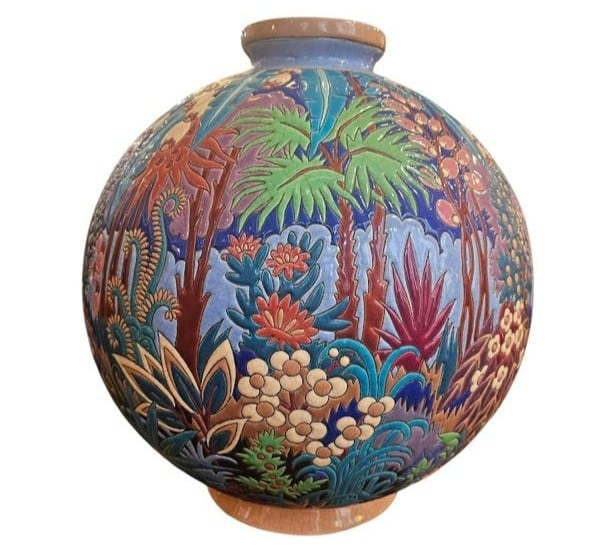
The distinctive globe shape of the most emblematic Art Deco Longwy vase, designed in 1931 by Maurice Paul Chevallier: “Boule coloniale, Amazonie et jungle”. The rich decoration with colorful trees and flowers is best served by the simple shape. © Antiquités Art Nouveau
The first central figure in this creative renewal was Raymond Chevallier (1900-1959), who led the art workshop from 1921. His cousin, Maurice Paul Chevallier (1892-1987), began as an artist in 1925 and served as the factory’s artistic director from 1931. Their designs captured the spirit of the age, integrating stylized forms, bold compositions, and innovative decorative motifs. Under their leadership, Longwy produced some of its most famous pieces, many of which remain highly sought after by collectors today.
The Art Deco Aesthetic at Longwy
During the Art Deco period, Longwy fully embraced the crackled enamel backgrounds as a distinctive stylistic feature. The subtle network of lines across the glazed surface forms a geometric decoration. Designs often depicted animals or regional subjects, moving beyond the traditional bird motifs that had long dominated earlier productions. These works helped cement Longwy’s reputation as a leading name in decorative ceramics during the early twentieth century.
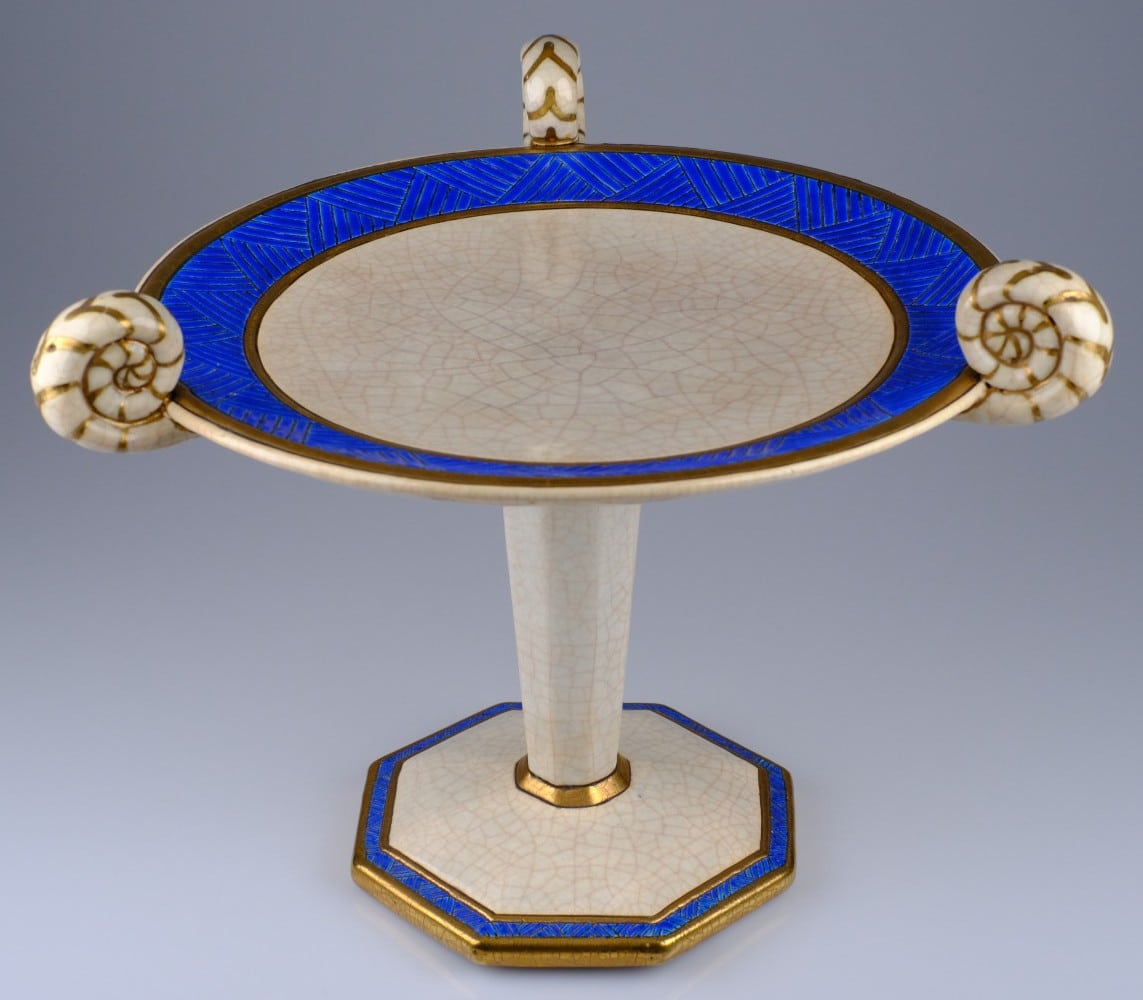
All the charm of a crackled glaze is magnified by the simple lines and colors (white, blue, gold). Contrasted circular and angular shapes. © 1920’s
During the Art Deco period, vase forms saw a particularly rich outpouring of creativity and are now among the most sought-after objects. Beyond the more traditional globular and ovoid shapes, designers emphasized vertical and horizontal faceting, resulting in polygonal and stepped forms. Standard sizes typically ranged from approximately 15 to 40 cm in height, while pieces exceeding 45 cm were generally reserved for limited editions or special commissions.
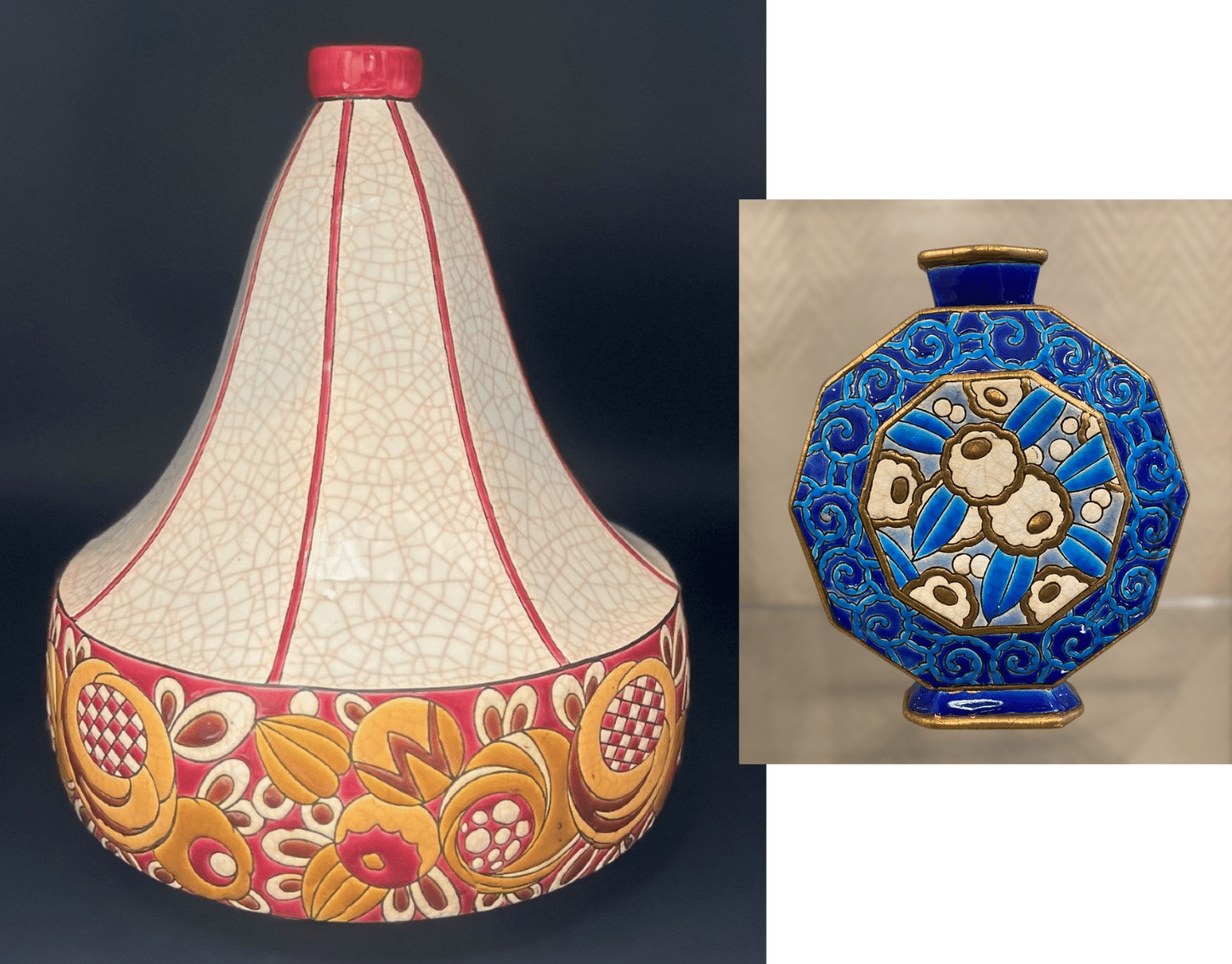
Two typical Art Deco vases by Longwy. Left: Top-shaped vase (vase toupie), H 34 cm. © Bertrand Klein Antiquités. Right: Decagonal vase, H 19.5 cm. © Guisset Antiquités
Many models from the Art Deco years differ from the exuberance of colors seen until then and instead offer a softer combination of tones, often in subtle gradations of a single hue (blue or brown, for example, as shown below). We can see in these models developed in collaboration with Primavera (the art studio of the Printemps luxury department store) and Pomone (the art studio for Bon Marché), the emblematic crackled enamel backgrounds.
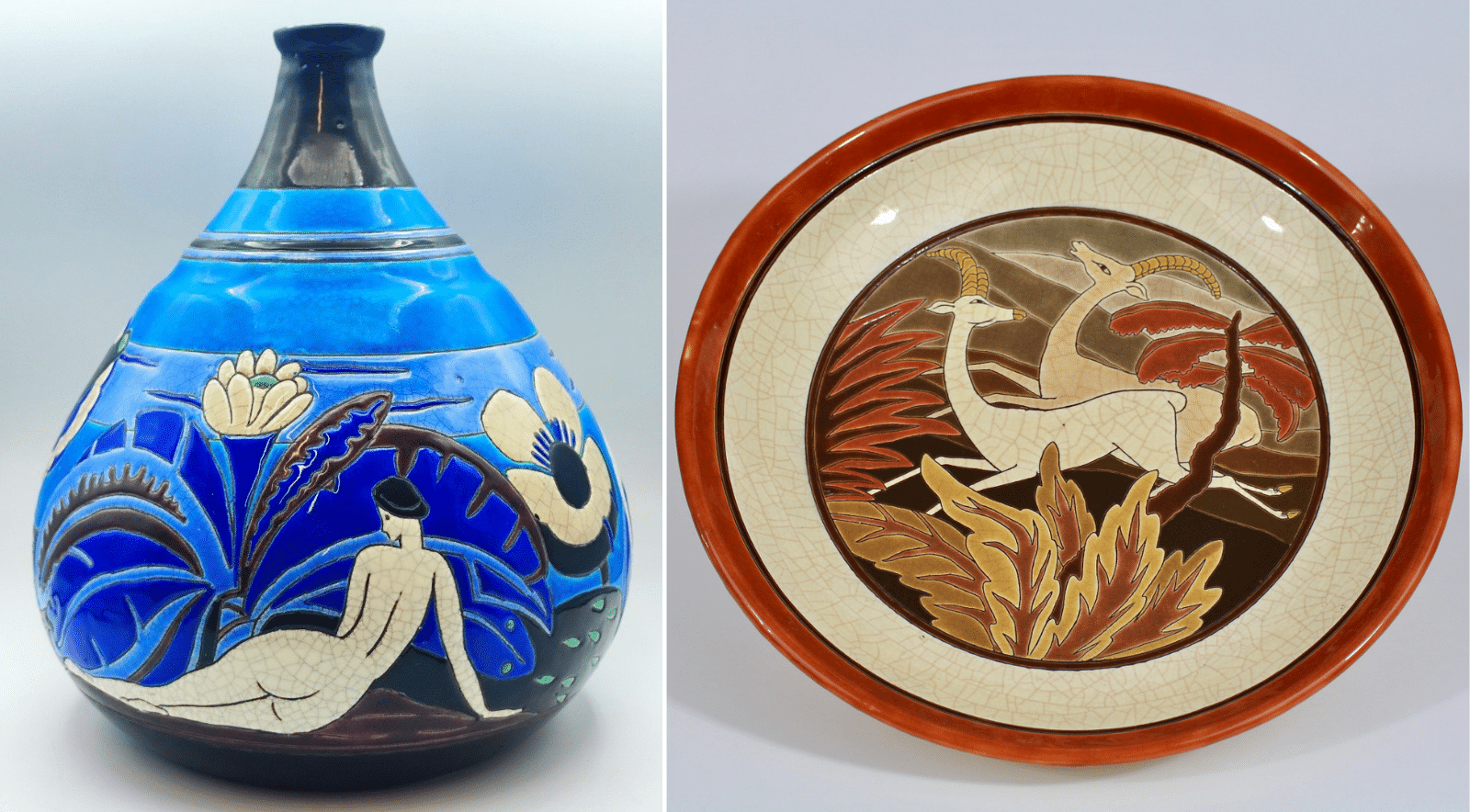
Primavera and Pomone (the respective art studios of the luxury Parisian department stores Printemps and Le Bon Marché) collaborated with Longwy during the Art Deco period. Left: A pear-shaped Primavera vase (© Antiquaire Nancy). Right: A large dish by Pomone (© Gaudin Antiquités).
Longwy’s Artistic Experimentation and Technical Diversity in the 19th Century
The flourishing decades of the late nineteenth century were not limited to cloisonné enamel alone. During this dynamic period, the Longwy factory experimented with numerous ceramic techniques and established itself not only as an industrial enterprise but also as an artistic laboratory within the broader world of French decorative arts.
Barbotine
One of the most technically demanding methods explored at Longwy was barbotine decoration. This approach involved applying liquid clay to create relief designs, often resembling painterly brushstrokes. Inspired in part by experiments at the Sèvres porcelain manufactory, Longwy developed barbotine pieces with a distinctly impressionistic quality. Produced mainly between the late 1870s and the end of the nineteenth century, these works were luxurious objects because of the complexity of their execution.
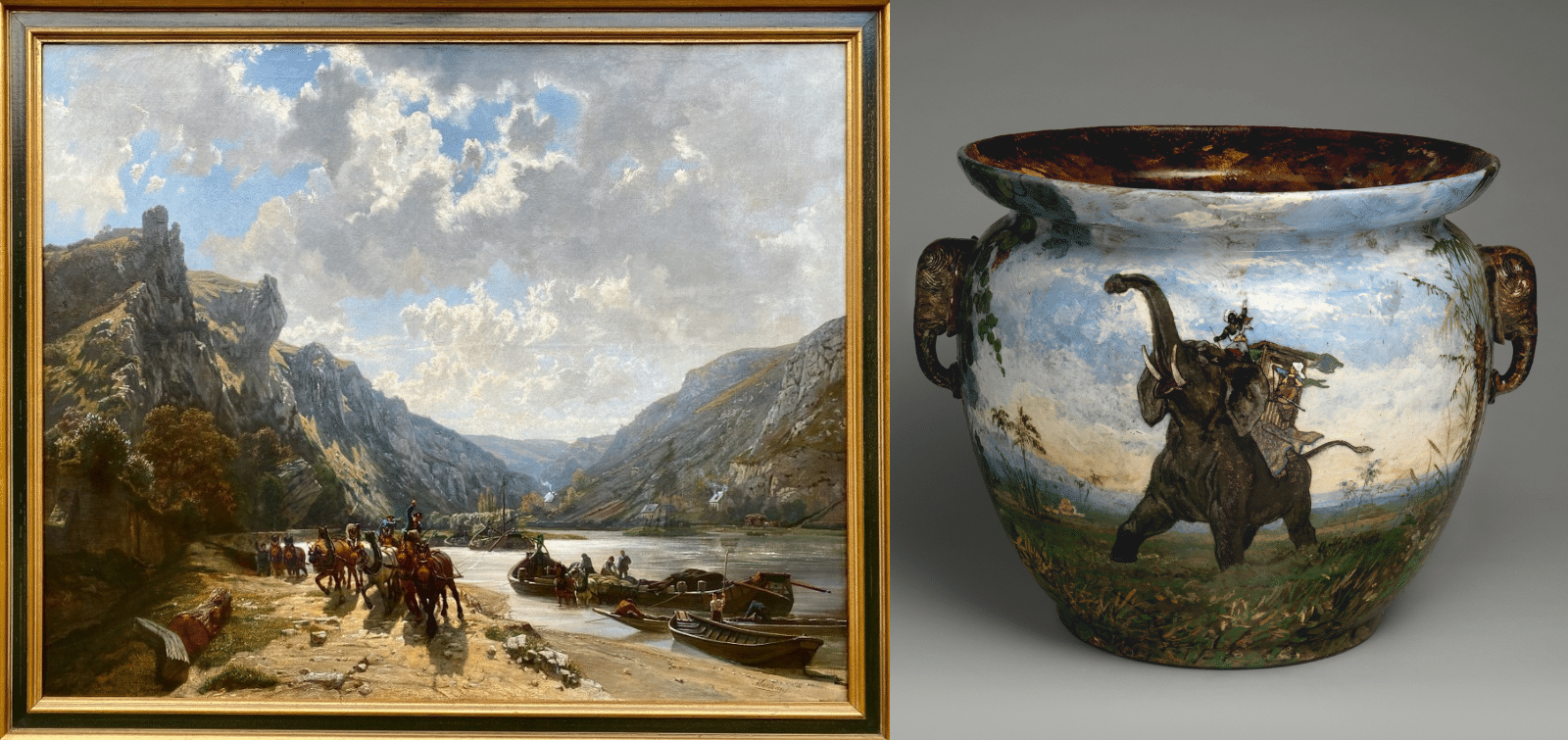
Martinus Antonius Kuytenbrouwer (1821-1897), originally a Dutch painter, spent much of his career in France during Napoleon III’s reign. He was a specialist in landscapes and animals. Note the similarities in his palette between this painting and the vase. Left: Oil on canvas, The Maas River (© Valentina Safarian Fine Art). Right: Elephant in a tiger hunting scene, barbotine painting on a vase, probably Longwy (The Met Museum, public domain).
Prominent artists collaborated to decorate the Longwy barbotine pieces, among them: Charles Rudhardt, Camille Barnoin, Simon Bida, Eugène Carrière, Emmanuel Kilbert, Martinus Kuytenbrouwer, and Cirode. The influence of Barbizon, Impressionism, and Art Nouveau is striking. Nature—with its landscapes, flora, and fauna—is central to most of their motifs.
Majolica
At the same time, Longwy produced majolica-style ceramics characterized by monochrome glazes in vibrant colors such as turquoise, green, ochre, and purple. Unlike the cloisonné enamel technique, majolica relied on smooth, richly colored surfaces that emphasized the object’s sculptural form. These pieces demonstrated the factory’s versatility and its ability to adapt to diverse artistic tastes.
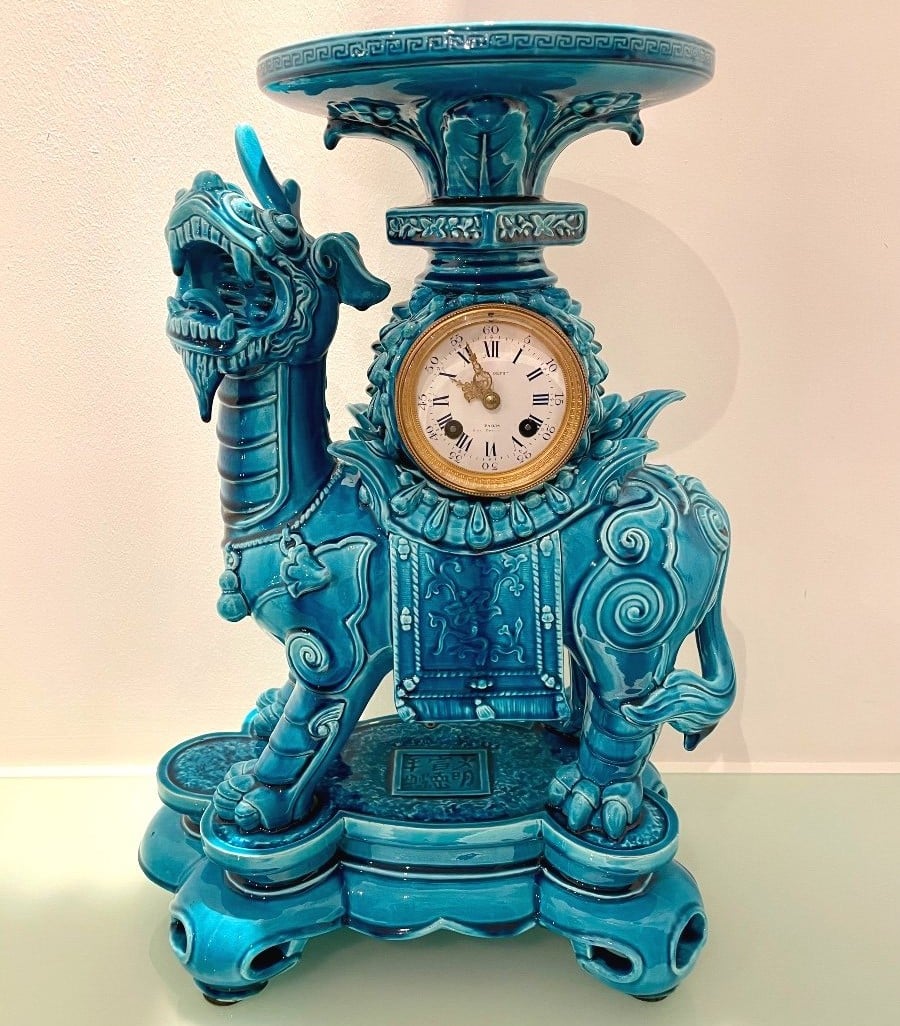
This unicorn dragon, in a majestic “Théodore Deck” turquoise blue, is characteristic of a Longwy production inspired by a fantasized Orient. Incense burner in the upper section. Clock in working order. © Antiquités Giono
Brocatelle
Another notable decorative method was brocatelle enamel. Unlike traditional Longwy cloisonné, brocatelle designs often lacked raised outlines and were applied on white or softly colored backgrounds. During the Art Deco period, this technique was frequently used for more playful or simplified motifs, including designs intended for decorative objects or even children’s tableware.
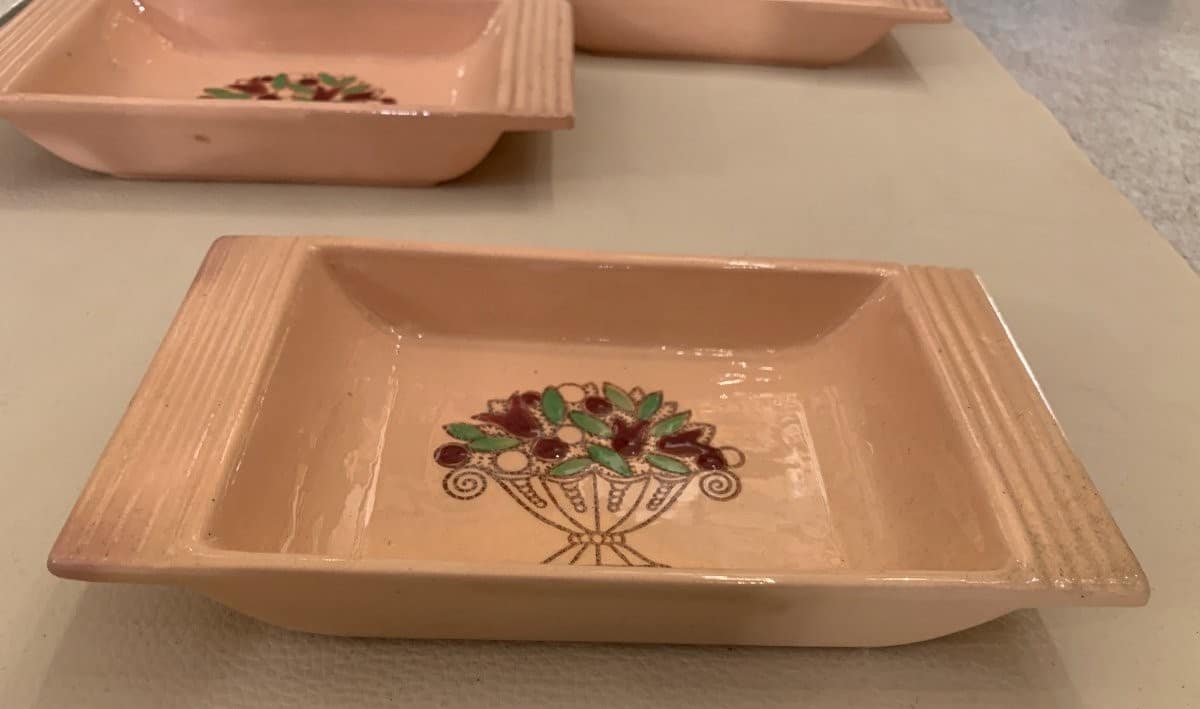
In this Art Deco catchall tray, we clearly see the raised enamels for the flowers and leaves of a stylized bouquet. Brocatelle technique on a powder pink background. © STRM Galerie Maximilien
Origins of the Longwy Manufacture and the Age of Table Services
To fully understand the success of Longwy enamels, one must return to the origins of the factory in the late eighteenth century. The manufacture was founded in 1798 by Charles Régnier in the town of Longwy, located in the Lorraine region of eastern France. This region had long been known as a land of arts du feu (“arts of fire” in English; an umbrella term covering the transformation of a mineral material by heat), home to numerous ceramic workshops and faience factories.
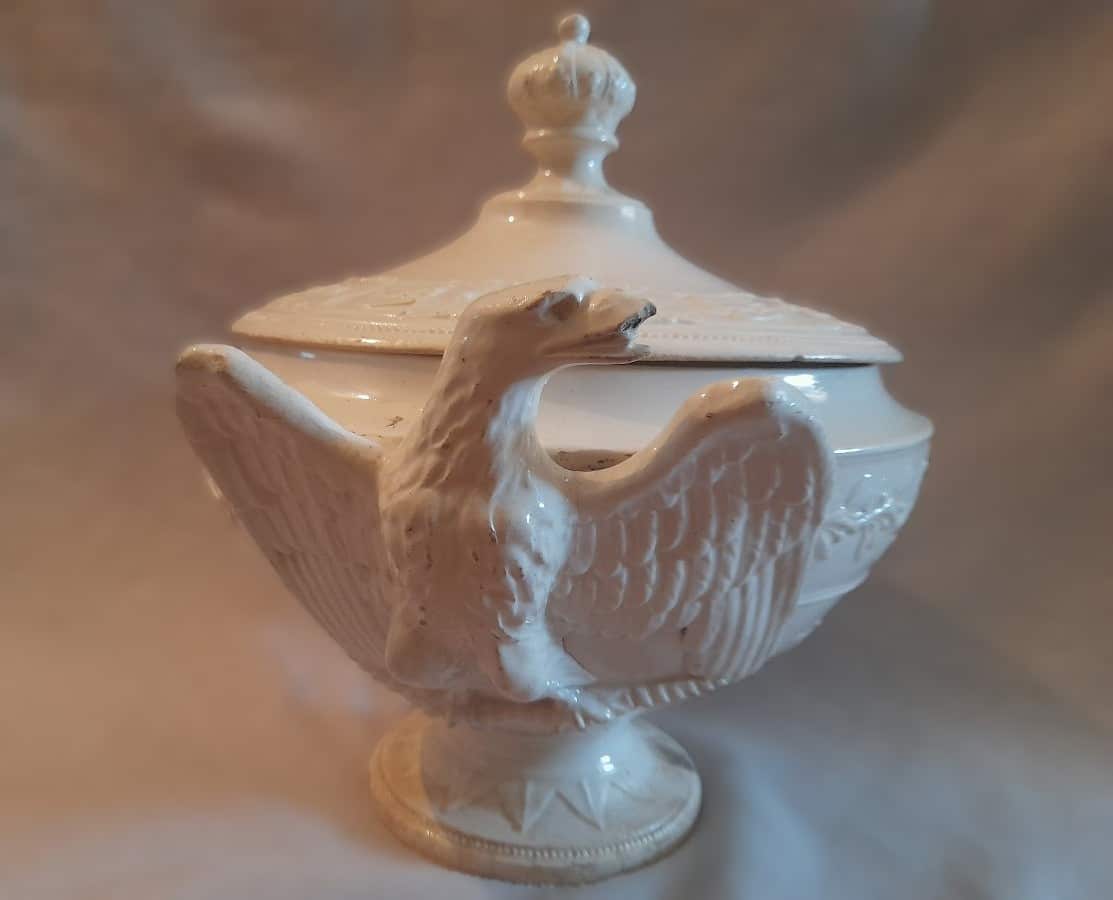
This Imperial tureen (more commonly known as the Legion of Honor model) is a pipe-clay earthenware with a lead-based glaze. In 1804, Napoleon I stopped by Longwy. He would have ordered services for the “Legion of Honor orphanages” he created. This tureen model would have been included. We don’t know the other pieces. © Remonter le temps
In the early nineteenth century, the factory went through an important transformation. After the fall of Napoleon I’s Empire, the business was purchased in 1815 by Jean-Antoine de Nothomb and his wife Marie-Catherine Antoinette Boch, a member of the family behind the famous Villeroy & Boch enterprise. Their leadership brought new technical improvements, better materials, and a stronger commercial organization, helping the factory grow and gain recognition.
In 1866, the management passed to their grandsons, Ferdinand and Hippolyte Huart, two engineers trained at the École Centrale in Paris. They continued modernizing production and encouraged artistic innovation. Under their direction, the factory diversified its products and began developing the decorative ceramics that would later make Longwy internationally famous (as explained above in the first section of this article).
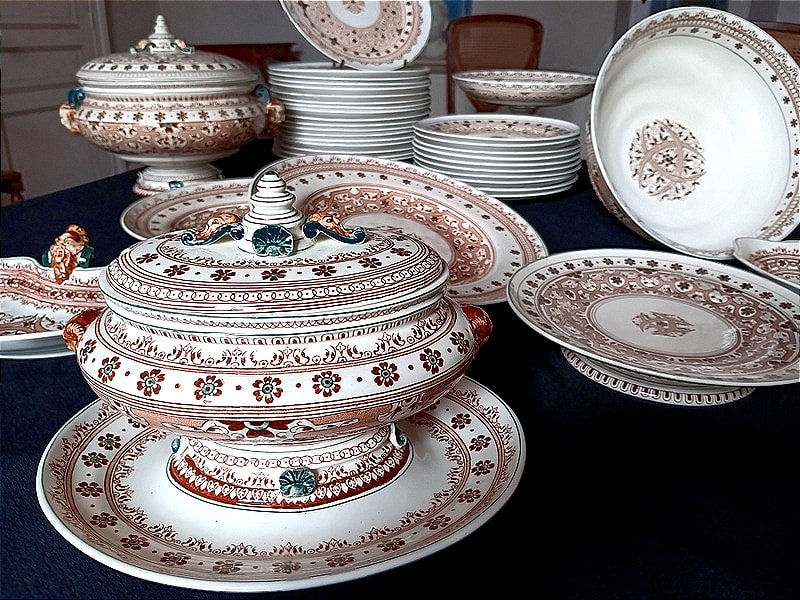
Henri II dinner service in fine earthenware with 44 pieces. A Renaissance-style decor in sepia and green. © Les trésors d’Isabelle
During the nineteenth century, however, the most prestigious productions were often elaborate table services. Among the most impressive examples was the remarkable “Henri II” service. Created in anticipation of the Paris Universal Exhibition of 1878, this service drew inspiration from Renaissance ornament and was produced until 1908. Its decorations featured interlaced friezes, crescent motifs, and mascaron heads, all painted by hand. The service included hundreds of different forms, making it one of the most ambitious ceramic table services ever produced by the factory.
Tableware remained an essential part of Longwy production well into the twentieth century. Yet by the 1960s, the market had changed dramatically. Demand for large ceremonial table services declined, and the factory gradually shifted its focus toward decorative pieces and luxury enamel works, which would become its defining specialty. Longwy stopped producing table services in 1962.
Conclusion: Between Tradition and Renewal
The history of Longwy enamels illustrates the delicate balance between tradition and innovation that characterizes many historic craft industries. After the Second World War, the manufactory faced the same economic pressures that affected numerous French ceramic factories. Changing consumer habits and increasing competition made it difficult to maintain the scale of earlier production.
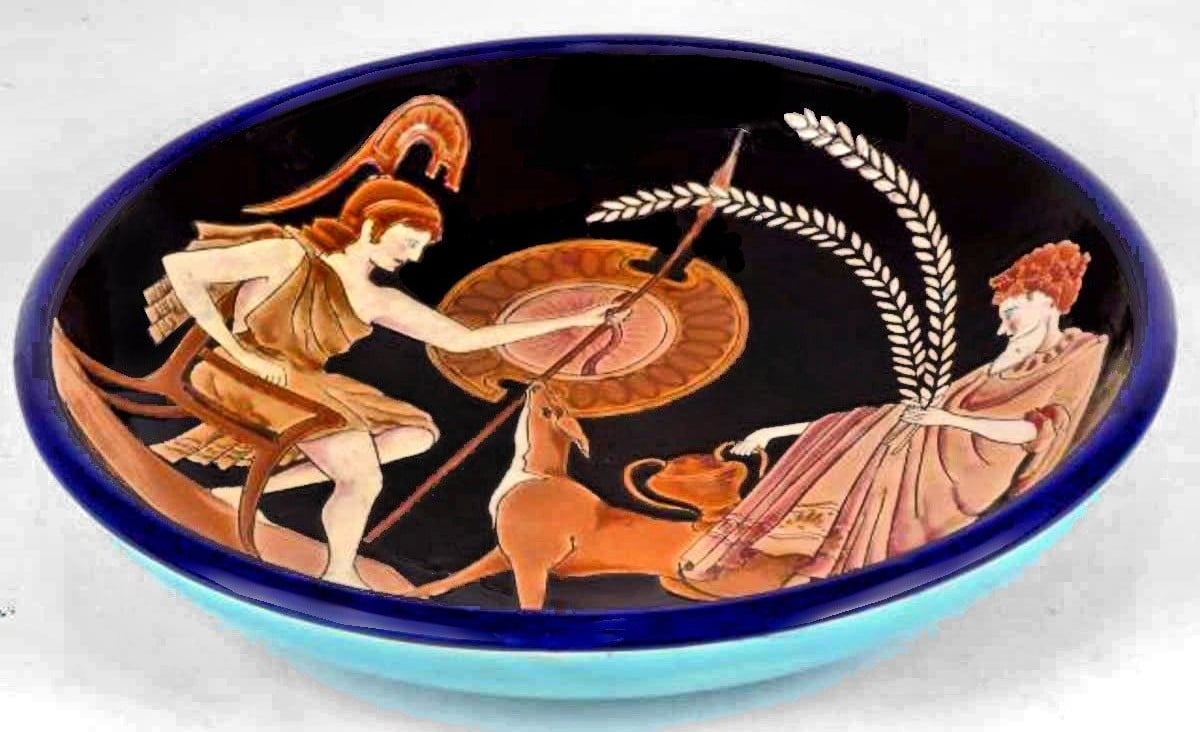
This Longwy dish, “Bacchus in front of Hermes,” is from a limited series (19/60) made between 1944 and 1949. Decor designed by Rolande Rizzi, Albert Kirchtetter was the enameler. © Galerie Tramway
Yet Longwy continued to explore new creative directions. Artists such as Paul Mignon, a former apprentice of Maurice Paul Chevallier, carried forward the classical Longwy aesthetic while adapting it to modern tastes. Other designers, including Rolande Rizzi, introduced fresh imagery and narrative scenes, proving that the traditional enamel technique could still inspire new artistic interpretations.
The factory also experimented with collaborations with major twentieth-century artists. Limited editions after works by figures such as Picasso or Picart Le Doux demonstrated the adaptability of the enamel technique to contemporary artistic languages. These experiments kept the manufactory connected to the broader currents of modern art.
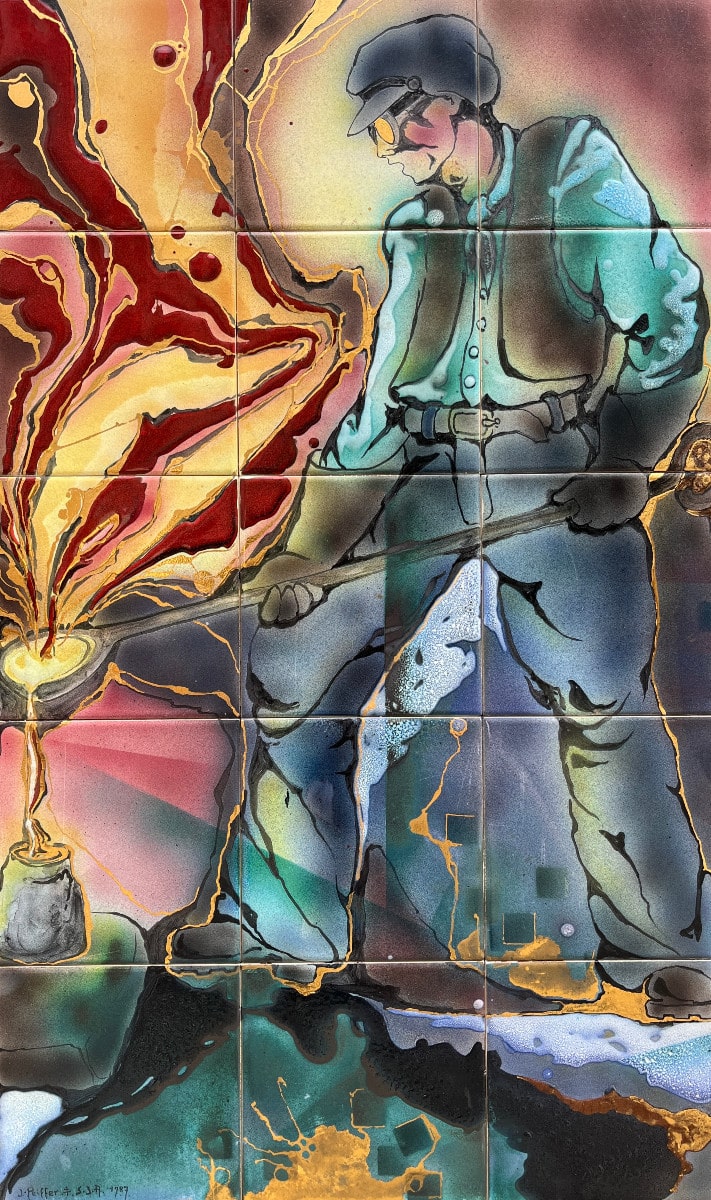
Foundry worker at the Longwy Enamels manufactory. Decorative plaque made of 15 faience tiles by Jacques G. Peiffer in 1987. In 1978, this renowned ceramist created the “Faïencerie Saint Jean l’Aigle Emaux de Longwy” with his wife. H 76 cm. © Antiquités Denis Ruga
The original historic company was eventually liquidated in 1977, but the story did not end there. New entrepreneurs took over the original manufactory, and former workers established several independent workshops dedicated to preserving the enamel tradition. Through these initiatives, the knowledge and craftsmanship of Longwy survived and continued to evolve.
Today, the Longwy enamel tradition remains alive thanks to these artisans and manufacturers. Their work preserves a unique decorative language while encouraging innovation for the future. More than two centuries after its foundation, Longwy continues to produce creations that are admired not only as beautiful objects but also as enduring symbols of French artistic heritage.
You May Like
Longwy | 19th-20th-Century Glazed Pottery | 19th-Century Ceramics | Art Deco Ceramics