OBJET VENDU
Grand tableau par Nicolas SICARD (1846-1920) Campement Gipsy
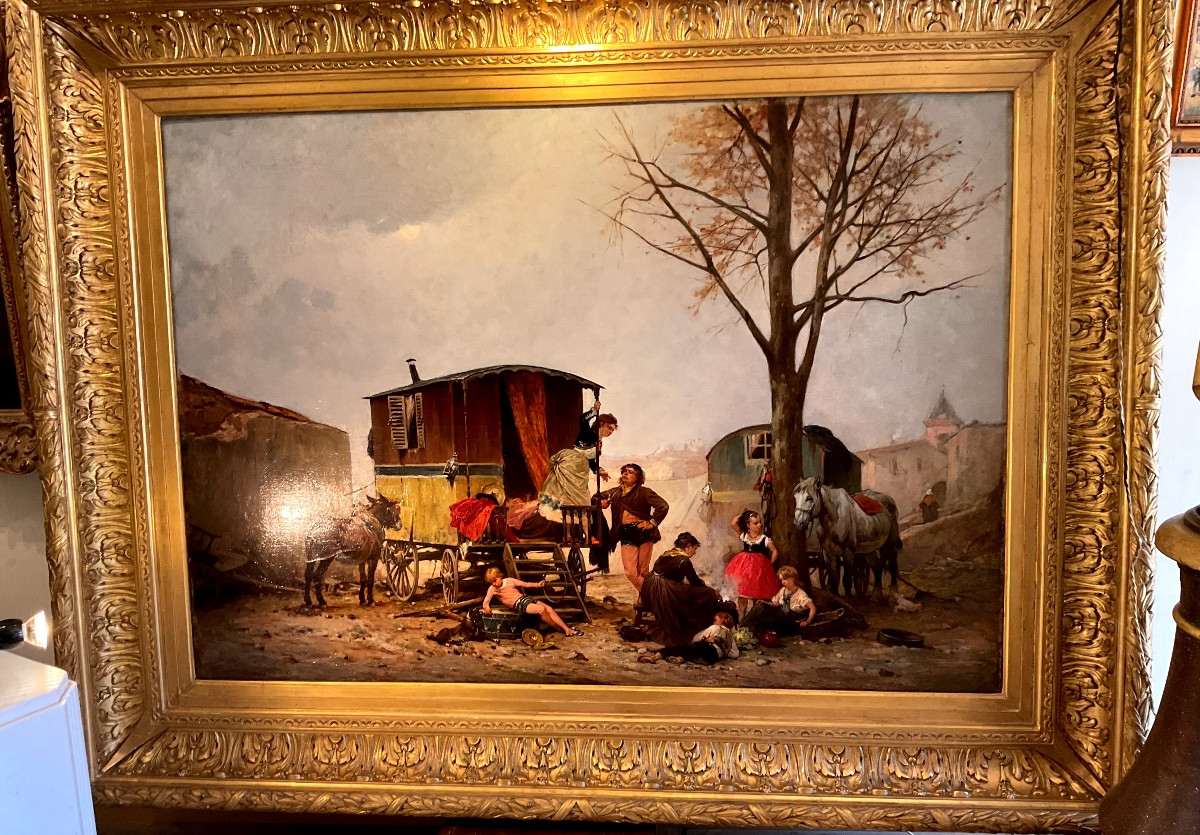


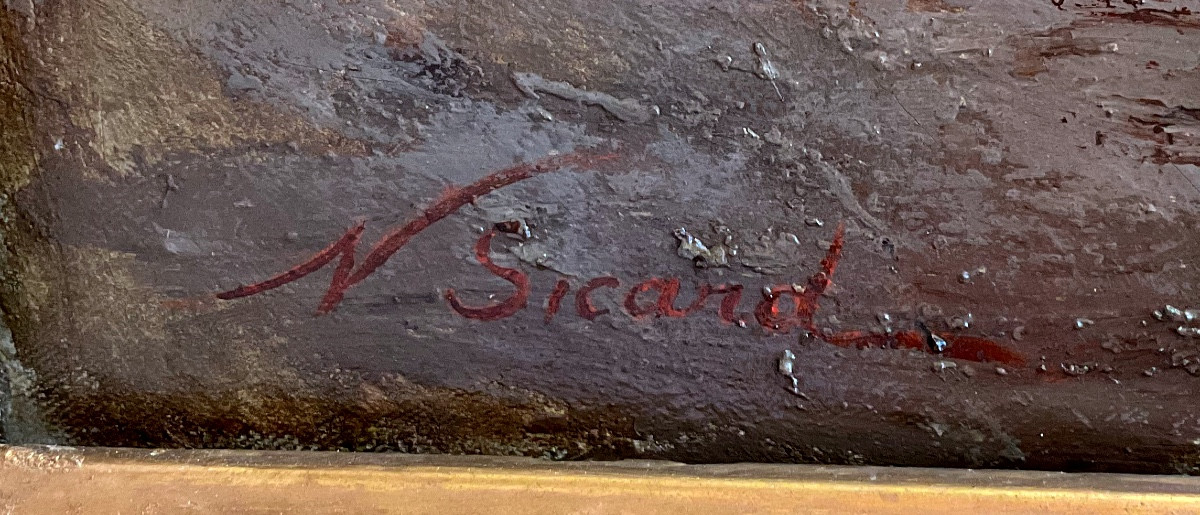


superbe tableau de salon avec son cadre d époque en bois et stuc doré de style Louis XV/ Louis XVI à motifs de Palmettes , signé en bas à gauche et sur sa toile d origine en parfait état .
peintre lyonnais élève de DANGUIN ET Victor VIBERT a l académie des Beaux Arts de Lyon , Il connut son premier succès en 1861, remportant le premier prix de lithographie et de peinture à la Société des Amis des Arts de Lyon.
De 1865 à 1868, Sicard réalisa des illustrations pour des livres d'art. Afin de perfectionner son art, il travailla comme décorateur pour Antoine Sublet, participant à de nombreux projets. En 1869, à seulement 23 ans, il présenta sa première œuvre au Salon de Paris. Cependant, en 1870, la guerre éclata et il s'engagea dans un bataillon d'artillerie, servant comme sergent dans la défense de Paris. Cette expérience influença profondément son œuvre ; il peignit des scènes de guerre et des champs de bataille avec un grand réalisme.
Carrière
Sicard ne reprit ses expositions qu'en 1872 à Paris et Lyon, puis en 1874 en province. Ses œuvres rencontrèrent un vif succès et le musée de Béziers acquit son tableau *Un chasseur malheureux* en 1874. Les critiques furent très favorables et il fut considéré comme un futur chef de file potentiel de l'école lyonnaise. Ses œuvres se vendirent bien et plusieurs furent acquises par des personnalités influentes comme Bernard Aynard, riche banquier et collectionneur de renom. Il entreprit ensuite un voyage en Espagne, qui lui révéla de nouvelles sources artistiques et des inspirations qu'il n'oublierait jamais. Il exposa abondamment et la qualité de son travail commença à être reconnue et saluée par la critique.
En 1881, après le décès de son père, il s'installa dans le 5e arrondissement de Lyon, où il vécut jusqu'à la fin de sa vie. Il épousa Caroline Garbit en 1882, à l'âge de 36 ans, et ils eurent sept enfants. Il fut admis à l'Académie des Sciences, des Beaux-Arts et des Lettres de Lyon[1] grâce à son tableau « Un Accident » en 1886. Il adhéra à la nouvelle Société des Beaux-Arts de Lyon en 1888, qui remplaça la Société des Amis des Arts de Lyon. La même année, il reçut la médaille d'or régionale « Grand Format » et fut nommé, le 4 décembre, au comité consultatif des musées, chargé de décider des nouvelles acquisitions pour le Musée des Beaux-Arts de Lyon, succédant ainsi à Danguin, son ancien professeur. En 1889, il remporta la troisième médaille à l'Exposition universelle pour son tableau « Après le duel ». Il fut élu président de la Société des Beaux-Arts de Lyon. Nommé Officier de l'Académie pour services rendus à l'éducation publique en 1894, il marqua un tournant dans sa carrière. Nommé professeur par décret ministériel la même année, il prit également la direction de l'École des Beaux-Arts de Lyon, la deuxième plus importante de France, succédant à M. Hédin, poste qu'il occupa pendant 24 ans. Il insista particulièrement sur l'importance du travail acharné dans le métier d'artiste, citant Millet et Ernest Meissonier en exemple. Ainsi, en 1900, sous la direction de Nicolas Sicard, l'École de Lyon remporta le premier Grand Prix à l'Exposition universelle, et quatre de ses élèves obtinrent le Prix de Rome. Finalement, de nombreux élèves remportèrent le Prix de Paris Raoul Servant (1912), faisant de Sicard un directeur prestigieux et renommé.
Il fut nommé Officier d'Instruction Publique et fait Chevalier de la Légion d'Honneur en 1900. Il quitta l'Académie des Sciences, des Beaux-Arts et des Lettres pour rejoindre le comité d'organisation de la rétrospective des artistes lyonnais de 1904.
Il prit sa retraite en 1918, à l'âge de 72 ans, épuisé par sa vie sociale, ses fonctions à l'Académie des Beaux-Arts et son travail créatif, sa vue déclinant. Il mourut le 1er janvier 1920 et fut inhumé au cimetière de la Loyasse.
La Chasse au Faucon.
La Chasse au Faucon.
L'Entrée du Pont Guillotière par temps de pluie, Musée des Beaux-Arts de Lyon.
L'Entrée du Pont Guillotière par temps de pluie, Musée des Beaux-Arts de Lyon.
Héritage
On peut encore admirer son œuvre à la cathédrale de Belley, à la chartreuse et à l'église des Sœurs de Saint-Joseph, où il travailla pour Sublet. Il fut le sujet de la rétrospective Nicolas Sicard à la Maison de Pays de Mornant, du 13 septembre au 12 octobre 1997. Son tableau *Le Repos de Diane*, peint en 1893, est toujours visible à la Préfecture du Rhône. Plusieurs de ses scènes de genre ont été acquises par l'État et reproduites sous forme de gravures. Une rue proche de son atelier (rue Dusquesne) porte son nom.He achieved his first success in 1861, winning first prize for lithography and painting at the Lyon Society of Friends of the Arts.
From 1865 to 1868, Sicard produced illustrations for art books. To further hone his skills, he worked as a decorator for Antoine Sublet, participating in numerous projects. In 1869, at only 23 years old, he submitted his first work to the Paris Salon. However, in 1870, war broke out, and he enlisted in an artillery battalion, serving as a sergeant in the defense of Paris. This experience would profoundly influence his work; he would paint scenes of war and battlefields with great realism.
Career
Sicard did not resume exhibiting until 1872 in Paris and Lyon, and in 1874 in the provinces. His works were successful, and the Béziers museum purchased his painting *An Unhappy Hunter* in 1874. The reviews were quite favorable, and he was considered a potential future leader of the Lyon school. His works sold well, and influential figures like Bernard Aynard, a wealthy banker and major collector, bought several of them. He then traveled to Spain, a journey that introduced him to new artistic sources and inspirations that he would never forget. He exhibited extensively, and the quality of his work began to gain recognition and widespread acclaim.
In 1881, after his father's death, he moved to the 5th arrondissement of Lyon, where he remained for the rest of his life. He married Caroline Garbit in 1882 at the age of 36, and they had seven children. He joined the Academy of Sciences, Fine Arts and Letters of Lyon[1] thanks to his painting An Accident in 1886. He subscribed to the new Lyon Society of Fine Arts in 1888, which replaced the Society of Friends of the Arts of Lyon. That same year, he received the regional gold medal "Large Format" and was appointed on December 4th to the advisory committee of museums, deciding on new acquisitions for the Museum of Fine Arts of Lyon and thus replacing Danguin, his former teacher. In 1889, he won the third medal at the Universal Exhibition for After the Duel. He was elected president of the New Lyon Society of Fine Arts. He was named an Officer of the Academy for services rendered to public education in 1894, a pivotal moment in his career. He was appointed professor by ministerial decree that same year and director of the Lyon School of Fine Arts, the second largest art school in France, succeeding Mr. Hédin, a position he held for 24 years. He particularly emphasized the importance of hard work in the artistic profession, citing Millet and Ernest Meissonier as examples. Thus, in 1900, under Nicolas Sicard's direction, the Lyon School won the first Grand Prix at the Universal Exhibition, and four students received the Prix de Rome under his tutelage. Finally, numerous students won the Prix de Paris Raoul Servant (1912), making Sicard a prestigious and renowned director.
He was appointed an Officer of Public Instruction and made a Knight of the Legion of Honor in 1900. He left the Academy of Sciences, Fine Arts, and Letters to join the organizing committee for the retrospective exhibition of Lyon artists in 1904.
He retired in 1918 at the age of 72, worn down by his social life, his duties at the Academy of Fine Arts, and his creative work, as his eyesight was failing. He died on January 1, 1920, and was buried in Loyasse Cemetery.
The Falcon Hunt.
The Falcon Hunt.
The Entrance to the Guillotière Bridge in Rainy Weather, Museum of Fine Arts of Lyon.
The Entrance to the Guillotière Bridge in Rainy Weather, Museum of Fine Arts of Lyon.
Legacy
We can still admire his work in Belley Cathedral, the Carthusian monastery, and the church of the Sisters of Saint Joseph, where he worked for Sublet. He was the subject of the Nicolas Sicard retrospective exhibition at the Maison de Pays in Mornant from September 13 to October 12, 1997. His painting *The Rest of Diana*, painted in 1893, can still be seen at the Rhône Prefecture. Several of his genre paintings were acquired by the State and reproduced as engravings. A street near his studio (Rue Dusquesne) bears his name.
peintre lyonnais élève de DANGUIN ET Victor VIBERT a l académie des Beaux Arts de Lyon , Il connut son premier succès en 1861, remportant le premier prix de lithographie et de peinture à la Société des Amis des Arts de Lyon.
De 1865 à 1868, Sicard réalisa des illustrations pour des livres d'art. Afin de perfectionner son art, il travailla comme décorateur pour Antoine Sublet, participant à de nombreux projets. En 1869, à seulement 23 ans, il présenta sa première œuvre au Salon de Paris. Cependant, en 1870, la guerre éclata et il s'engagea dans un bataillon d'artillerie, servant comme sergent dans la défense de Paris. Cette expérience influença profondément son œuvre ; il peignit des scènes de guerre et des champs de bataille avec un grand réalisme.
Carrière
Sicard ne reprit ses expositions qu'en 1872 à Paris et Lyon, puis en 1874 en province. Ses œuvres rencontrèrent un vif succès et le musée de Béziers acquit son tableau *Un chasseur malheureux* en 1874. Les critiques furent très favorables et il fut considéré comme un futur chef de file potentiel de l'école lyonnaise. Ses œuvres se vendirent bien et plusieurs furent acquises par des personnalités influentes comme Bernard Aynard, riche banquier et collectionneur de renom. Il entreprit ensuite un voyage en Espagne, qui lui révéla de nouvelles sources artistiques et des inspirations qu'il n'oublierait jamais. Il exposa abondamment et la qualité de son travail commença à être reconnue et saluée par la critique.
En 1881, après le décès de son père, il s'installa dans le 5e arrondissement de Lyon, où il vécut jusqu'à la fin de sa vie. Il épousa Caroline Garbit en 1882, à l'âge de 36 ans, et ils eurent sept enfants. Il fut admis à l'Académie des Sciences, des Beaux-Arts et des Lettres de Lyon[1] grâce à son tableau « Un Accident » en 1886. Il adhéra à la nouvelle Société des Beaux-Arts de Lyon en 1888, qui remplaça la Société des Amis des Arts de Lyon. La même année, il reçut la médaille d'or régionale « Grand Format » et fut nommé, le 4 décembre, au comité consultatif des musées, chargé de décider des nouvelles acquisitions pour le Musée des Beaux-Arts de Lyon, succédant ainsi à Danguin, son ancien professeur. En 1889, il remporta la troisième médaille à l'Exposition universelle pour son tableau « Après le duel ». Il fut élu président de la Société des Beaux-Arts de Lyon. Nommé Officier de l'Académie pour services rendus à l'éducation publique en 1894, il marqua un tournant dans sa carrière. Nommé professeur par décret ministériel la même année, il prit également la direction de l'École des Beaux-Arts de Lyon, la deuxième plus importante de France, succédant à M. Hédin, poste qu'il occupa pendant 24 ans. Il insista particulièrement sur l'importance du travail acharné dans le métier d'artiste, citant Millet et Ernest Meissonier en exemple. Ainsi, en 1900, sous la direction de Nicolas Sicard, l'École de Lyon remporta le premier Grand Prix à l'Exposition universelle, et quatre de ses élèves obtinrent le Prix de Rome. Finalement, de nombreux élèves remportèrent le Prix de Paris Raoul Servant (1912), faisant de Sicard un directeur prestigieux et renommé.
Il fut nommé Officier d'Instruction Publique et fait Chevalier de la Légion d'Honneur en 1900. Il quitta l'Académie des Sciences, des Beaux-Arts et des Lettres pour rejoindre le comité d'organisation de la rétrospective des artistes lyonnais de 1904.
Il prit sa retraite en 1918, à l'âge de 72 ans, épuisé par sa vie sociale, ses fonctions à l'Académie des Beaux-Arts et son travail créatif, sa vue déclinant. Il mourut le 1er janvier 1920 et fut inhumé au cimetière de la Loyasse.
La Chasse au Faucon.
La Chasse au Faucon.
L'Entrée du Pont Guillotière par temps de pluie, Musée des Beaux-Arts de Lyon.
L'Entrée du Pont Guillotière par temps de pluie, Musée des Beaux-Arts de Lyon.
Héritage
On peut encore admirer son œuvre à la cathédrale de Belley, à la chartreuse et à l'église des Sœurs de Saint-Joseph, où il travailla pour Sublet. Il fut le sujet de la rétrospective Nicolas Sicard à la Maison de Pays de Mornant, du 13 septembre au 12 octobre 1997. Son tableau *Le Repos de Diane*, peint en 1893, est toujours visible à la Préfecture du Rhône. Plusieurs de ses scènes de genre ont été acquises par l'État et reproduites sous forme de gravures. Une rue proche de son atelier (rue Dusquesne) porte son nom.He achieved his first success in 1861, winning first prize for lithography and painting at the Lyon Society of Friends of the Arts.
From 1865 to 1868, Sicard produced illustrations for art books. To further hone his skills, he worked as a decorator for Antoine Sublet, participating in numerous projects. In 1869, at only 23 years old, he submitted his first work to the Paris Salon. However, in 1870, war broke out, and he enlisted in an artillery battalion, serving as a sergeant in the defense of Paris. This experience would profoundly influence his work; he would paint scenes of war and battlefields with great realism.
Career
Sicard did not resume exhibiting until 1872 in Paris and Lyon, and in 1874 in the provinces. His works were successful, and the Béziers museum purchased his painting *An Unhappy Hunter* in 1874. The reviews were quite favorable, and he was considered a potential future leader of the Lyon school. His works sold well, and influential figures like Bernard Aynard, a wealthy banker and major collector, bought several of them. He then traveled to Spain, a journey that introduced him to new artistic sources and inspirations that he would never forget. He exhibited extensively, and the quality of his work began to gain recognition and widespread acclaim.
In 1881, after his father's death, he moved to the 5th arrondissement of Lyon, where he remained for the rest of his life. He married Caroline Garbit in 1882 at the age of 36, and they had seven children. He joined the Academy of Sciences, Fine Arts and Letters of Lyon[1] thanks to his painting An Accident in 1886. He subscribed to the new Lyon Society of Fine Arts in 1888, which replaced the Society of Friends of the Arts of Lyon. That same year, he received the regional gold medal "Large Format" and was appointed on December 4th to the advisory committee of museums, deciding on new acquisitions for the Museum of Fine Arts of Lyon and thus replacing Danguin, his former teacher. In 1889, he won the third medal at the Universal Exhibition for After the Duel. He was elected president of the New Lyon Society of Fine Arts. He was named an Officer of the Academy for services rendered to public education in 1894, a pivotal moment in his career. He was appointed professor by ministerial decree that same year and director of the Lyon School of Fine Arts, the second largest art school in France, succeeding Mr. Hédin, a position he held for 24 years. He particularly emphasized the importance of hard work in the artistic profession, citing Millet and Ernest Meissonier as examples. Thus, in 1900, under Nicolas Sicard's direction, the Lyon School won the first Grand Prix at the Universal Exhibition, and four students received the Prix de Rome under his tutelage. Finally, numerous students won the Prix de Paris Raoul Servant (1912), making Sicard a prestigious and renowned director.
He was appointed an Officer of Public Instruction and made a Knight of the Legion of Honor in 1900. He left the Academy of Sciences, Fine Arts, and Letters to join the organizing committee for the retrospective exhibition of Lyon artists in 1904.
He retired in 1918 at the age of 72, worn down by his social life, his duties at the Academy of Fine Arts, and his creative work, as his eyesight was failing. He died on January 1, 1920, and was buried in Loyasse Cemetery.
The Falcon Hunt.
The Falcon Hunt.
The Entrance to the Guillotière Bridge in Rainy Weather, Museum of Fine Arts of Lyon.
The Entrance to the Guillotière Bridge in Rainy Weather, Museum of Fine Arts of Lyon.
Legacy
We can still admire his work in Belley Cathedral, the Carthusian monastery, and the church of the Sisters of Saint Joseph, where he worked for Sublet. He was the subject of the Nicolas Sicard retrospective exhibition at the Maison de Pays in Mornant from September 13 to October 12, 1997. His painting *The Rest of Diana*, painted in 1893, can still be seen at the Rhône Prefecture. Several of his genre paintings were acquired by the State and reproduced as engravings. A street near his studio (Rue Dusquesne) bears his name.
Trouvez votre bonheur parmi des objets similaires :
Tableaux scènes de genre